Monday, November 17, 2008

PCI's QSA's/ASV's Must Participate in Quality Assurance Program

PCI SSC launches quality assurance programs for QSAs and ASVs


Wakefield, Mass., Nov. 17, 2008 -- The PCI Security Standards Council (PCI SSC), a global, open industry standards body providing management of the Payment Card Industry Data Security Standard (PCI DSS), PIN Entry Device (PED) Security Requirements and the Payment Application Data Security Standard (PA-DSS), announces that it has launched a quality assurance program for Qualified Security Assessors (QSAs) and Approved Scanning Vendors (ASVs).

The new program was designed to provide QSAs and ASVs with a set of requirements that helps ensure they provide consistent, quality validation and assessment services to merchants and service providers.

The PCI SSC developed the quality assurance program as a direct result of feedback from the Council’s participating organizations and assessment community and is intended to promote consistent interpretation of the PCI standards and ensure quality is maintained among all vendors.

Participation in the program will be required for the Council’s registered QSAs and ASVs, in order for them to retain the ability to conduct PCI assessments.


“Feedback from the Council’s participating organizations and others made it clear that the assessment process for the PCI standards would benefit greatly from more rigorous guidelines,” said Bob Russo, general manager, PCI Security Standards Council. “As a result, we created a clear-cut program that will help ensure all those involved in this process are consistent, credible, competent and ethical.”

The new quality assurance program is based on eight guiding principles. Through the program, the Council and assessor community commit to:

Uphold the best interest of the assessor client

Adhere to validation requirements among the assessor company
Adhere to validation requirements among the assessor employee
Maintain consistent assessor procedures and reporting
Interpret the PCI standards appropriately as applicable to the client’s systems & environment
Remain current with industry trends and PCI SSC updates in the assessor community
Report all opinions as factual, documented and defendable, and
Maintain a positive relationship between the assessor and PCI SSC.

An expanded range of communications channels will allow the PCI SSC to interact with assessors, merchants and service providers on an ongoing basis through certification reviews, credit checks, training, educational webinars, newsletters, a dedicated e-mail service, question and answer documents, informational supplements and feedback forms. A team of dedicated staff will validate assessor application and renewals, ensure that training is relevant and accessible to organizations and maintain the integrity of the testing process. This team also will be responsible for assessor performance monitoring and overseeing any necessary disciplinary action, which could include probation or revocation.

The program will continue to be rolled out in a four-stage process throughout 2009.

For More Information:


More information on the PCI Security Standards Council and becoming a participating organization please visit www.pcisecuritystandards.org , or contact the PCI Security Standards Council at participation@pcisecuritystandards.org.

About the PCI Security Standards Council: The mission of the PCI Security Standards Council is to enhance payment account security by driving education and awareness of the PCI Data Security Standard and other standards that increase payment data security. The PCI Security Standards Council was formed by the major payment card brands American Express, Discover Financial Services, JCB International, MasterCard Worldwide and Visa Inc. to provide a transparent forum in which all stakeholders can provide input into the ongoing development, enhancement and dissemination of the PCI Data Security Standard (DSS), PIN Entry Device (PED) Security Requirements and the Payment Application Data Security Standard (PA-DSS). Merchants, banks, processors and other vendors are encouraged to join as participating organizations.

Reblog this post [with Zemanta]

32% of eCommerce Users Unable to Complete Primary Task


New iPerceptions Data Shows eCommerce Sites Fall Short For Consumers

3 out of 10 website visitors report that they are unable to accomplish the task they are at the site to do -- whether it is buy a product, access customer support, research pricing or read a blog


NEW YORK, Nov 17, 2008 (BUSINESS WIRE) -- iPerceptions Inc., a leading provider of web-focused Voice of Customer analytics, today released new data that indicates that eCommerce and retail companies are risking millions in sales by underserving site visitors in the run up to a challenging holiday season. iPerceptions' 4Q website survey data collected from over 50,000 site visitors shows that consumers are often unable to accomplish what they came to the site to do -- and 1 out of every 2 visitors with a clear intent to buy is walking away without purchasing.

According to the data, the aggregate task completion rate for eCommerce sites in October 2008 was 68%, meaning that 3 out of 10 consumers were not able to complete their primary task during the course of their site visit. Task completion rates were lowest for consumers who stated that the primary purpose of their visit was to purchase products or access customer support, hovering at 52% and 51% respectively.

The iPerceptions study also provides new insight into the multitude of reasons that people visit eCommerce sites. While 16% of all visitors stated that the purpose of their visit was to buy, the majority were there to browse; compare and research products (47%); access customer service or customer support (10%); and check out prices and promotions (11%). Additional reasons to come to a site included finding a store location (4%), as well as a long tail of other reasons (10%) such as reading a blog, asking an expert a question or watching a video. Task completion rates were highest for people looking for a store location (80%), researching a product (76%) and seeking pricing and promotions (78%).

The good news for retailers is that site visitors who are able to complete their primary purpose of visit are twice as likely to make a repeat visit, while 67% of visitors who complete their primary purpose report enhanced brand opinion (vs. only 18% for those who do not). Additionally, 60% report a higher future likelihood to purchase either online or offline (vs. only 14% for those who do not).

"In the face of tightening budgets, retailers can't afford to be swayed by conventional wisdom or the HIPPO -- the Highest Paid Person's Opinion," said Jonathan Levitt, vice president of marketing at iPerceptions. "eCommerce practitioners have spent the last 15 years focusing on the shopping cart and the conversion funnel, but they are still losing half of the people who come to their site intending to make a purchase. Now is the time to tune into the voices of real customers to get a reality check on what people want from their website experience."

About iPerceptions


iPerceptions is one of North America's leading web-focused Voice of Customer analytics providers. Its webValidator Continuous Listening solution and Proprietary iPerceptions Satisfaction Index (iPSI) turn thousands of data points into easy-to-understand strategic and tactical decision support for website marketers. iPerceptions' clients include such well known brands as InterContinental Hotels, General Motors, Dell Computers, Hyundai, LG Electronics, Choice Hotels International, BMW and Monster Worldwide. iPerceptions has offices in New York, Toronto, Montreal and London.

SOURCE: iPerceptions


Reblog this post [with Zemanta]

Information Card Rolled out by Equifax/Parity

Equifax teams up with Parity to roll out I-Card for online transactions

Equifax has partnered with identity management services provider Parity to introduce the Equifax online identity card (I-Card).

The initiative enables visitors on e-commerce websites which accept the I-card to conduct online transactions without revealing financial information online or having to use multiple passwords, confirming only proof of age online. Users who are interested in getting the Equifax I-Card can apply for it on the company's website and they will also gain access to Parity's Azigo I-card management software which allows for one-click sign-in and identity verification. When creating the I-Card, Equifax made use of its authentication service eIDverifier, multiple data sources for identity verification as well as open source technology that is approved by The Information Card Foundation, a group of consumer and technology companies. The group focuses on building products designed to help customers get control of their personal information.

The Equifax I-Card is more of a demo aimed at online businesses, but such technology could enable the creation of cards that contain personal data such as customers' profile, purchase preferences, online payment, or verified identity information

For more information, on the Information Card Foundation, click here:

(will open in a new window)


Reblog this post [with Zemanta]

Debit Talks, Credit Walks Part II


Debit Talks, Credit Walks...II  (Part I here)


In an article titled "Less Power to Purchase", Nancy Trejos writes for the Washington Post about credit card issuers lowering credit limits and raising their rates and fees to all their customers, not just high risk ones. 

In another article in NYT, Citi, backed off their promise not to raise interest rates...

"Citi to Raise Credit Card Interest Rates 3%


In an article entitled "Despite Pledge, Citigroup to Raise Credit Card Rates, Blaming ‘Difficult’ Environment", Eric Dash writes for the New York Times that Citi is "reneging on a promise it made to tens of millions of credit card customers in good times" by raising interest rates - by 2 to 3 percent...


Companies Slash Customers' Credit Lines - washingtonpost.com


Consumers' Credit Card Limits Slashed as Companies Try to Reduce Risk

Cecil Bello has stumbled into a new corner of the credit squeeze. The 32-year-old management consultant has had the limits reduced on three of her credit cards.

In September, U.S. Bank notified the Fairfax County resident that she no longer had a $14,500 limit on a card that had a balance of about $5,000. Her new limit left her just $500 from being maxed out, she said.  Then came an Oct. 26 letter from American Express that said she now had a limit of $14,000, down from $22,000. That letter said her "total debt is too high relative to your payment history with us and other creditors."  Early this month, she received an e-mail from American Express notifying her that another card with a $5,000 limit had been reduced to $3,000 and that her new cash advance limit was down to $200.

Bello said she had made more than the minimum payments on time each month.  "I am taking responsibility for paying off my debt," she said. "But when credit card companies trap people this way, it's almost impossible to dig yourself out of the hole."

Credit card companies are increasingly putting the clamps on their customers. Lenders are taking a wide range of steps to mitigate their risk as unemployment rates tick up and the number of delinquent borrowers grows. Besides cutting credit limits, card companies are raising rates and fees, and suspending offers such as zero percent balance transfers. They are also making rewards programs less rewarding and shutting down inactive accounts, industry analysts and watchdogs said.


continue reading at the Washington Post

Reblog this post [with Zemanta]

Encryption Key2Key


Editor's Note:  This is rather amusing.  BMW releases information about their work on a RFID Chip enabled car key in the UK which doesn't use chip and PIN.  The good news is that the key can be "canceled" if someone loses them.  The bad news is that cars sales are in the tank, and even if BMW could retrofit all their customers with this "key" I don't think they own enough of the market to entice the gas station owners to install the "small electronic reader than can decipher the details and debit the cash accordingly"   Therefore, I don't expect this to be something that even approaches take off, let alone get's off the ground.  This pig certainly won't fly...but as I said, it is rather amusing :) 


The car key that will pay your petrol bill | Mail Online

By Daniel Cochlin

Last updated at 12:46 AM on 16th November 2008
Drivers have got used to cars doing ever more for them – and now BMW is working on a vehicle that will even buy its own petrol.

After filling up, motorists will simply wave their ignition key in front of the pump to settle their bill, eliminating the need to queue up tediously in the forecourt shop.

The same technology will also work for parking meters, meaning drivers will no longer face the anguish of rooting around for the right coins and usually coming up a few pence short.

BMW is working on a car key that will enable motorists to settle a petrol bill by waving it in front of the pump. The system works because the key contains a tiny chip holding details of the driver’s bank account.

Fuel pumps and ticket machines need to be fitted with a small electronic reader that can decipher the details and debit the cash accordingly. 

The system, which may also be fitted at toll booths and even train and Underground stations for drivers leaving their cars behind, does not use a PIN code – raising fears that the keys would be targeted by thieves.

But BMW said the keys could be quickly cancelled if lost or stolen and the company hopes the system will be so successful that its drivers will use the key as their personal credit card.

Dutch firm NXP Semiconductors, which has developed the key along with BMW, revealed a prototype – with two small antennas on the top – at a trade show in Paris this month.  A spokesman said the scheme could also be used by park-and-ride drivers who wanted to jump on a bus. He said: ‘This key works in a very similar way to the Oyster card used on public transport in London.  ‘If the petrol station is fitted with a reader, you could pay the bill just using the key and without the need to go inside.  ‘There is no chip and PIN involved so it is quicker than a credit card. The key looks like the one now used in a BMW 7 Series.’

He explained: ‘All you need to do is hold it about 4in from the reader and it will automatically take the money from your account.  ‘We hope it could also be used by people who want to leave their cars and jump on a train, and they could just hold their keys up to a reader in the train station.  ‘This is all about making life easier for BMW drivers, and allowing them to get in their cars without worrying where their wallet is or if they have enough cash.’

Professor Raymond Freymann, managing director of BMW Group Research and Technology, said: ‘We are doing research in enhancing the capabilities of the car key into one smart device for access, payment and service that will simplify the lives of BMW car drivers in the future.’ 

The key has been given the green light by the German Federal Office of Information Security, meaning it is satisfied it meets the country’s highest standards for keeping bank details safe.

Friday, November 14, 2008

Windows Live Aims to Be Hub for Web

Microsoft's new Windows Live aims to be hub for Web (Reuters) by Reuters: Yahoo! Tech
SEATTLE (Reuters) - Microsoft Corp said on Wednesday its next release of Windows Live online services will integrate e-mail, instant messaging, photos and Web applications from other companies into a single platform.

Microsoft aims to position Windows Live with its widely-used e-mail and messaging services as the hub for a growing number of Internet applications and incorporate new features similar to those found on popular social networks.

The strategy puts Microsoft into competition with social networking sites Facebook and News Corp's MySpace, which started to open their fast-growing websites to outside software developers last year.

The new Windows Live service plans to feature a main profile page that updates users to their friends' activities within Windows Live and on more than 50 outside Web services including Yahoo Inc's Flickr photo site and career-oriented social networking site LinkedIn.

"It's a race to see who will work better and faster with everyone else," said Charlene Li, founder of consulting company Altimeter Group. "It's the recognition that you can't be an island of yourself."

Microsoft said Web users are overrun with accounts at multiple Internet sites, each requiring a password and each with a different set of friends. Its goal is to simplify the Web lives of its users who go to Microsoft's Windows Live e-mail or instant messaging accounts.

The company's Windows Live strategy is also central to its plans to wrestle away online advertising revenue from Google Inc, which has used its dominant search engine to expand into e-mail, online word processing and other businesses that compete directly with Microsoft.

Microsoft plans to roll out the new Windows Live services, which will include a revamped e-mail, calendar and a new photo application, in the United States over the coming weeks and then make it available in 54 countries early next year.  (continue reading)

Reblog this post [with Zemanta]

2 Out of 3 Ain't Bad, 7 out of 9 Is...

Annual percentage rates on seven out of nine categories of cards -- business, instant approval, airline, balance transfer, low interest, cash back and reward cards -- all rose slightly from the previous week.

Only two categories of cards didn't increase, according to the weekly report issued Thursday. The APR on cards for people with bad credit held steady at 10.82 percent while rates on student cards dropped slightly to 13.9 percent, down from 14.02 percent.

The across the board increases were largely the result of sharp hikes in rates for select American Express cards, said Ben Woolsey, spokesman for CreditCards.com, which tracks about 200 credit cards.

The hikes by American Express overshadowed some lowered APRs by major card issuers such as Citi and Chase, Woolsey said.  American Express Co. is expecting write-offs in its credit card portfolio to continue to mount in the fourth quarter and into next year as consumers struggle with a worsening economy.  Earlier this week, the company said it received government approval to become a bank holding company -- a sign the lender is facing difficulty funding its operations amid the credit crisis.

First Data Reports Third Quarter Results

First Data - First Data Reports Third Quarter 2008 Revenue Growth of 4%
First Data Reports Third Quarter 2008 Revenue Growth of 4%

DENVER, November 14, 2008 – First Data Corp. today reported its financial results for the third quarter of 2008. Consolidated revenues were up 4% to $2.2 billion. The adjusted earnings before interest, taxes, depreciation and amortization (EBITDA) were up 7% to $694 million.

Loss from continuing operations was $164 million, but included $270 million of incremental interest expense, net of tax, and $124 million of incremental depreciation and amortization, net of tax, compared to the third quarter of 2007. Both the incremental interest expense and depreciation and amortization are primarily attributable to the transaction with affiliates of Kohlberg Kravis Roberts & Co. (the "Transaction"). A table describing adjusted EBITDA and reconciling income (loss) from continuing operations to adjusted EBITDA is included in the accompanying schedules.

"Despite a difficult economic climate, we were able to grow revenue and adjusted EBITDA," said Michael Capellas, Chairman and Chief Executive Officer. "Our investments in product innovation are gaining momentum and you will see us announce some significant wins especially in the mobile commerce space."

Segment Results

Merchant Services

For the quarter, Merchant Services generated revenues of $1 billion, a growth rate of 6% or down 3% excluding reimbursable debit network fees. Revenue was positively impacted by 9% transaction growth. This impact was offset by the slowing U.S. economy which reduced transaction growth for smaller merchants and shifted transactions to some nationwide discounters and wholesalers. Operating profit was $106 million, down 60% or down 9% to $248 million excluding purchase accounting adjustments comprised principally of increased amortization expense related to the Transaction. Operating profit margin was 36.0% excluding reimbursable debit network fees and purchase accounting adjustments, compared to 38.6% in the third quarter of 2007. Operating profit was impacted by approximately $19 million of certain costs related to cost reduction initiatives, which accounted for seven percentage points of the 9% decline noted above and also impacted the 36.0% operating profit margin by three percentage points during the quarter. Reported operating profit margin for the quarter was 10.4 %.

Financial Services

For the quarter, Financial Services generated revenue of $700 million, down 5% or down 8% excluding reimbursables and purchase accounting adjustments. Adjusted revenue reflects modest growth in the card issuing business. This growth was offset by lost business and check volume declines in the TeleCheck business. In addition, the third quarter of 2007 included approximately $16 million more in revenues resulting from contract termination fees compared to this quarter. Operating profit was $111 million, down 23% or down 3% to $144 million excluding purchase accounting adjustments comprised principally of increased amortization expense related to the Transaction. Operating profit margin for the quarter was 28.1% excluding reimbursables and purchase accounting adjustments, compared to 26.5% in the third quarter of 2007. Operating profit was impacted by approximately $18 million of costs related to cost reduction initiatives, which negatively impacted the 3% decline noted above by thirteen percentage points and negatively impacted the 28.1% operating profit margin by four percentage points during the quarter. Reported operating margin was 15.9% for the quarter.

International

For the quarter, International generated revenue of $487 million, up 19%. Revenue benefited from 21% transaction growth which was in part driven by acquisitions in prior quarters. Operating profit was $49 million, up 59% or up 79% to $54 million excluding purchase accounting adjustments related to the Transaction. Operating margin was 11.2% excluding purchase accounting adjustments related to the Transaction compared to 7.4% in the third quarter of 2007. Adjusted operating profit included the partial reversal of a loss reserve for the failed airline in one of International's merchant acquiring alliances and lower employee related expenses. These items were offset by approximately $16 million in incremental investments in data center consolidation, platform initiatives and other expenses related to cost reduction initiatives. Reported operating margin was 10.0%.

A slide presentation will be made
available under the "Investor Relations" section of the Web site at A slide presentation to accompany the call will be included in the webcast and will be made
available under the "Investor Relations" section of the Web site at http://ir.firstdatacorp.com/events.cfm.


Reblog this post [with Zemanta]

Citi Goes To Town, Fires "Little Village" Population 60,000

Citi Firing 60,000, Chairman May Still Lose Job: Tech Ticker, Yahoo! Finance
Citi Firing 60,000, Chairman May Still Lose Job
Posted Nov 14, 2008 11:19am EST by Henry Blodget in Newsmakers, Recession, Banking
From ClusterStock, Nov. 14, 2008:

Citi CEO Vikram Pandit has ordered business unit heads to cut employee compensation costs by 25%, the WSJ says. This could lead to 60,000 firings by next year. The cuts will include the investment banking division. The firm has already fired 23,000 people over the past year, reducing its global workforce to 352,000.

The company vehemently denied the WSJ's report yesterday that Chairman Win Bisschof may soon be sent packing. The WSJ says it stands by its story.

Vik Pandit bought 750,000 of thee 1.2 million shares Citi brass scooped up yesterday. This sounds bold at first, but it's still chicken feed (under $10 million), and its value was likely calculated to be higher than that in getting everyone to talk about how Citi management is buying.

Lastly, Citi is jacking up the interest rates on its credit cards, punishing already overwhelmed consumers: Citigroup is notifying some credit-card customers that their interest rates are being raised by an average of three percentage points.

Citigroup is one of the nation's largest issuers of credit cards, with 54 million active accounts. The unit had a loss of $902 million in the third quarter, compared with $1.4 billion in profit a year earlier, as a growing number of customers fell behind or defaulted on their payments.

A person familiar with the strategy estimated that the rate increases would apply to less than 20% of Citigroup's card portfolio.

"The industry has recently experienced an unprecedented market cycle with severe funding dislocation and significant consumer credit deterioration driven by the mortgage crisis and rising unemployment. In light of these unprecedented developments and others, Citi will be repricing a group of customers in our Citi-branded consumer credit-card business in the U.S. to appropriately manage these risks," said John Carey, chief administrative officer of the credit-card unit.

Citigroup's move follows a similar change by American Express Co., which is raising rates to some customers by two to three percentage points. Raising rates on customers is a delicate dance for credit-card companies. While the firms want to pull in more revenue from customers who carry a balance from month to month, they don't want to tip those customers into default because that hurts the card issuer's bottom line.

Reblog this post [with Zemanta]

Thursday, November 13, 2008

No Time Like "The Present" to Use Gift Cards

I wrote about this a couple days ago (Short Circuit in Gift Cards?), and today there's a video story on San Francisco's ABC News.  As I stated, the best time to use gift cards is immediately.  Until someone comes up with a better method for protecting consumers.  Sharper Image gift card holders lost around $25 million. Linen's and Things in in the midst of it's mess and Circuit City is next.  If you'd like to watch the video, click the link below... 


Bankrupt stores have no cash to back gift cards - 11/13/08 - San Francisco - abc7news.com - Video Available
 
Last year's most popular Christmas gift is now one of the most feared -- the gift card.


Consumers spend an estimated $50 to $80 billion a year on gift cards. It's become big business and the gift of choice for people like Freddie Vasquez.  "It's easy. You just find what it is that they like, go to the store, get it and you're done," said Vasquez, a San Francisco resident.

But with major retailers in trouble, those gift cards could become worthless. Under California law, bankrupt companies that are still doing business must honor gift cards. Consumers, however, have little recourse if a retailer closes their doors for good.  An estimated $25 million worth of gift cards went unused by the time Sharper Image shut down.

"You're average consumer doesn't know who's in trouble. They don't know financially who's in trouble. So that's why buyers you know have to beware," said Professor Eugene Muscat, from USF's School of Business and Management.

Retail industry researchers say gift-card holders could lose over $75 million from store closures by year's end. Which in large part explains why 43 percent of consumers say they plan to give gift cards less often this year. Regardless, consumer researcher Kathleen Kusek doesn't expect retailers to give in so easily.

"I think they might add incentives to gift cards, so perhaps with getting a $100 gift card the buyer will get a discount on another purchase they're making. That there will be other value added things to encourage the gift card market because it is so profitable for retailers," said Kathleen Kusek, a consumer researcher.

Even so, many shoppers are being cautious with their holiday shopping by buying gift cards from stores they're confident will stay afloat, or by going the old-fashioned route.

"I'll probably just pick out gifts his year," said one shopper.  "I don't want to give a gift that someone can't redeem," said another shopper.

If you do receive gift cards this holiday season, retail experts say the best advice is to use them right away.

Reblog this post [with Zemanta]

Chase Paymentech Gift Card Study Released

Payments News: Chase Paymentech Announces Gift Card Study Results - November 13, 2008
Chase Paymentech Announces Gift Card Study Results

Chase Paymentech has announced the results of a survey commissioned to provide insight into consumers’ attitudes towards gift cards. "The study, which polled 850 American adults, found that gift card awareness and usage remains very high, with nine in ten respondents having received or purchased a gift card. Additionally, two-thirds of respondents have bought at least one gift card within the past 12 months."

Just as impressive, the data also shows that most adults (55 percent) plan to buy the same number of cards as they did last year, and 21 percent plan to buy more. Similar estimates show shoppers plan to load either the same amount (55 percent) or more (21 percent) funds on those cards. All things considered, the study suggests retailers with gift cards to be well positioned during what is anticipated to be a slow holiday season.

“Gift cards are an interesting opportunity for retailers,” said George Wilcox, Group Executive, Chase Paymentech. “What our research indicates is that gift cards may prove to be a bright point in a retail season that’s going to face its own share of challenges.”

Additional results provided by this study include:
  • Typically, consumers spent more than the amount of the gift card when they are redeemed, with 85 percent adding an average of $17.70 out of their own wallets.
  • Gift card buyers who purchased a gift card within the past 12 months bought 4.7 cards for others, in addition to two cards for themselves. This may indicate that gift cards are being used as potential budgeting tools.
  • 82 percent of users said that a discount for the purchaser's use when buying the gift card would make them somewhat or much more likely to purchase gift cards. Free specialized gift packaging for cards is a strong purchase motivator as well (61 percent).
“One of the more compelling aspects of this study,” said Wilcox, “is that gift card buyers plan well ahead of time to purchase a gift card.”

Retailers need to answer this enthusiasm with visible and accommodating gift card displays.

More than one-third of past year gift card purchasers (37 percent) have entered a store intending to buy a gift card and left without buying it because:
  • They couldn’t find the gift card display (21 percent)
  • They didn’t care for any of the designs (21 percent)
  • They changed their mind and decided on another item (20 percent)
  • The cards were locked behind the counter (15 percent)
Retailers who are aware of gift card popularity, and make gift card purchases easy for consumers, are more likely to capture those sales.  “During a down holiday season, where each sale is increasingly important, gift card purchases will be crucial,” said Wilcox.
Reblog this post [with Zemanta]

Sorry...No Credit Card Forgiveness!

Regulators nix credit card debt forgiveness plan - Yahoo! News

"Credit card charge-off rates, balances written off as unpaid, rose to 6.8 percent in August, up 48 percent from a year earlier, according to Moody's Investors Service. Americans are weighed down by about $900 billion in credit card debt, according to the latest available Federal Reserve figures."

Editor's Note: Look at the graph below. In 2007 it was half as much. It doubled in a year!


WASHINGTON – Federal bank regulators have rejected a request by banks and consumer advocates for a program to let lenders forgive huge portions of credit card debt.

The Office of the Comptroller of the Currency rejected the request for a special program that would allow as much as 40 percent of credit card debt to be forgiven for consumers who don't qualify for existing repayment plans. An unusual alliance of financial industry interests and consumer advocates, represented by the Financial Services Roundtable and the Consumer Federation of America, made the request to the Treasury Department agency on Oct. 29. It demonstrated the urgency of the situation in a deepening economic crisis: consumers — even those with strong credit records — defaulting at high levels on their credit cards, while banks battered by the credit crisis bleed tens of billions from the losses.

An agency official said the government objects to allowing banks to defer losses for several years on the forgiven debt, as would occur in accounting by lenders under the special program.

The Financial Services Roundtable, which represents more than 100 large banks, brokerage firms and insurance companies, will "continue to look for ways to help consumers in these extraordinary times," said the group's senior vice president, Scott Talbott. Travis Plunkett, legislative director of Consumer Federation, said that with the number of deeply indebted consumers growing dramatically, "we still hope to work with bank regulators or Congress to create an alternative" to bankruptcy for them.

Under the proposal, borrowers would be able to defer payment of income taxes they owe on the forgiven part of the credit card debt until after the remainder was paid off. The lenders could wait until then to book their losses on the forgiven debt.

The two groups hoped such a pilot program would become permanent and that as many as 50,000 people struggling with credit card debt would be involved. On an individual basis, the amount of debt to be forgiven would rise according to the severity of the borrower's financial situation, up to a maximum of 40 percent. Consumers would be allowed to pay back the remainder over several years.


The largest credit-card banks each set aside between $1 billion and $3.5 billion in the third quarter for losses on card loans as their profits plummeted. The biggest credit card lenders include Discover Financial Services LLC, Bank of America Corp., Citigroup Inc., JPMorgan Chase & Co., Capital One Financial Corp., American Express Co. and HSBC Holdings.

Reblog this post [with Zemanta]

Banks to Halt Money Transfers for Net Gambling


Editor's Note: Why is Barney Frank (no relation l'm proud to say :) against this?  AML (Anti-Money Laundering) was designed in large part to prevent the funding of terrorist organizations.  I thought this law had passed in 2006, apparently they're tightening it up with this final rule.   
Banks told to halt money transfers for Internet gambling


The government today gave banks and other payment services a year to stop transfers of money to Internet gambling sites.

The move came as the Bush administration issued a final rule implementing the Unlawful Internet Gambling Enforcement Act of 2006, which bans payments made through credit cards, electronic funds transfers and checks for online wagering. The Treasury Department and Federal Reserve set a Dec. 1, 2009, deadline.

Two days ago the chairman of the House Financial Services Committee, Rep. Barney Frank, D-Mass., urged the White House to not go forward with the ban, arguing that should be left to President-elect Barack Obama.

"This midnight rulemaking will tie the hands of the new administration, burden the financial services industry at a time of economic crisis, and contradict the stated intent of the Financial Services Committee," Frank said.

By not defining illegal Internet gambling, the law is "leaving it to each financial institution to reconcile conflicting state and federal laws, court decisions and inconsistent Department of Justice interpretations when determining whether to process a transaction."

The NFL lobbied for the ban. Naturally, the Net gambling industry and Las Vegas were against it.

Reblog this post [with Zemanta]

Unembossed Around

Dynamic Card Solutions experiences high demand for unembossed cards
Thursday 13 November 2008 | 10:00 AM CET


Instant issuance card provider Dynamic Card Solutions (DCS) reports that it is experiencing increasing demands from financial institutions for its instant issuance unembossed 'flat' cards.

DCS develops and manufactures CardWizard, an instant issue and PIN selection software application which aims to provide financial institutions a card issuance model which allows for the personalization of customer and associate cards according to the various affinity programs or institutional brands they represent.

The company attributes the increasing demand for flat cards to two main factors: the first is that they can be issued on the spot in bank branches and reach consumers immediately, allowing them instant access to funds and cutting back significantly on mailing costs, delays and possible risks. The second reason is that 98% of plastic cards are processed electronically; thus the need for embossed debit and credit cards has practically been eliminated.
Reblog this post [with Zemanta]

Wednesday, November 12, 2008

Sour E-conomy Doesn't E-qual Sour Grapes for E-Commerce


Digital Transaction News reports on the recent Javelin Strategy and Research  Study which says Online Sales shouldn't be hurt to badly.  I tend to go with the idea that bricks and mortar will be hurt not only by the economy, but "at the expense" of people trickling...should I say flocking...to e-commerce.  (see graphic below right from when I talked about about the Paradigm Shift.  

A Sour Economy Won’t Hurt Online Shopping Or Alternative Payments


(November 12, 2008) Retail sales are slumping and stores are closing, but the online retailing channel—and thereby online payment transaction volumes—will come through relatively unscathed, according to a new report from Javelin Strategy and Research. Javelin’s latest online retail payments forecast predicts Internet retail purchases will total $148 billion this year, up 10.4% from an estimated $134 billion in 2007.

That’s much better than the outlook for overall retail sales. The U.S. Commerce Department recently estimated that retail and food sales adjusted for seasonal variations but not price differences were down in September by 1.2 % from August and by 1.0% from September 2007. The government’s estimate for October is due Friday, and many retailing analysts are predicting the worst Christmas spending season in years.


Reblog this post [with Zemanta]

PCI DSS Version 1.2 Webinar


Want a Crash Course in Understanding PCI DSS Version 1.2?


The PCI Security Standards Council, the standards body providing management of the Payment Card Industry Data Security Standard (PCI DSS), PIN Entry Device (PED) Security Requirements and the Payment Application Data Security Standard (PA-DSS), has announced it will be offering a complimentary webinar,

"Understanding PCI DSS Version 1.2...to be held on Tuesday Nov. 25, 2008 at 11:30 a.m. EST (and at 7:30 p.m. EST.)

The session will be repeated on Wednesday Dec. 17, 2008 at 10:30 a.m. EST and 8:30 p.m. EST.

These one hour webinars are designed for merchants and service providers who are implementing the PCI DSS and want to better understand the changes brought about with version 1.2 which was released on Oct. 1, 2008. The series and will feature Bob Russo, General Manager of the Council and Lauren Holloway, Chairperson of the Council’s Technical Working Group. During each session Mr. Russo and Ms. Holloway will address key elements of version 1.2 and what it means for any organization’s compliance efforts.

Webinar participants will discover:

  • Elements of each of the 12 requirements of version 1.2;
  • What has changed from version 1.1
  • Key dates for version 1.2;
  • The intent of the Council in making any changes.

To register for the 11:30 a.m. EST session on Nov, 25 click http://register.webcastgroup.com/event/?wid=0801125084404 and for the 7:30 p.m. EST session click http://register.webcastgroup.com/event/?wid=0801125084405.

To register for the 10:30 a.m. EST session on Dec. 17 click http://register.webcastgroup.com/event/?wid=0801217084406 and for the 8:30 p.m. EST session click http://register.webcastgroup.com/event/?wid=0801217084407.

These webinars will be recorded and available for download on the Council’s Web site for those who cannot attend any of the sessions.

Reblog this post [with Zemanta]

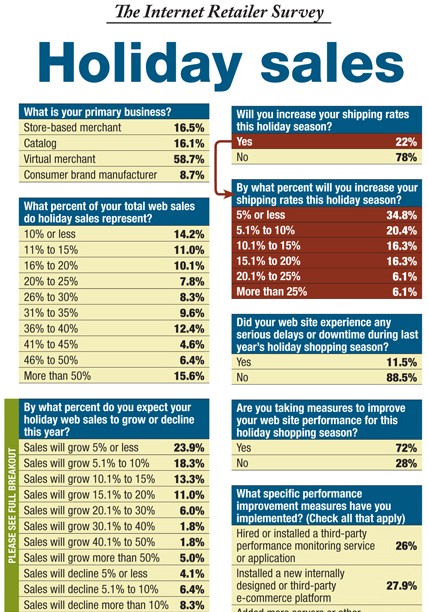
Internet Retailer: 81% Believe Holiday Online Sales Will Grow

InternetRetailer.com - As the economy sinks, will the sleigh rise?
Even in the midst of economic chaos, 81% of retailers believe their online sales will grow this holiday season
By Bill Siwicki

With the economy teetering on the brink and consumers frazzled by the sinking stock market and manic efforts of elected officials, the big question in retail today is: Will holiday sales this season be HO-HO-HO or HO-OH-NO? It depends on the sales channel, retailers, research firms and analysts say. Sales have been down this year, in some cases significantly, in bricks-and-mortar stores. However, online sales continue to grow—though not at the rapid pace of years past.

Even amid economic turmoil, 81.1% of retailers believe their holiday web sales will grow to some degree this season, according to the latest Internet Retailer survey. This is good news—for the most part, some analysts say.

“It is encouraging to see four out of five expect to grow web sales in the face of such a poor economy,” says Jim Okamura, senior partner at retail consulting firm J.C. Williams Group Ltd. “However, that one-in-five figure is higher than I’ve seen in a long time, especially in the face of continuing online sales growth where the focus being paid to the online channel has never been higher.”

Continue Reading at Internet Retailer.com


Reblog this post [with Zemanta]

New Look Quarterly from Forrester Research

Received an email from Forrester Research and found it interesting  enough to share.  I'm sure they don't mind since they invited me to share/email this with anyone, so I am.  This particular report aims to provide insight from eBiz-execs seeking to grow their eBiz. 

If you'd like further information on how to subscribe to First Look Quarterly's you may click here.  If you'd l ike to participate in their eBusiness Panel, you can sign up here.  Here's the email:

Welcome to the new First Look designed specially for eBusiness & Channel Strategy professionals!


Whatever your politics, you can't envy Barack Obama. He's just walked into the biggest economic disaster in American history. Housing prices are plummeting, businesses are unable to raise capital, unemployment is rising, the stock market hasn't displayed signs of a bottom yet, and consumer confidence is at the lowest level since the University of Michigan even started to measure the metric. There's a guy out there who calls himself Dr. Doom who thinks that it could take decades to recover. It's enough to make just about anyone want to crawl into a hole and hibernate until there's better news.

Anyone, that is, but an eBusiness manager. Because if there is a silver lining in this cloud, it is that the online sector of nearly every consumer-facing business continues to experience growth and garner executive attention. From a Forrester survey of eBusiness executives, we know that the key reasons why an online business exists are to acquire new customers, reduce the current cost of servicing customers, and retain existing customers. The impact of the Web channel is clear and quantifiable, and that should leave you in pretty good shape.

In fact, 72% of retailers said that the Web channel is better suited to withstand an economic slowdown than other channels.
But a downturn is never a good thing, and companies have a bad habit of killing even the geese that lay the golden eggs during tough times. What are the things you need to be prepared for?

We see three:


  • A continued slump in consumer confidence. With all the bad news out there, how can customers or businesses possibly be anything but uncertain about the future? Your Web site is in a unique position to address this challenge.

  • Demand for value. If "trading up" was the catchphrase of the last decade, you can bet money that "trading down" will be an imperative for indebted, cash-flow-negative consumers to get the most out from the limited resources they do have. Is it any wonder that Wal-Mart, whose mantra is "Everyday low prices," is one of the only stores to experience positive comp store sales in recent months?

  • High customer acquisition costs. As consumers and businesses are tighter with their wallets, marketing spend is less likely to yield much bang for the buck. That means focusing on your customers who know you, love you (or at least tolerate you), and are likely to spend more with you. In other words, this means more need to focus on customer retention.
So what to do? eBusiness managers should be doing several things to address these changes. In the short term, we suggest three strategies.

Addressing customer confidence issues in your digital contact points. If your business is in good shape, don't be afraid to trumpet it -- on your home page, on log-in pages, in your emails. We received an email from Citizens Bank recently that said just that: The times are uncertain, but your deposits are not. What a comforting message during turbulent times that many eBusiness executives ignore. In fact, one in five US online travelers avoids destinations because a Web site's content doesn't make them feel comfortable; 26% cite the same problem with hotel Web sites.

Boosting customer care. There may be places to cut funds, but if you are in an industry where consumers are skittish, make sure that you have human help on hand to answer questions and allay concerns. When consumers want customer service, they are most likely to either go to a store or call a service rep. Interactive chat and click-to-call show promise, especially for online banking sites. In a recent survey, we found that while 85% of researchers who contacted a firm during the research process used the phone, just 43% found that method helpful. By contrast, just 47% used click-to-call, but satisfaction rates were significantly higher at 61%

Perfecting retention marketing strategies. The king of all digital retention tactics is email marketing, and it's time to make sure you're not just batching and blasting your entire customer base with irrelevant messages. Segment your best customers, and create useful content that will engage them and give them a reason to interact with you even when their liquidity is low.

That's just the tip of the iceberg. We have many documents that we've published recently and have on our docket in the coming weeks to advise various eBusiness groups on weathering the economic storm. The good news is that if you're reading this, you'll likely be one of the players that not only emerges from this downturn intact, but stronger and better than before.

Seeing the glass half full,
Sucharita Mulpuru


Research Referenced In This Issue

Brand-Building Online Content Matters For eBusiness And Channel Strategy In A Recession (47266)
How To Get Customers To Shop Online (45822)
Optimizing Customer Retention Programs (44400)
The Business Case For Interactive Help In Financial Services (42472)
The Cost Of eBusiness Operations And Customer Acquisition (46111)
The State Of Retailing Online 2008: Profitability, Economy, And Multichannel Report (45508)

Reblog this post [with Zemanta]

Tuesday, November 11, 2008

Short Circuit in Gift Cards?

Circuit City Stores, Inc.Image via Wikipedia
If You've got a Circuit City Gift Card, Use it Now!

Circuit City tried to reassure shoppers that it would be business as usual despite its Chapter 11 bankruptcy filing. 

They've asked a bankruptcy court to let it honor gift cards.  That's simply rhetoric to reassure gift card holders.  In reality, the gift cards are about to "short-circuit" both in the context of their future as an acceptable electronic payment and the time they'll be around.

The purpose of bankruptcy is to "restructure" but having heard  rhetoric following the Pay By Touch "bankruptcy" filing and imminent "restructuring," I'd advise consumers to take into account the fact that Circuit City is a retailer in serious financial trouble. That will affect their gift cards.  Sorry...I'd love to paint a rosier picture, but a "Sharper Image" comes to mind instead.  (To refresh your memory, their gift card holders lost everything)

So if you have a Circuit City gift card use it immediately.  In fact,  I'd advise that you do that across the board with any retailer where you have a prepaid gift card.

In this environment, I've got 3 words for you..."use it now".  In the past, people have shown a tendency to hold on to the gift cards for a couple of months.   I'm not a big believer in gift cards, they're the opposite of a layaway program...you're basically "loaning" money to the retailer and getting nothing in return. 

But  if you must get one, and not many are considering it this holiday season (see previous post) instead of dolling out your hard earned cash for a store branded (closed loop) gift card, you should only "consider" purchasing a gift card that is Visa/MC/Discover/AMEX branded/backed,  (open loop cards)
  
I wouldn't be the least bit surprised, if  and when the Circuit City gift cards do indeed short-circuit, to see the gift card landscape vastly affected forever.  They'll either be some new regulation introduced, someone will come up with an improved program or consumers will shy away, at least from...closed loop gift cards.


Reblog this post [with Zemanta]

Holidaze - Only 1.1% Will Use Credit Cards More

Cash is king for U.S. holiday shoppers: survey | U.S. | Reuters

CHICAGO (Reuters) - Cash is king this holiday season as consumers try to limit their credit card purchases or have maxed out on credit altogether, according to a survey conducted for Reuters.

A total of 88.6 percent of those surveyed said they would use more cash for buying holiday gifts this year, while 59.7 percent said they will use credit cards less, according to the survey by America's Research Group.

Only 1.1 percent said they will use credit cards more.


These stark differences could be partly due to consumers feeling more credit pressures as the economy weakens and banks become less willing to extend credit, said Britt Beemer, chairman of consumer tracking firm America's Research Group.

But another, even larger reason could be that many consumers -- 43.2 percent -- will give gift cards less often this year because they are worried that those cards would be worthless if a retailer files for bankruptcy.

Consumers who shy away from gift cards may just give cash instead, he said.

"If the only store I know of (that) is going to be around for sure is Wal-Mart, and I don't want to give a girlfriend a Wal-Mart gift card, cash is a lot more sexy," Beemer said.

The 2008 holiday season is shaping up to be challenging, at the very least, for retailers. The National Retail Federation has forecast the lowest increase in spending by consumers in at least six years.

Adding to the pressure for traditional retailers is the fact that bankrupt retailers like Circuit City are liquidating inventory at stores they are closing.  One-third of survey respondents said they will go to liquidation sales in place of their normal retailers this Christmas. 

Consumers are also trying to spread the pain across several paychecks, with 65 percent saying they plan to buy a few gifts each week and 31 percent saying they started shopping early so they would not have a big bill in one month.

One positive for retailers? The move to give cash instead of gift cards could lift sales during the holiday season, Beemer said.  "If somebody has cash, they spend it immediately," he said. "If somebody has a gift card, it rolls on to next Memorial Day or July 4 weekend."

Another positive factor could be lower gasoline prices, with 35.4 percent of respondents saying that lower gas prices will encourage them to spend more.

The survey consisted of 1,000 interviews conducted November 6-8 and has an error factor of plus or minus 3.8 percent.

Reblog this post [with Zemanta]

Disqus for ePayment News