Heartland Data Breach Update: Now More Than 600 Institutions Impacted
Bermuda, Canada and Guam Now Report Effects from BreachBermuda, Canada and Guam All Report Effects from Breach
If your institution has been affected in the Heartland breach and you are not on this list, please send an email to editor@bankinfosecurity.com.
Include your name, email, and a phone number where you may be contacted for verification.
Heartland Payment Systems data breach coverage
Following is the latest up-to-date list of institutions impacted by the Heartland breach and - where available - the total number of cards compromised:
Click Here to See the Institutions Affected
Thursday, April 23, 2009
Heartland Breach...Now More than 600 Banks Impacted
Telephone Fraud Fears Bigger than PC Fraud
Banking / Finance News
Source: PCWorld
Complete item: http://www.pcworld.com/article/163741/forget_computers_phone_crime_is_worrying_banks.html
Description:
Computer fraud may be a big problem for banks today, but the telephone is becoming a critical tool for fraudsters, bank executives say.
In addition to calling customers about suspicious transactions, banks use SMS (Short Message Service) to request that customers contact them. So, fraudsters have begun using a variety of techniques to try to trick the banks into thinking they're communicating with legitimate customers via the telephone. "Call-center authentication is, to me, the biggest pain point right now," said Stan Szwalbenest, remote channel risk director with JP Morgan Chase, speaking at the RSA conference in San Francisco this week.
Editor's Note: HomeATM has developed an outstanding application whereby a mobile user can connect our PCI 2.0 certified device to ANY mobile phone, swipe their card, enter their PIN "ONE TIME" disconnect our device and the phone can then be used as a "secure" payment device henceforth. More on this later...
E-Secure-IT
https://www.e-secure-it.com
Source: PCWorld
Complete item: http://www.pcworld.com/article/163741/forget_computers_phone_crime_is_worrying_banks.html
Description:
Computer fraud may be a big problem for banks today, but the telephone is becoming a critical tool for fraudsters, bank executives say.
In addition to calling customers about suspicious transactions, banks use SMS (Short Message Service) to request that customers contact them. So, fraudsters have begun using a variety of techniques to try to trick the banks into thinking they're communicating with legitimate customers via the telephone. "Call-center authentication is, to me, the biggest pain point right now," said Stan Szwalbenest, remote channel risk director with JP Morgan Chase, speaking at the RSA conference in San Francisco this week.
Editor's Note: HomeATM has developed an outstanding application whereby a mobile user can connect our PCI 2.0 certified device to ANY mobile phone, swipe their card, enter their PIN "ONE TIME" disconnect our device and the phone can then be used as a "secure" payment device henceforth. More on this later...
E-Secure-IT
https://www.e-secure-it.com
Cybersecurity - White House Must Lead
| Hathaway: White House Must Lead in Cybersecurity Scant on Detail, Speech Points to Future Policy | ||
> Read the entire article |
Obama: "Credit Card Fine Print not Fine"
Obama pledges protections for credit-card users
WASHINGTON – President Barack Obama said Thursday his administration is determined to get a credit-card law that eliminates tricky fine print, sudden rate increases and late fees that give millions of consumers headaches.
"I trust that those in the industry who want to act responsibly will engage with us in a constructive fashion, and that we're going to get this done in short order," Obama said, delivering a pointed message to leading executives of credit-card issuing companies seated at his side.
Both the House and the Senate are pursuing bills to give consumers greater protections. Obama said his economic advisers will examine the various proposals and work with Congress and the industry, but he made clear he intends to sign a law.
At issue is how to protect consumers, particularly in a severe recession, while not imposing the kind of rules that could make it harder for banks to offer credit or put credit out of reach for many borrowers. Industry advocates are wary of those consequences and hopeful Obama will listen.
Obama outlined the principles he wants in any legislation: Protections so that consumers won't face sudden, surprising jumps in fees; requirements that companies publish their forms in plainspoken language, with no more fine print; the availability of customer-friendly comparison shopping on credit-card offers; and greater enforcement so that violators feel the "full weight" of the law.
The president also acknowledged the importance of credit cards; almost 80 percent of U.S. households have one. Credit cards often serve as a vital source of liquidity, both for individuals and small businesses.
Online Finance Conference June 16th in London
Source: fstech
Complete item: http://www.fstech.co.uk/conferences/online-finance/index.htm
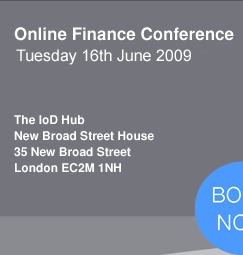
FST Magazine (www.fstech.co.uk) is proud to announce its annual Online Finance Conference on: Tuesday, 16 June 2009 at the IoD Hub in London.
The world is moving online, but change brings both opportunities and challenges. Fundamental to this are the customers, and whether their relationship with technology will also change their perception of value and trust. From perspective of financial services companies, there are questions about how technology can defend access,protect privacy and expand upon the service offered.
This one-day conference looks at the challenges facing CTOs, CIOs, CISOs and online professionals. It provides a comprehensive overview of the most urgent issues facing the financial services industry and the correct strategies to cope with Online Payment, Payment Security, Mobile Payment, Customer Behaviour,and Online Fraud, in what is an increasing hostile cyber-world.
E-Secure-IT
https://www.e-secure-it.com
Give Me Free ID Theft Service Say 60% of Online Bank Users
Consumers wishing to keep closer tabs on personal finances, and aggressive moves by banks to acquire new business, caused continued growth in the number of US online banking customers throughout 2008, according to comScore's annual review of the online banking industry.
The April 2009 comScore State of Online Banking report, based on passively observed online behavioral data from the comScore Online Bank Benchmarker and a 2009 survey of nearly 5,000 US online banking customers, provides insights into service usage, customer satisfaction, personal financial management and paperless banking.
Key findings are highlighted below (courtesy of MarketingCharts).
Top Online Banks Continue to Acquire Customers
After several years of strong growth in the use of online banking at the top-10 banks, the second half of 2007 showed the first signs of softness as sequential quarterly growth rates fell below 1%. This growth rate rebounded somewhat in 2008 as banks became more aggressive in their online banking customer acquisition efforts.
Profit Not in the Cards for Chase in Q1
CHASE CARD UNIT POSTS Q1 LOSS
JPMorgan Chase & Co. today announced its Card Services unit lost $547 million during the first quarter ended March 31, compared with a profit of $609 million during the same quarter a year earlier. Revenues for the unit were $5.1 billion, up 30.8% compared with revenues of $3.9 billion for the first quarter of 2008. The revenue gains were offset by a sharp increase in charge-offs and lower income from credit card fees, the company said.
Continue Reading
2004 Fraud vs. 2009 Fraud
Threats are becoming more sophisticated, and cybercriminals are getting smarter at evading new authentication controls, according to an RSA Conference panel of security practitioners representing three major financial institutions.More on DNS Cache Poisoning.... See Yesterday's "PIN Payments News" Post "Name Your Poison and Cache In"
Members of the panel, comprising experts at Bank of America, PayPal and JPMorganChase, agreed Wednesday that the burden is on them to secure their systems for customers -- many of whom are being greeted with slick new attempts to take over accounts. Securing systems includes implementing a defense-in-depth approach that offers multifactor authentication on the front end and fraud detection capabilities on the back end, the panelists said. Editor's Note: How about KISS? Get rid of username: password: and replace it with 2FA SafeTPIN. Cloned site threat...gone, phishing threats, elminated, DNS Cache Poisoning(see below)...cured, stolen account numbers, useless without the PIN. It's 2009 and it's time...
"The bad guys invested in a spell checker," joked David Shroyer, senior vice president at Bank of America's Online Security and Enrollment division. "I'd love to combat phishing in 2004 versus what we're facing today." Editor's Note: Exactly my point (2002 was a different lifetime when it came to combating fraud) in yesterday's post: And You Say You Want Software PIN Debit?
Continue Reading
Source: EWeek
Complete item: Report-Claims-DNS-Cache-Poisoning-Attack-Against-Brazilian-Bank
Description:
An unsubstantiated report claims that a successful DNS cache poisoning attack was conducted recently against Banco Bradesco, a Brazilian bank. The reports are in Portuguese. This Google translation explains it in typically clumsy, broken English.
The actual DNS cache belonged to Brazilian ISP NET Virtua. DNS cache poisoning is an attack against DNS servers, usually through a vulnerability in the DNS software, allowing the attacker to change the IP addresses that users receive. In this case, they changed the entries for the Bradesco servers, redirecting users to a malicious Bradesco look-alike server. The same attack also poisoned the entries for Google's Adsense servers, with the purpose of installing a Trojan on the users' systems.
Wednesday, April 22, 2009
Name Your Poison and Cache In
From now on, every time you see the graphic on the left, expect to read a post or article about why banks need to get rid of the username: password: routine. It ain't safe!!! Here's another example why...
Complete item: http://www.theregister.co.uk/2009/04/22/bandesco_cache_poisoning_attack/
One of Brazil's biggest banks has suffered an attack that redirected its customers to fraudulent websites that attempted to steal passwords and install malware, according to an unconfirmed report.
According to this Google translation of an article penned in Portuguese, the redirection of Bradesco was the result of what's known as a cache poisoning attack on Brazilian internet service provider NET Virtua.
DNS cache poisoning attacks exploit weaknesses in the internet's domain name system. ISPs that haven't patched their systems against the vulnerabilities are susceptible to attacks that replace the legitimate IP address of a given website with a fraudulent number. End users who rely on the lookup service are then taken to malicious websites even though they typed the correct domain name into their browser.
In 1998, Eugene E. Kashpureff admitted to federal US authorities that on two occasions the previous year he used cache poisoning to divert traffic intended for InterNIC to AlterNIC, a competing domain name registration site that he owned.
Makers of DNS software were largely able to prevent the attacks by adding pseudo-random transaction ID numbers to lookup requests that must be included in any responses. Then, last year, IOActive researcher Dan Kaminsky revealed a new way to poison DNS caches, touching off a mad scramble by the world's ISPs to fix the vulnerability before it was exploited.
The article from Globo.com cited a Bradesco representative who said that about 1 percent of the bank's customers were affected by the attack. It went on to suggest that customers who were paying attention would have noticed Bradesco's secure sockets layer certificate generated an error when they were redirected to the fraudulent login page.
Interestingly, it also said that a domain used for Google Adsense was redirected to a site that used malicious Javascript to install malware redirected machines. The attacks have since been resolved, the article stated.
It's still not clear exactly how the caches were tainted. Representatives for the ISP and the bank hadn't responded to requests for comment at time of publication.
For more details :
http://translate.google.com/translate?prev=hp&hl=en&js=n&u=http%3A%2F%2Fg1.globo.com/Noticias/Tecnologia/0,
,MUL1088103-6174,00-ATAQUE+LEVA+CLIENTES+DO+VIRTUA+A+SITE+CLONADO+DE+BANCO.html
Complete item: http://www.theregister.co.uk/2009/04/22/bandesco_cache_poisoning_attack/
One of Brazil's biggest banks has suffered an attack that redirected its customers to fraudulent websites that attempted to steal passwords and install malware, according to an unconfirmed report.
According to this Google translation of an article penned in Portuguese, the redirection of Bradesco was the result of what's known as a cache poisoning attack on Brazilian internet service provider NET Virtua.
DNS cache poisoning attacks exploit weaknesses in the internet's domain name system. ISPs that haven't patched their systems against the vulnerabilities are susceptible to attacks that replace the legitimate IP address of a given website with a fraudulent number. End users who rely on the lookup service are then taken to malicious websites even though they typed the correct domain name into their browser.
"That's pretty serious when you're talking about a banking organization," said Paul Ferguson, a security researcher with anti-virus provider Trend Micro. "If people are trying to log in to their account and they get rejected, they'll try again and again with the same user name and password."DNS cache poisoning has been around since the mid 1990s, when researchers discovered that DNS resolvers could be flooded with spoofed IP addresses for sensitive websites. The servers store the incorrect information for hours or days at a time, so the attack has the potential to send large numbers of end users to fraudulent websites that install malware or masquerade as a bank or other trusted destination and steal sensitive account information.
In 1998, Eugene E. Kashpureff admitted to federal US authorities that on two occasions the previous year he used cache poisoning to divert traffic intended for InterNIC to AlterNIC, a competing domain name registration site that he owned.
Makers of DNS software were largely able to prevent the attacks by adding pseudo-random transaction ID numbers to lookup requests that must be included in any responses. Then, last year, IOActive researcher Dan Kaminsky revealed a new way to poison DNS caches, touching off a mad scramble by the world's ISPs to fix the vulnerability before it was exploited.
The article from Globo.com cited a Bradesco representative who said that about 1 percent of the bank's customers were affected by the attack. It went on to suggest that customers who were paying attention would have noticed Bradesco's secure sockets layer certificate generated an error when they were redirected to the fraudulent login page.
Interestingly, it also said that a domain used for Google Adsense was redirected to a site that used malicious Javascript to install malware redirected machines. The attacks have since been resolved, the article stated.
It's still not clear exactly how the caches were tainted. Representatives for the ISP and the bank hadn't responded to requests for comment at time of publication.
For more details :
http://translate.google.com/translate?prev=hp&hl=en&js=n&u=http%3A%2F%2Fg1.globo.com/Noticias/Tecnologia/0,
,MUL1088103-6174,00-ATAQUE+LEVA+CLIENTES+DO+VIRTUA+A+SITE+CLONADO+DE+BANCO.html
I'll Give You $10k for Your Nokia 1100!
Why? Cause I can selll it for $25k. No...scroll down further ...I can sell it for $32k. Of course if you hooked up our device to your phone, and swiped your card and entered your PIN (ONE TIME) that phone would be a secure payment terminal. I've gotten a few emails regarding hooking up our device to a mobile phone and wanted to clarify. You would only need to swipe and enter your PIN "one-tiime" to morph your phone into a secure payment device. Not everytime you wanted to purchase something. I'll have more on this in future posts, but in the meantime, if you've got a Nokia 1100 let me know!
Complete item: http://www.theregister.co.uk/2009/04/21/nokia_1100_scam/
Description:
Scammers are reportedly prepared to pay $25,000 for German Nokia 1100 handsets, on the basis that they can be reprogrammed to intercept SMS messages and thus crack banking security.
The claim comes from Ultrascan, a security association that generally follows up 419 scams and ID theft. Ultrascan tells us it was approached by Dutch police concerned that the price of a second-hand Nokia 1100 was unexpectedly rising. The company subsequently discovered that buyers were interested in a security flaw that makes the German version of the handset worth so much, though the technical background remains obscure.
The supposed exploit is based around codes - mTAN - that are sent to customers over SMS and are unique to each mobile-banking transaction. The premise is that criminals have "thousands" of login details and just lack these single-use codes, so are trying to get hold of Nokia 1100 handsets to intercept them.
The problem with this hypothsis is that the GSM security model is managed by the SIM, which colludes with the network's authentication server to create an encryption key which is made available to the handset. Communications can only be intercepted by getting hold of that key, or breaking the encryption itself, neither of which is easier to do while in position of a Nokia 1100, German or otherwise.
We put these technical issues to Ultrascan who told us that they "did not investigate [the technical] part", but are hoping to get hold of a '1100 for testing in the next few days to see what is possible.
In the early days of GSM some operators introduced a critical flaw (zeros) into early versions of GSM cryptography, to enable the use of cheaper SIMs, but almost all operators have since upgraded to proper security and 3G networks have open algorithms that are well known to be pretty secure. Some countries, such as Pakistan, aren't permitted to use cryptography so still suffer from SIM-cloning and the like, but such places don't generally offer mobile banking for obvious reasons.
Ultrascan say they'll be in touch when they have more technical details, but for the moment it's beyond us how one phone can intercept calls made to a different SIM, and it seems more likely that one scammer is simply ripping off another with promises of magic handsets.
Complete item: http://www.computerworld.com/action/article.do?command=viewArticleBasic&articleId=9131906&source=NLT_SEC
Description:
The mystery why cybercriminals want a discontinued Nokia phone isn't getting any clearer. Hackers have been offering up to $32,413 in underground forums for Nokia 1100 phones made in the company's former factory in Bochum, Germany. The phone can allegedly be hacked so as to facilitate illegal online banking transfers, according to the Dutch company Ultrascan Advanced Global Investigations.
Nokia said on Tuesday it is not aware that resale prices for a phone that retailed for less than $17 when it debuted in 2003 have risen so high. Further, Nokia maintains the phone's software isn't flawed.
"We have not identified any phone software problem that would allow alleged use cases," the company said in an e-mailed statement.
The 1100 can apparently be reprogrammed to use someone else's phone number, which would also let the device receive text messages. That capability opens up an opportunity for online banking fraud.
In countries such as Germany, banks send an mTAN (mobile Transaction Authentication Number) to a person's mobile phone that must be entered into a Web-based form in order to, for example, transfer money into another account. A TAN can only be used once, a security feature known as a one-time passcode.
Criminals have proven adept at obtaining people's usernames and log-ins for online bank accounts, either through tricking people into visiting look-alike bank Web sites, through clever e-mail messages or simply hacking PCs.
European banks typically issue customers a list of TANs, but phishers tricked people into revealing those. Deutsche Postbank used to accept any TAN from the list to complete a transaction. Then the bank moved to requesting specific TANs from the list. After continuing fraud, it decided in 2005 to expanded the use of mTANs.
"The mTAN is valid only for the requested transfer and only for a short period," according to the bank's Web site. "It thus has no value for a fraudster."
That is, unless the hacker could also receive the mTAN, which Nokia 1100 hack allegedly allows.
Nokia said it doesn't know of an 1100 software problem that would allow call spoofing. The company said that a phone's SIM (Subscriber Identity Module) card -- which holds the device's phone number -- has security mechanisms that are separate from the phone itself.
Nokia said it is aware of commercial services that claim to provide caller identification or phone-number spoofing services, but in those cases the service provider acts as a proxy between the caller and the recipient, Nokia said.
But it is possible to have multiple phones running on a service provider's network that use the same phone number, said Sean Sullivan, a security adviser at F-Secure Corp., a security vendor in Helsinki, Finland. Usually, the last phone that used the network will be the one that receives inbound messages, he said.
Complete item: http://www.theregister.co.uk/2009/04/21/nokia_1100_scam/
Description:
Scammers are reportedly prepared to pay $25,000 for German Nokia 1100 handsets, on the basis that they can be reprogrammed to intercept SMS messages and thus crack banking security.
The claim comes from Ultrascan, a security association that generally follows up 419 scams and ID theft. Ultrascan tells us it was approached by Dutch police concerned that the price of a second-hand Nokia 1100 was unexpectedly rising. The company subsequently discovered that buyers were interested in a security flaw that makes the German version of the handset worth so much, though the technical background remains obscure.
The supposed exploit is based around codes - mTAN - that are sent to customers over SMS and are unique to each mobile-banking transaction. The premise is that criminals have "thousands" of login details and just lack these single-use codes, so are trying to get hold of Nokia 1100 handsets to intercept them.
The problem with this hypothsis is that the GSM security model is managed by the SIM, which colludes with the network's authentication server to create an encryption key which is made available to the handset. Communications can only be intercepted by getting hold of that key, or breaking the encryption itself, neither of which is easier to do while in position of a Nokia 1100, German or otherwise.
We put these technical issues to Ultrascan who told us that they "did not investigate [the technical] part", but are hoping to get hold of a '1100 for testing in the next few days to see what is possible.
In the early days of GSM some operators introduced a critical flaw (zeros) into early versions of GSM cryptography, to enable the use of cheaper SIMs, but almost all operators have since upgraded to proper security and 3G networks have open algorithms that are well known to be pretty secure. Some countries, such as Pakistan, aren't permitted to use cryptography so still suffer from SIM-cloning and the like, but such places don't generally offer mobile banking for obvious reasons.
Ultrascan say they'll be in touch when they have more technical details, but for the moment it's beyond us how one phone can intercept calls made to a different SIM, and it seems more likely that one scammer is simply ripping off another with promises of magic handsets.
Complete item: http://www.computerworld.com/action/article.do?command=viewArticleBasic&articleId=9131906&source=NLT_SEC
Description:
The mystery why cybercriminals want a discontinued Nokia phone isn't getting any clearer. Hackers have been offering up to $32,413 in underground forums for Nokia 1100 phones made in the company's former factory in Bochum, Germany. The phone can allegedly be hacked so as to facilitate illegal online banking transfers, according to the Dutch company Ultrascan Advanced Global Investigations.
Nokia said on Tuesday it is not aware that resale prices for a phone that retailed for less than $17 when it debuted in 2003 have risen so high. Further, Nokia maintains the phone's software isn't flawed.
"We have not identified any phone software problem that would allow alleged use cases," the company said in an e-mailed statement.
The 1100 can apparently be reprogrammed to use someone else's phone number, which would also let the device receive text messages. That capability opens up an opportunity for online banking fraud.
In countries such as Germany, banks send an mTAN (mobile Transaction Authentication Number) to a person's mobile phone that must be entered into a Web-based form in order to, for example, transfer money into another account. A TAN can only be used once, a security feature known as a one-time passcode.
Criminals have proven adept at obtaining people's usernames and log-ins for online bank accounts, either through tricking people into visiting look-alike bank Web sites, through clever e-mail messages or simply hacking PCs.
European banks typically issue customers a list of TANs, but phishers tricked people into revealing those. Deutsche Postbank used to accept any TAN from the list to complete a transaction. Then the bank moved to requesting specific TANs from the list. After continuing fraud, it decided in 2005 to expanded the use of mTANs.
"The mTAN is valid only for the requested transfer and only for a short period," according to the bank's Web site. "It thus has no value for a fraudster."
That is, unless the hacker could also receive the mTAN, which Nokia 1100 hack allegedly allows.
Nokia said it doesn't know of an 1100 software problem that would allow call spoofing. The company said that a phone's SIM (Subscriber Identity Module) card -- which holds the device's phone number -- has security mechanisms that are separate from the phone itself.
Nokia said it is aware of commercial services that claim to provide caller identification or phone-number spoofing services, but in those cases the service provider acts as a proxy between the caller and the recipient, Nokia said.
But it is possible to have multiple phones running on a service provider's network that use the same phone number, said Sean Sullivan, a security adviser at F-Secure Corp., a security vendor in Helsinki, Finland. Usually, the last phone that used the network will be the one that receives inbound messages, he said.
Web Site Redirects for Coke, Microsoft and HSBC
This is just the tip of the iceberg as to what we can expect in the near future. Again, bank websites are most at risk of these DNS Hijack's and as long as they continue to use what many consider to be obsolete "username, password" they continue to needlessly put their online banking customers at risk. It isn't hard to imagine a scenario whereby a bank website is cloned and their DNS hijacked. The bank's customer, completely unaware, enter's their username and password into the box. The bad guys now go to the "real" site, enter the username and password and "voilla" complete unfettered access to that individuals account.
Of course, if Banks used HomeATM's PCI 2.0 certifed SafeTPIN Pin Entry Device for secure 2FA (2 factor authentication) log-in, a cloned website would NOT work. The unsuspecting banking customer would be redirected to the "hijacked" site, but instead of a username/password log-in they would be instructed to swipe their card and enter their PIN. Since the information is encrypted inside the SAFETPIN (instead of the browser) the bad guys wouldn't have anything with which to get into the genuine site. Same thing with cloned cards. They wouldn't work.
Same thing with phishing....which costs banks $350 a pop. I'll give you 10 SafeTPIN's for $350 and reduce your phishhing attacks to zero. Click on the graphic on the right about phish-stick-tistics as to why that would be the best investment a bank could make.
Here's the article about the DNS hijacking...
Source: Zone-h
Complete item: http://www.zone-h.org/news/id/4708
Description:
Some Turkish defacers broke into the New Zealand based registrar Domainz.net (which belongs to MelbourneIT) and redirected some of their customers' high profile web sites to a third party server with a defaced page. Companies which had their New Zealand web sites defaced include Microsoft, HSBC, Coca-Cola, F-secure, Bitdefender, Sony and Xerox.
The hacked websites carried the messages: "Hacked by Peace Crew" ,"STOP THE WAR ISRAEL". In addition the crackers inserted a picture of Bill Gates creampie'd on the Microsoft defacements.
It is interesting to note that the attacker going by the handle of "agd_scorp", a member of Peace Crew, hacked a big amount of MSN and microsoft.* web sites in the past (Microsoft Canada, Morocco, Tunisia, Austria, Ireland... MSN Israel, Korea, Spain, Denmark, China, Norway...).
This time they exploited a simple SQL Injection vulnerability to hack the administration panel of the registrar, where they modified the DNS records of the domains. Again, it is quite scary to see how a so big company can get hacked because of a famous programming vulnerability.
Registrars have been one of the main aims during the past months as they are often the weakest link and an easy target for attackers who want to hijack high profile web sites.
E-Secure-IT
https://www.e-secure-it.com
Of course, if Banks used HomeATM's PCI 2.0 certifed SafeTPIN Pin Entry Device for secure 2FA (2 factor authentication) log-in, a cloned website would NOT work. The unsuspecting banking customer would be redirected to the "hijacked" site, but instead of a username/password log-in they would be instructed to swipe their card and enter their PIN. Since the information is encrypted inside the SAFETPIN (instead of the browser) the bad guys wouldn't have anything with which to get into the genuine site. Same thing with cloned cards. They wouldn't work.
Same thing with phishing....which costs banks $350 a pop. I'll give you 10 SafeTPIN's for $350 and reduce your phishhing attacks to zero. Click on the graphic on the right about phish-stick-tistics as to why that would be the best investment a bank could make.
Here's the article about the DNS hijacking...
Source: Zone-h
Complete item: http://www.zone-h.org/news/id/4708
Description:
Some Turkish defacers broke into the New Zealand based registrar Domainz.net (which belongs to MelbourneIT) and redirected some of their customers' high profile web sites to a third party server with a defaced page. Companies which had their New Zealand web sites defaced include Microsoft, HSBC, Coca-Cola, F-secure, Bitdefender, Sony and Xerox.
The hacked websites carried the messages: "Hacked by Peace Crew" ,"STOP THE WAR ISRAEL". In addition the crackers inserted a picture of Bill Gates creampie'd on the Microsoft defacements.
It is interesting to note that the attacker going by the handle of "agd_scorp", a member of Peace Crew, hacked a big amount of MSN and microsoft.* web sites in the past (Microsoft Canada, Morocco, Tunisia, Austria, Ireland... MSN Israel, Korea, Spain, Denmark, China, Norway...).
This time they exploited a simple SQL Injection vulnerability to hack the administration panel of the registrar, where they modified the DNS records of the domains. Again, it is quite scary to see how a so big company can get hacked because of a famous programming vulnerability.
Registrars have been one of the main aims during the past months as they are often the weakest link and an easy target for attackers who want to hijack high profile web sites.
E-Secure-IT
https://www.e-secure-it.com
Blogging Has Come a Long Way
Blogging Has Come a Long Way, Baby
APRIL 22, 2009
Blogging ain’t what it used to be.
If yesterday’s blogs were about personal expression, today’s are about two-way conversations that take place on many fronts: independent, standalone blogs; social networks; e-commerce and mainstream media sites; and microblogging platforms such as Twitter.
“This blogging activity presents new opportunities for marketers to influence—and monitor—conversations that may be relevant to their businesses,” says Paul Verna, eMarketer senior analyst and author of the new report, The Blogosphere: A-Twitter with Activity. “These conversations will continue to happen with or without participation from marketers, but those who join in—whether through their own sites or through a brand presence on independent ones—will have a place at the table.”
And the opportunities are large—larger than many people and pundits expected only a few years ago.
“Blogs are now mainstream media,” said Richard Jalichandra, CEO of Technorati. “You’re also seeing mainstream media coming in the other direction by adding blog content.”
This point of view is echoed by David Tokheim, of Six Apart Media. “The lines are becoming blurred between a standalone blog that might be created on TypePad or Blogger or WordPress and blog content that’s created by The New York Times.”
Currently, 27.9 million US Internet users have a blog they update at least once per month, and they represent 14% of the Internet population. By 2013, 37.6 million users will update their blogs at least monthly.
Several sources put the number of US bloggers even higher (Note: Though often reported in 2009, the estimates are for 2008.) Even more important than the number of bloggers, though, is the number of blog readers.
eMarketer estimates that in 2009 96.6 million US Internet users will read a blog at least once per month. By 2013, 128.2 million people, or 58% of all US users, will do the same.
“Blog sites now touch tens of millions of people in the US, and the numbers of blog readers and creators are projected to continue growing,” says Mr. Verna. The numbers tell the tale—or long tail, if you prefer.
“Blogging activity presents new opportunities for marketers to monitor and influence conversations relevant to their businesses,” says Mr. Verna. “Opportunities no marketer should ignore.”
Before you read your next blog, or tweet, download the new eMarketer report, The Blogosphere: A-Twitter with Activity.
APRIL 22, 2009
Blogging ain’t what it used to be.
If yesterday’s blogs were about personal expression, today’s are about two-way conversations that take place on many fronts: independent, standalone blogs; social networks; e-commerce and mainstream media sites; and microblogging platforms such as Twitter.
“This blogging activity presents new opportunities for marketers to influence—and monitor—conversations that may be relevant to their businesses,” says Paul Verna, eMarketer senior analyst and author of the new report, The Blogosphere: A-Twitter with Activity. “These conversations will continue to happen with or without participation from marketers, but those who join in—whether through their own sites or through a brand presence on independent ones—will have a place at the table.”
And the opportunities are large—larger than many people and pundits expected only a few years ago.
This point of view is echoed by David Tokheim, of Six Apart Media. “The lines are becoming blurred between a standalone blog that might be created on TypePad or Blogger or WordPress and blog content that’s created by The New York Times.”
Currently, 27.9 million US Internet users have a blog they update at least once per month, and they represent 14% of the Internet population. By 2013, 37.6 million users will update their blogs at least monthly.
Several sources put the number of US bloggers even higher (Note: Though often reported in 2009, the estimates are for 2008.) Even more important than the number of bloggers, though, is the number of blog readers.
“Blog sites now touch tens of millions of people in the US, and the numbers of blog readers and creators are projected to continue growing,” says Mr. Verna. The numbers tell the tale—or long tail, if you prefer.
“Blogging activity presents new opportunities for marketers to monitor and influence conversations relevant to their businesses,” says Mr. Verna. “Opportunities no marketer should ignore.”
Before you read your next blog, or tweet, download the new eMarketer report, The Blogosphere: A-Twitter with Activity.
On Online Banking
Source: Finextra
Complete item: http://www.finextra.com/fullstory.asp?id=19946
Description:
The number of US online banking customers continued to grow at a steady rate throughout 2008 as customers looked to keep a close eye on their finances during the recession, according to research from Web metrics firm comScore.
The study found the growth in the number of customers at the 10 most-visited online banks hardened in 2008 as financial institutions became more aggressive in their customer acquisition efforts, after weak gains the previous year.
Over 51 million Americans visited one of the top ten online banking sites in the fourth quarter of 2008, around four million more than in the same period the previous year.
ComScore says nearly 60% of the total US Internet population now visits any one of the top 20 financial institutions' sites in any give quarter.
The study also examined customer satisfaction with online services and a survey of over 4800 US adults shows 71% are "highly satisfied" with their primary online bank - just one per cent down on the previous year.
Satisfaction with credit card issuers also held steady at 62%, compared to 65% the previous year.
However, brokerage firms saw their highly satisfied customers decline from 70% of respondents in 2008 to 58% in 2009.
Complete item: http://www.finextra.com/fullstory.asp?id=19946
Description:
The number of US online banking customers continued to grow at a steady rate throughout 2008 as customers looked to keep a close eye on their finances during the recession, according to research from Web metrics firm comScore.
The study found the growth in the number of customers at the 10 most-visited online banks hardened in 2008 as financial institutions became more aggressive in their customer acquisition efforts, after weak gains the previous year.
Over 51 million Americans visited one of the top ten online banking sites in the fourth quarter of 2008, around four million more than in the same period the previous year.
ComScore says nearly 60% of the total US Internet population now visits any one of the top 20 financial institutions' sites in any give quarter.
The study also examined customer satisfaction with online services and a survey of over 4800 US adults shows 71% are "highly satisfied" with their primary online bank - just one per cent down on the previous year.
Satisfaction with credit card issuers also held steady at 62%, compared to 65% the previous year.
However, brokerage firms saw their highly satisfied customers decline from 70% of respondents in 2008 to 58% in 2009.
And You Say You Want Software Internet PIN Debit?
Pay By Touch pushed ATMDirect but nobody listened. (okay Accel Exchange did do a pilot with JPaul) Then Pay By Touch went bankrupt...and ATMDirect's assets went up for sale AGAIN!
Not a single payments entity placed a bid. Not Paypal (who paid almost a billion for eBillMe) not a single EFT Network, no alternative payment company whatsoever even showed a hint of interest.
Finally, it was purchased for a measly $600k, including Dell according to one report./IBM according to another, Blade Servers valued at $1.5 million plus. Fast forward to 2009. ATMDirect's software-based platform, under a new name, "Acculynk" is gaining some traction. With the exponential growth of malicious threats hitting the web, time may have passed this "application" bye.
Ironically, in the short history of the Internet, the year 2002 was probably the optimal time to introduce a software-based PIN Debit application. But 2009? Look at the chart above. A 12 Fold increase in malicious code threats since the beginning of 2007? That means that there are web-based attacks that exist this morning that didn't exist last week, let alone in 2000. So what does tomorrow hold? Not a lot of promise for alternative PIN debit. Especially when you consider that (not surprisingly) the "VAST MAJORITY" of attacks focus on Financial Services.
Take a gander at the article below from The Sydney Morning Herald based on last week's release of the results of a new study on Intenet security by Symantec...it seems obvious the time for an internet PIN Debit application was years ago, not now.
False sense of security - Banking - Money - Business - Home - smh.com.au John Kavanagh - April 22, 2009
No website is safe from the increasing number of internet criminals who want your money. Internet security threats are increasingly likely to come from popular, trusted sites with a large number of visitors. The growing sophistication of internet fraudsters and the techniques they use are resulting in an increasing number of cases where malicious code is finding its way into the web browsers of visitors to websites of reputable organizations.
This is the main finding of the Internet Security Threat Report, published last week by Symantec. The report is based on feedback from 240,000 sensors monitoring attack activity in 200 countries. The report says the online underground economy is maturing, with a range of "service providers" selling phishing tool kits and blank credit cards, as well as stolen data.
The area where the threat level is highest is financial services. Frauds and malicious attacks involving bank and other finance sector websites make up more than 75 per cent of the total.The senior director of Symantec Australia and New Zealand, David Dzienciol, says bank account and credit card details are the most popular items being traded by internet criminals.
The report says 76 per cent of phishing attacks target financial-services sites. Keystroke logging, a technique used to steal online banking log-on details, is another common form of attack. Twelve per cent of all data breaches in 2008 involved credit card information.
Credit card details are the most popular items for sale in the "underground economy". The reason for this, the report says, is that "there are numerous ways for that stolen information to be cashed out. The underground economy has a well-established infrastructure for monetising such information."
The report states: "The lengthy and complicated steps being pursued to launch successful web-based attacks demonstrate the increasing sophistication of the methods used by attackers."
Local banks are reporting that fraud levels in some areas, such as check fraud, have gone down but..."The area where there has been a big increase is in card-not-present transactions involving credit and debit cards (card-not-present transactions take place online)
The Australian Payments Clearing Association (APCA) reports that in the 2007-08 financial year, check fraud declined from 1.4 cents to 0.8 of a cent in every $1000 of payments. Debit card fraud (involving Eftpos and ATM transactions) went up from 7.1 cents to 7.4 cents for every $1000 of payments. Credit and charge card fraud jumped from 38.6 cents to 50.2 cents for every $1000.
APCA says card-not-present fraud accounts for 48 per cent of card fraud. (Editor's Note: A software PIN Debit application is a "card-not-present" approach) True PIN Debit is a debit card that is 1. Swiped, in order to capture the PIN Offset, the PIN Verification Value and the Track 2 Data and has True 2FA (two-factor authentication) by entering the PIN after the magnetic stripe data is captured. HomeATM has the ONLY TRUE PIN Debit solution designed for eCommerce.)
symantec, malicious code, Internet PIN Debit, Acculynk, HomeATM
Monday, April 20, 2009
Visit HomeATM at ETA...Booth 647! (FIS Booth) and We'll Put $10 on Your Card in Real Time!
HomeATM will be at Fidelity Information Services Booth (eFunds/Metavante/NYCE) Tuesday thru Thursday! So stop by booth #647 during the ETA Meeting & Expo April 21-23at the Mandalay Bay Resort & Casino and visit with one of ourmerchant experts.
(Look for anyone wearing a Polo with "PINterchange for the Internet " on their back)
Cause when it comes to providing "TRUE" PIN Debit for the Web, and military grade security,
we've got YOUR back covered!
(Look for anyone wearing a Polo with "PINterchange for the Internet " on their back)
Cause when it comes to providing "TRUE" PIN Debit for the Web, and military grade security,
we've got YOUR back covered!
Also...be sure to check out FIS’:
- Creative solutions to accepting PIN Debit for payment at Web-based merchant sites
- Expanding payment options
- Reduced interchange costs (PINterchange!)
Stop by and say hello.
We've got a $10.00 "Card" Present for you!
Correction: Booth #647
Just mention the fact that you saw this post in the "PIN Payments News Blog" and we'll put $10 on ANY US BANKCARD in "REAL TIME."
(right before your eyes)
RKL ATM Security (Remote Key Loading)
ATM Security | Remote key loading: The next in ATM security for ISOs | ATM Marketplace
By Tracy Kitten editor • 20 Apr 2009
Dennis "Abe" Abraham has spent the last five years waiting for remote key loading to reach a tipping point. The president of Concord, N.C.-based Trusted Security Solutions Inc., developer of the A98 remote key loading system, says the timing for RKL is finally right, and independent sales organizations are now seriously considering their options.
Though complicated by complex algorithms and multiple levels of encryption, the function of remote key loading is simple. Basically, RKL eliminates the need for ATM technicians to physically visit ATMs for manual key changes — thus eliminating expense and the possibility for human error.
story continues below...
After completing their investments in Triple DES upgrades, ATM deployers are now finally able to focus some time and money on RKL. Up to this point, financial institutions have expressed interest in RKL, but few have made large investments. In the ISO space, movement has been, by and large, non-existent.
And there are a few reasons for that.
Deployers of off-premises ATMs have not been as diligent about ensuring their keys are changed. In fact, before the October 2008 release of version 1.2 of the Payment Card Industry Council Data Security Standard, no definitive requirements for key changing existed. ATM deployers were required to change keys if and when audited, but audits were not mandated across the board.
Under version 1.2, keys must be changed every 12 months, and the networks are watching, says Chuck Hayes, product development manager for Long Beach, Miss.-based Triton Systems of Delaware. That PCI push has encouraged manufacturers like Triton to start marketing RKL part of the overall ATM offering.
"It's a differentiator for us," Hayes said. "It's the first time an RKL solution has been brought to market for the off-premises space, and that's helping us enjoy a competitive advantage."
Triton's patent-pending RKL offer may only require a software upgrade, if the ATM already has Triton's upgraded encrypting PIN pad.
For an ISO that acquires and needs to merge a fleet of remote-key capable ATMs with an existing fleet of ATMs that aren't remote-key ready, the Triton solution calls for a mere switch of the host for transaction processing, Hayes says.
"The business case for ISOs is simple: less key handling," he said. "That's an advantage. If an ATM key was corrupted, the host could rekey that ATM within minutes, rather than having to go through the manual process of sending someone out, which takes time and expense."
A case for ISOs and FIs
Continue Reading at ATM marketplace
Midnight Raid Attack Creates HelluvaSMS
Source: CNet
Complete item
Description:
Be careful who you give your mobile phone number out to. An attacker with the right toolkits and skill could hijack your phone remotely just by sending SMS messages to it, according to mobile security firm Trust Digital.
In what it calls a "Midnight Raid Attack" because it would be most effective when a victim is asleep, an attacker could send a text message to a phone that would automatically start up a Web browser and direct the phone to a malicious Web site, said Dan Dearing, vice president of marketing at Trust Digital. The Web site could then download an executable file on the mobile phone that steals data off the phone, he said.
Dearing demonstrates how this can be done in a video on YouTube.
In another type of attack, an attacker could hijack a phone by sending a type of SMS message called a control message over the GSM network to a victim's phone that is using a Wi-Fi network and then use special toolkits to sniff the Wifi traffic looking for the victim's e-mail log-in information. This attack is explained in another YouTube video.
While the attacks at this point are proof-of-concepts, they could be done if someone has the requisite knowledge and toolkits, said Dearing. Trust Digital recently announced software called EMM 8.0 that can help organizations protect employee phones from these types of attacks, he said.
"This is a completely real threat," said Philippe Winthrop, a director in the global wireless practice at Strategy Analytics. "We will see these attacks. It's a matter of time."
Complete item
Description:
Be careful who you give your mobile phone number out to. An attacker with the right toolkits and skill could hijack your phone remotely just by sending SMS messages to it, according to mobile security firm Trust Digital.
In what it calls a "Midnight Raid Attack" because it would be most effective when a victim is asleep, an attacker could send a text message to a phone that would automatically start up a Web browser and direct the phone to a malicious Web site, said Dan Dearing, vice president of marketing at Trust Digital. The Web site could then download an executable file on the mobile phone that steals data off the phone, he said.
Dearing demonstrates how this can be done in a video on YouTube.
In another type of attack, an attacker could hijack a phone by sending a type of SMS message called a control message over the GSM network to a victim's phone that is using a Wi-Fi network and then use special toolkits to sniff the Wifi traffic looking for the victim's e-mail log-in information. This attack is explained in another YouTube video.
While the attacks at this point are proof-of-concepts, they could be done if someone has the requisite knowledge and toolkits, said Dearing. Trust Digital recently announced software called EMM 8.0 that can help organizations protect employee phones from these types of attacks, he said.
"This is a completely real threat," said Philippe Winthrop, a director in the global wireless practice at Strategy Analytics. "We will see these attacks. It's a matter of time."
Online Security Fears Deepening...HomeATM Can Help
In an Index that tracks trends in consumer perception of security issues among approximately 8,500 people in nine countries, Unisys has reported that ID theft and fraud fears have surged in the last six months as recession bites.
“Reports that fraudsters are increasingly moving online, in addition to well publicized security breaches, may have also helped push up the Unisys Security Index for Internet security concerns from 105 a year ago to 121 in the UK,” the company said.
Editor's Note: See the device on the left? Fraudsters hate it because instead of "Typers" consumers become "Swipers." I love the irony... "Consumers "swipe their card information" vs. Fraudster's being the "Swiping Type"...
Virtually "every" security expert knows that entering a card number, expiration date and CVV with a keyboard is the exact "type" of transaction that allows fraudsters to "swipe" your financial details. On the flipside, when you "swipe" your own card details with our SafeTPIN terminal, and enter your PIN, it's done "outside" the browser space, is "instantaneously" 3DES encrypted "inside" the box" and the data is never transmitted in the clear.
In addition to 3DESD end-to-end encryption, HomeATM employs DUKPT key management AND also encrypts the Track 2 data.
These procedures helped the HomeATM "SafeTPIN" become the FIRST and ONLY payment terminal/PIN Entry Device IN THE WORLD, designed solely for e-commerce to be PCI 2.0 PED Certified.
Thus, HomeATM is also the "FIRST and ONLY" provider of "Tried and TRUE" PIN Debit for eCommerce." The card is present, the Track 2 data is captured (including the PIN Offset (PVKI) AND the PIN Verification Value (PVV) and the PIN provides 2FA (two factor authentication)
Again, on the flip side, with a software PIN Debit "application" (see graphic below/right) the card is NOT PRESENT, the Track 2 data is NOT captured, (nor is the PVKI/PVV), and the PIN does NOT provide 2FA, because the Primary Account Number (PAN) could have been purchased for a dime online. So, if your perception is that there's "TWO" Internet PIN Debit choices, hardware or software, it's time to re-evaluate...because the truth is:
There's only ONE TRUE PIN Debit "solution" for the web. HomeATM...period. Speaking of "conventional" you can visit us at Booth 347 at the ETA Convention. Oh...and did I mention that HomeATM is EMV/SmartCard/Chip and PIN ready? I think I just did...back to the article
The study assessed attitudes towards national security and epidemics, financial services security, as well as sentiment towards spam, virus and online financial transactions, and physical risk and identity theft.
It used measures of consumer perceptions on a scale of zero to 300, with 300 representing the highest level of perceived anxiety. The relaxed Belgians scored a low 94 on a rating of internet security concerns.
Overall, the average score for citizens of the nine countries surveyed is 133, representing a moderate level of concern. Those surveyed are most concerned about financial security and least concerned about Internet security.
Unisys said its twice yearly survey presents an interesting social indicator regarding how safe consumers feel on key areas of security.
Some 72% of UK citizens believe they are at greater risk from identity theft and related crimes such as credit card fraud, as a result of the financial crisis
Four out of every five people in Germany are extremely or very concerned about identity theft, yet under half would accept biometric technology to verify their identities.
As many as 88% of consumers are concerned about other people obtaining and using their credit card, debit card or bank account details or are concerned about others gaining unauthorized access to or misusing their personal information.
“Fraud fears have deepened as a result of the financial crisis,” Neil Fisher, VP at Unisys said.
The company found that bankcard fraud is the greatest single area of concern across all markets, with concerns about misuse of credit or debit card details being the top concern among adults in five countries and the number two concern in four more countries.
Identity theft is seen as the second greatest area of concern, being the number one concern in three countries and the number two concern in four more.
Since the last survey six months ago, Unisys measured a jump of ten-points in its Internet Security Index and charted a significant six-point rise in its Financial Security Index. Its National Security Index continues its downward trend, while its Personal Security Index is essentially flat.
Mikeyy Worm: Jokes on Twitter...Womp!
Source: Sophos
Complete item: http://www.sophos.com/blogs/gc/g/2009/04/18/mikeyy-worm-jokes-twitters-expense/
Description: Another day, another Twitter worm. After yesterday's attack referencing the likes of Ashton Kutcher and Oprah Winfrey we are now seeing many Twitter users spreading messages on behalf of a new version of the Mikeyy worm, this time their common denominator is that they're all jokes including the (somewhat bizarre) word "womp".
Here are some of the messages that are being sent from compromised accounts on Twitter right now:
Once again, Twitter is left looking amateurish in its response as it clearly hasn't properly hardened its systems from these kind of cross-site scripting attacks. Until they get their act together, users need to remember to turn off scripting (the combination of Firefox and NoScript is a good one) if viewing users' profiles.
Complete item: http://www.sophos.com/blogs/gc/g/2009/04/18/mikeyy-worm-jokes-twitters-expense/
Description: Another day, another Twitter worm. After yesterday's attack referencing the likes of Ashton Kutcher and Oprah Winfrey we are now seeing many Twitter users spreading messages on behalf of a new version of the Mikeyy worm, this time their common denominator is that they're all jokes including the (somewhat bizarre) word "womp".
Here are some of the messages that are being sent from compromised accounts on Twitter right now:
- Ninety-nine percent of all lawyers give the rest a bad name. Womp. mikeyy.
- If your father is a poor man, it is your fate, if your father-in-law is a poor man, it's your stupidity. Womp. mikeyy.
- If you are born ugly blame your parents, if you died ugly blame your doctor. Womp. mikeyy.
- Money is not the only thing, it's everything. Womp. mikeyy.
- Every man should marry. After all, happiness is not the only thing in life. Womp. mikeyy.
- Success is a relative term. It brings so many relatives. Womp. mikeyy.
- Be nice to your kids. They'll choose your nursing home. Womp. mikeyy.
- 'Your future depends on your dreams', So go to sleep. Womp. mikeyy.
Once again, Twitter is left looking amateurish in its response as it clearly hasn't properly hardened its systems from these kind of cross-site scripting attacks. Until they get their act together, users need to remember to turn off scripting (the combination of Firefox and NoScript is a good one) if viewing users' profiles.
Oracle Buys Sun Microsystems
iTWire - Oracle vertically integrates paying $7.4B for Sun
by Stan Beer
Tuesday, 21 April 2009
In what is being viewed as a move to vertically integrate its business, business software giant has agreed to buy struggling servers hardware vendor Sun Microsystems for US$7.4 billion cash.
The deal will see Oracle pay a more than 40% premium of $9.50 a share for the company whose founder Scott McNealey coined the phrase “the network is the computer”.
Sun was at one time a rising star in the Unix servers business, with its Solaris operating system and Sparc based proprietary servers.
However, the commoditisation of the servers business through the x86 platform has bitten deeply into Sun’s bread and butter.
While Sun is primarily considered to be a hardware company, it does have some considerable software jewels in its crown. Aside from Solaris, Sun was the developer of the Java software development platform and owns Star Office, the commercial version of Open Office.From Oracle's point of view - or least what its boss Larry Ellison claims - the Sun purchase will give Oracle a one-stop-shop or "applications to disk" capability, where the company could offer customers a tightly integrated hardware and software solution.
Commentators at this stage seem unsure about the wisdome of Oracle's strategy with this purchase because it's the first time the software giant has ventured boldly into the hardware space.
However, many note that previous acquisitions for Oracle such as PeopleSoft, Siebel and Bea have been successful.
In addition, as some pundits point out, Sun is not just a hardware company but is also strong in the software platform space. And the vertical integration of major computing conglomerates in the mould of IBM and HP, with hardware, software and services appearsto be where the market is heading.
Subscribe to:
Posts (Atom)