NEW YORK (AP) -- Average interest rates on most types of credit cards rose slightly this week, according to a report from CreditCards.com.
Annual percentage rates on seven out of nine categories of cards -- business, instant approval, airline, balance transfer, low interest, cash back and reward cards -- all rose slightly from the previous week.
Only two categories of cards didn't increase, according to the weekly report issued Thursday. The APR on cards for people with bad credit held steady at 10.82 percent while rates on student cards dropped slightly to 13.9 percent, down from 14.02 percent.
The across the board increases were largely the result of sharp hikes in rates for select American Express cards, said Ben Woolsey, spokesman for CreditCards.com, which tracks about 200 credit cards.
The hikes by American Express overshadowed some lowered APRs by major card issuers such as Citi and Chase, Woolsey said. American Express Co. is expecting write-offs in its credit card portfolio to continue to mount in the fourth quarter and into next year as consumers struggle with a worsening economy. Earlier this week, the company said it received government approval to become a bank holding company -- a sign the lender is facing difficulty funding its operations amid the credit crisis.
Loss from continuing operations was $164 million, but included $270 million of incremental interest expense, net of tax, and $124 million of incremental depreciation and amortization, net of tax, compared to the third quarter of 2007. Both the incremental interest expense and depreciation and amortization are primarily attributable to the transaction with affiliates of Kohlberg Kravis Roberts & Co. (the "Transaction"). A table describing adjusted EBITDA and reconciling income (loss) from continuing operations to adjusted EBITDA is included in the accompanying schedules.
"Despite a difficult economic climate, we were able to grow revenue and adjusted EBITDA," said Michael Capellas, Chairman and Chief Executive Officer. "Our investments in product innovation are gaining momentum and you will see us announce some significant wins especially in the mobile commerce space."
Segment Results Merchant Services For the quarter, Merchant Services generated revenues of $1 billion, a growth rate of 6% or down 3% excluding reimbursable debit network fees. Revenue was positively impacted by 9% transaction growth. This impact was offset by the slowing U.S. economy which reduced transaction growth for smaller merchants and shifted transactions to some nationwide discounters and wholesalers. Operating profit was $106 million, down 60% or down 9% to $248 million excluding purchase accounting adjustments comprised principally of increased amortization expense related to the Transaction. Operating profit margin was 36.0% excluding reimbursable debit network fees and purchase accounting adjustments, compared to 38.6% in the third quarter of 2007. Operating profit was impacted by approximately $19 million of certain costs related to cost reduction initiatives, which accounted for seven percentage points of the 9% decline noted above and also impacted the 36.0% operating profit margin by three percentage points during the quarter. Reported operating profit margin for the quarter was 10.4 %. Financial Services For the quarter, Financial Services generated revenue of $700 million, down 5% or down 8% excluding reimbursables and purchase accounting adjustments. Adjusted revenue reflects modest growth in the card issuing business. This growth was offset by lost business and check volume declines in the TeleCheck business. In addition, the third quarter of 2007 included approximately $16 million more in revenues resulting from contract termination fees compared to this quarter. Operating profit was $111 million, down 23% or down 3% to $144 million excluding purchase accounting adjustments comprised principally of increased amortization expense related to the Transaction. Operating profit margin for the quarter was 28.1% excluding reimbursables and purchase accounting adjustments, compared to 26.5% in the third quarter of 2007. Operating profit was impacted by approximately $18 million of costs related to cost reduction initiatives, which negatively impacted the 3% decline noted above by thirteen percentage points and negatively impacted the 28.1% operating profit margin by four percentage points during the quarter. Reported operating margin was 15.9% for the quarter. International For the quarter, International generated revenue of $487 million, up 19%. Revenue benefited from 21% transaction growth which was in part driven by acquisitions in prior quarters. Operating profit was $49 million, up 59% or up 79% to $54 million excluding purchase accounting adjustments related to the Transaction. Operating margin was 11.2% excluding purchase accounting adjustments related to the Transaction compared to 7.4% in the third quarter of 2007. Adjusted operating profit included the partial reversal of a loss reserve for the failed airline in one of International's merchant acquiring alliances and lower employee related expenses. These items were offset by approximately $16 million in incremental investments in data center consolidation, platform initiatives and other expenses related to cost reduction initiatives. Reported operating margin was 10.0%.
A slide presentation will be made available under the "Investor Relations" section of the Web site at A slide presentation to accompany the call will be included in the webcast and will be made available under the "Investor Relations" section of the Web site at http://ir.firstdatacorp.com/events.cfm.
Citi Firing 60,000, Chairman May Still Lose Job Posted Nov 14, 2008 11:19am EST by Henry Blodget in Newsmakers, Recession, Banking From ClusterStock, Nov. 14, 2008:
Citi CEO Vikram Pandit has ordered business unit heads to cut employee compensation costs by 25%, the WSJ says. This could lead to 60,000 firings by next year. The cuts will include the investment banking division. The firm has already fired 23,000 people over the past year, reducing its global workforce to 352,000.
The company vehemently denied the WSJ's report yesterday that Chairman Win Bisschof may soon be sent packing. The WSJ says it stands by its story.
Vik Pandit bought 750,000 of thee 1.2 million shares Citi brass scooped up yesterday. This sounds bold at first, but it's still chicken feed (under $10 million), and its value was likely calculated to be higher than that in getting everyone to talk about how Citi management is buying.
Lastly, Citi is jacking up the interest rates on its credit cards, punishing already overwhelmed consumers: Citigroup is notifying some credit-card customers that their interest rates are being raised by an average of three percentage points.
Citigroup is one of the nation's largest issuers of credit cards, with 54 million active accounts. The unit had a loss of $902 million in the third quarter, compared with $1.4 billion in profit a year earlier, as a growing number of customers fell behind or defaulted on their payments.
A person familiar with the strategy estimated that the rate increases would apply to less than 20% of Citigroup's card portfolio.
"The industry has recently experienced an unprecedented market cycle with severe funding dislocation and significant consumer credit deterioration driven by the mortgage crisis and rising unemployment. In light of these unprecedented developments and others, Citi will be repricing a group of customers in our Citi-branded consumer credit-card business in the U.S. to appropriately manage these risks," said John Carey, chief administrative officer of the credit-card unit.
Citigroup's move follows a similar change by American Express Co., which is raising rates to some customers by two to three percentage points. Raising rates on customers is a delicate dance for credit-card companies. While the firms want to pull in more revenue from customers who carry a balance from month to month, they don't want to tip those customers into default because that hurts the card issuer's bottom line.
I wrote about this a couple days ago (Short Circuit in Gift Cards?), and today there's a video story on San Francisco's ABC News. As I stated, the best time to use gift cards is immediately. Until someone comes up with a better method for protecting consumers. Sharper Image gift card holders lost around $25 million. Linen's and Things in in the midst of it's mess and Circuit City is next. If you'd like to watch the video, click the link below...
Consumers spend an estimated $50 to $80 billion a year on gift cards. It's become big business and the gift of choice for people like Freddie Vasquez. "It's easy. You just find what it is that they like, go to the store, get it and you're done," said Vasquez, a San Francisco resident. But with major retailers in trouble, those gift cards could become worthless. Under California law, bankrupt companies that are still doing business must honor gift cards. Consumers, however, have little recourse if a retailer closes their doors for good. An estimated $25 million worth of gift cards went unused by the time Sharper Image shut down.
"You're average consumer doesn't know who's in trouble. They don't know financially who's in trouble. So that's why buyers you know have to beware," said Professor Eugene Muscat, from USF's School of Business and Management.
Retail industry researchers say gift-card holders could lose over $75 million from store closures by year's end. Which in large part explains why 43 percent of consumers say they plan to give gift cards less often this year. Regardless, consumer researcher Kathleen Kusek doesn't expect retailers to give in so easily.
"I think they might add incentives to gift cards, so perhaps with getting a $100 gift card the buyer will get a discount on another purchase they're making. That there will be other value added things to encourage the gift card market because it is so profitable for retailers," said Kathleen Kusek, a consumer researcher.
Even so, many shoppers are being cautious with their holiday shopping by buying gift cards from stores they're confident will stay afloat, or by going the old-fashioned route.
"I'll probably just pick out gifts his year," said one shopper. "I don't want to give a gift that someone can't redeem," said another shopper.
If you do receive gift cards this holiday season, retail experts say the best advice is to use them right away.
Chase Paymentech Announces Gift Card Study Results
Chase Paymentech has announced the results of a survey commissioned to provide insight into consumers’ attitudes towards gift cards. "The study, which polled 850 American adults, found that gift card awareness and usage remains very high, with nine in ten respondents having received or purchased a gift card. Additionally, two-thirds of respondents have bought at least one gift card within the past 12 months."
Just as impressive, the data also shows that most adults (55 percent) plan to buy the same number of cards as they did last year, and 21 percent plan to buy more. Similar estimates show shoppers plan to load either the same amount (55 percent) or more (21 percent) funds on those cards. All things considered, the study suggests retailers with gift cards to be well positioned during what is anticipated to be a slow holiday season.
“Gift cards are an interesting opportunity for retailers,” said George Wilcox, Group Executive, Chase Paymentech. “What our research indicates is that gift cards may prove to be a bright point in a retail season that’s going to face its own share of challenges.”
Additional results provided by this study include:
Typically, consumers spent more than the amount of the gift card when they are redeemed, with 85 percent adding an average of $17.70 out of their own wallets.
Gift card buyers who purchased a gift card within the past 12 months bought 4.7 cards for others, in addition to two cards for themselves. This may indicate that gift cards are being used as potential budgeting tools.
82 percent of users said that a discount for the purchaser's use when buying the gift card would make them somewhat or much more likely to purchase gift cards. Free specialized gift packaging for cards is a strong purchase motivator as well (61 percent).
“One of the more compelling aspects of this study,” said Wilcox, “is that gift card buyers plan well ahead of time to purchase a gift card.”
Retailers need to answer this enthusiasm with visible and accommodating gift card displays.
More than one-third of past year gift card purchasers (37 percent) have entered a store intending to buy a gift card and left without buying it because:
They couldn’t find the gift card display (21 percent)
They didn’t care for any of the designs (21 percent)
They changed their mind and decided on another item (20 percent)
The cards were locked behind the counter (15 percent)
Retailers who are aware of gift card popularity, and make gift card purchases easy for consumers, are more likely to capture those sales. “During a down holiday season, where each sale is increasingly important, gift card purchases will be crucial,” said Wilcox.
Regulators nix credit card debt forgiveness plan - Yahoo! News
"Credit card charge-off rates, balances written off as unpaid, rose to 6.8 percent in August, up 48 percent from a year earlier, according to Moody's Investors Service. Americans are weighed down by about $900 billion in credit card debt, according to the latest available Federal Reserve figures."
Editor's Note: Look at the graph below. In 2007 it was half as much. It doubled in a year!
WASHINGTON – Federal bank regulators have rejected a request by banks and consumer advocates for a program to let lenders forgive huge portions of credit card debt.
The Office of the Comptroller of the Currency rejected the request for a special program that would allow as much as 40 percent of credit card debt to be forgiven for consumers who don't qualify for existing repayment plans. An unusual alliance of financial industry interests and consumer advocates, represented by the Financial Services Roundtable and the Consumer Federation of America, made the request to the Treasury Department agency on Oct. 29. It demonstrated the urgency of the situation in a deepening economic crisis: consumers — even those with strong credit records — defaulting at high levels on their credit cards, while banks battered by the credit crisis bleed tens of billions from the losses.
An agency official said the government objects to allowing banks to defer losses for several years on the forgiven debt, as would occur in accounting by lenders under the special program. The Financial Services Roundtable, which represents more than 100 large banks, brokerage firms and insurance companies, will "continue to look for ways to help consumers in these extraordinary times," said the group's senior vice president, Scott Talbott. Travis Plunkett, legislative director of Consumer Federation, said that with the number of deeply indebted consumers growing dramatically, "we still hope to work with bank regulators or Congress to create an alternative" to bankruptcy for them.
Under the proposal, borrowers would be able to defer payment of income taxes they owe on the forgiven part of the credit card debt until after the remainder was paid off. The lenders could wait until then to book their losses on the forgiven debt.
The two groups hoped such a pilot program would become permanent and that as many as 50,000 people struggling with credit card debt would be involved. On an individual basis, the amount of debt to be forgiven would rise according to the severity of the borrower's financial situation, up to a maximum of 40 percent. Consumers would be allowed to pay back the remainder over several years.
The largest credit-card banks each set aside between $1 billion and $3.5 billion in the third quarter for losses on card loans as their profits plummeted. The biggest credit card lenders include Discover Financial Services LLC, Bank of America Corp., Citigroup Inc., JPMorgan Chase & Co., Capital One Financial Corp., American Express Co. and HSBC Holdings.
Editor's Note: Why is Barney Frank (no relation l'm proud to say :) against this? AML (Anti-Money Laundering) was designed in large part to prevent the funding of terrorist organizations. I thought this law had passed in 2006, apparently they're tightening it up with this final rule.
Banks told to halt money transfers for Internet gambling
The government today gave banks and other payment services a year to stop transfers of money to Internet gambling sites.
The move came as the Bush administration issued a final ruleimplementing the Unlawful Internet Gambling Enforcement Act of 2006, which bans payments made through credit cards, electronic funds transfers and checks for online wagering. The Treasury Department and Federal Reserve set a Dec. 1, 2009, deadline.
Two days ago the chairman of the House Financial Services Committee, Rep. Barney Frank, D-Mass., urged the White House to not go forward with the ban, arguing that should be left to President-elect Barack Obama.
"This midnight rulemaking will tie the hands of the new administration, burden the financial services industry at a time of economic crisis, and contradict the stated intent of the Financial Services Committee," Frank said.
By not defining illegal Internet gambling, the law is "leaving it to each financial institution to reconcile conflicting state and federal laws, court decisions and inconsistent Department of Justice interpretations when determining whether to process a transaction."
Dynamic Card Solutions experiences high demand for unembossed cards Thursday 13 November 2008 | 10:00 AM CET
Instant issuance card provider Dynamic Card Solutions (DCS) reports that it is experiencing increasing demands from financial institutions for its instant issuance unembossed 'flat' cards.
DCS develops and manufactures CardWizard, an instant issue and PIN selection software application which aims to provide financial institutions a card issuance model which allows for the personalization of customer and associate cards according to the various affinity programs or institutional brands they represent.
The company attributes the increasing demand for flat cards to two main factors: the first is that they can be issued on the spot in bank branches and reach consumers immediately, allowing them instant access to funds and cutting back significantly on mailing costs, delays and possible risks. The second reason is that 98% of plastic cards are processed electronically; thus the need for embossed debit and credit cards has practically been eliminated.
Digital Transaction News reports on the recent Javelin Strategy and Research Study which says Online Sales shouldn't be hurt to badly. I tend to go with the idea that bricks and mortar will be hurt not only by the economy, but "at the expense" of people trickling...should I say flocking...to e-commerce. (see graphic below right from when I talked about about theParadigm Shift.
A Sour Economy Won’t Hurt Online Shopping Or Alternative Payments
(November 12, 2008) Retail sales are slumping and stores are closing, but the online retailing channel—and thereby online payment transaction volumes—will come through relatively unscathed, according to a new report from Javelin Strategy and Research. Javelin’s latest online retail payments forecast predicts Internet retail purchases will total $148 billion this year, up 10.4% from an estimated $134 billion in 2007.
That’s much better than the outlook for overall retail sales. The U.S. Commerce Department recently estimated that retail and food sales adjusted for seasonal variations but not price differences were down in September by 1.2 % from August and by 1.0% from September 2007. The government’s estimate for October is due Friday, and many retailing analysts are predicting the worst Christmas spending season in years.
Want a Crash Course in Understanding PCI DSS Version 1.2?
The PCI Security Standards Council, the standards body providing management of the Payment Card Industry Data Security Standard (PCI DSS), PIN Entry Device (PED) Security Requirements and the Payment Application Data Security Standard (PA-DSS), has announced it will be offering a complimentary webinar,
"Understanding PCI DSS Version 1.2...to be held on Tuesday Nov. 25, 2008 at 11:30 a.m. EST (and at 7:30 p.m. EST.)
The session will be repeated on Wednesday Dec. 17, 2008 at 10:30 a.m. EST and 8:30 p.m. EST.
These one hour webinars are designed for merchants and service providers who are implementing the PCI DSS and want to better understand the changes brought about with version 1.2 which was released on Oct. 1, 2008. The series and will feature Bob Russo, General Manager of the Council and Lauren Holloway, Chairperson of the Council’s Technical Working Group. During each session Mr. Russo and Ms. Holloway will address key elements of version 1.2 and what it means for any organization’s compliance efforts.
Webinar participants will discover:
Elements of each of the 12 requirements of version 1.2;
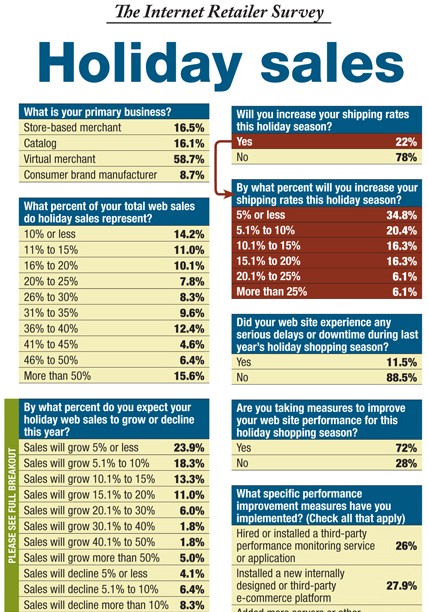
Even in the midst of economic chaos, 81% of retailers believe their online sales will grow this holiday season By Bill Siwicki
With the economy teetering on the brink and consumers frazzled by the sinking stock market and manic efforts of elected officials, the big question in retail today is: Will holiday sales this season be HO-HO-HO or HO-OH-NO? It depends on the sales channel, retailers, research firms and analysts say. Sales have been down this year, in some cases significantly, in bricks-and-mortar stores. However, online sales continue to grow—though not at the rapid pace of years past.
Even amid economic turmoil, 81.1% of retailers believe their holiday web sales will grow to some degree this season, according to the latest Internet Retailer survey. This is good news—for the most part, some analysts say.
“It is encouraging to see four out of five expect to grow web sales in the face of such a poor economy,” says Jim Okamura, senior partner at retail consulting firm J.C. Williams Group Ltd. “However, that one-in-five figure is higher than I’ve seen in a long time, especially in the face of continuing online sales growth where the focus being paid to the online channel has never been higher.” Continue Reading at Internet Retailer.com
Received an email from Forrester Research and found it interesting enough to share. I'm sure they don't mind since they invited me to share/email this with anyone, so I am. This particular report aims to provide insight from eBiz-execs seeking to grow their eBiz.
If you'd like further information on how to subscribe to First Look Quarterly's you may click here. If you'd l ike to participate in their eBusiness Panel, you can sign up here. Here's the email:
Welcome to the new First Look designed specially for eBusiness & Channel Strategy professionals!
Whatever your politics, you can't envy Barack Obama. He's just walked into the biggest economic disaster in American history. Housing prices are plummeting, businesses are unable to raise capital, unemployment is rising, the stock market hasn't displayed signs of a bottom yet, and consumer confidence is at the lowest level since the University of Michigan even started to measure the metric. There's a guy out there who calls himself Dr. Doom who thinks that it could take decades to recover. It's enough to make just about anyone want to crawl into a hole and hibernate until there's better news.
Anyone, that is, but an eBusiness manager. Because if there is a silver lining in this cloud, it is that the online sector of nearly every consumer-facing business continues to experience growth and garner executive attention. From a Forrester survey of eBusiness executives, we know that the key reasons why an online business exists are to acquire new customers, reduce the current cost of servicing customers, and retain existing customers. The impact of the Web channel is clear and quantifiable, and that should leave you in pretty good shape.
A continued slump in consumer confidence. With all the bad news out there, how can customers or businesses possibly be anything but uncertain about the future? Your Web site is in a unique position to address this challenge.
Demand for value. If "trading up" was the catchphrase of the last decade, you can bet money that "trading down" will be an imperative for indebted, cash-flow-negative consumers to get the most out from the limited resources they do have. Is it any wonder that Wal-Mart, whose mantra is "Everyday low prices," is one of the only stores to experience positive comp store sales in recent months?
High customer acquisition costs. As consumers and businesses are tighter with their wallets, marketing spend is less likely to yield much bang for the buck. That means focusing on your customers who know you, love you (or at least tolerate you), and are likely to spend more with you. In other words, this means more need to focus on customer retention.
So what to do? eBusiness managers should be doing several things to address these changes. In the short term, we suggest three strategies.
Addressing customer confidence issues in your digital contact points. If your business is in good shape, don't be afraid to trumpet it -- on your home page, on log-in pages, in your emails. We received an email from Citizens Bank recently that said just that: The times are uncertain, but your deposits are not. What a comforting message during turbulent times that many eBusiness executives ignore. In fact, one in five US online travelers avoids destinations because a Web site's content doesn't make them feel comfortable; 26% cite the same problem with hotel Web sites.
Boosting customer care. There may be places to cut funds, but if you are in an industry where consumers are skittish, make sure that you have human help on hand to answer questions and allay concerns. When consumers want customer service, they are most likely to either go to a store or call a service rep. Interactive chat and click-to-call show promise, especially for online banking sites. In a recent survey, we found that while 85% of researchers who contacted a firm during the research process used the phone, just 43% found that method helpful. By contrast, just 47% used click-to-call, but satisfaction rates were significantly higher at 61%
Perfecting retention marketing strategies. The king of all digital retention tactics is email marketing, and it's time to make sure you're not just batching and blasting your entire customer base with irrelevant messages. Segment your best customers, and create useful content that will engage them and give them a reason to interact with you even when their liquidity is low.
That's just the tip of the iceberg. We have many documents that we've published recently and have on our docket in the coming weeks to advise various eBusiness groups on weathering the economic storm. The good news is that if you're reading this, you'll likely be one of the players that not only emerges from this downturn intact, but stronger and better than before.
If You've got a Circuit City Gift Card, Use it Now!
Circuit City tried to reassure shoppers that it would be business as usual despite its Chapter 11 bankruptcy filing.
They've asked a bankruptcy court to let it honor gift cards. That's simply rhetoric to reassure gift card holders. In reality, the gift cards are about to "short-circuit" both in the context of their future as an acceptable electronic payment and the time they'll be around.
The purpose of bankruptcy is to "restructure" but having heard rhetoric following the Pay By Touch "bankruptcy" filing and imminent "restructuring," I'd advise consumers to take into account the fact that Circuit City is a retailer in serious financial trouble. That will affect their gift cards. Sorry...I'd love to paint a rosier picture, but a "Sharper Image" comes to mind instead. (To refresh your memory, their gift card holders lost everything)
So if you have a Circuit City gift card use it immediately. In fact, I'd advise that you do that across the board with any retailer where you have a prepaid gift card.
In this environment, I've got 3 words for you..."use it now". In the past, people have shown a tendency to hold on to the gift cards for a couple of months. I'm not a big believer in gift cards, they're the opposite of a layaway program...you're basically "loaning" money to the retailer and getting nothing in return.
But if you must get one, and not many are considering it this holiday season (see previous post) instead of dolling out your hard earned cash for a store branded (closed loop) gift card, you should only "consider" purchasing a gift card that is Visa/MC/Discover/AMEX branded/backed, (open loopcards)
I wouldn't be the least bit surprised, if and when the Circuit City gift cards do indeed short-circuit, to see the gift card landscape vastly affected forever. They'll either be some new regulation introduced, someone will come up with an improved program or consumers will shy away, at least from...closed loop gift cards.
CHICAGO (Reuters) - Cash is king this holiday season as consumers try to limit their credit card purchases or have maxed out on credit altogether, according to a survey conducted for Reuters.
A total of 88.6 percent of those surveyed said they would use more cash for buying holiday gifts this year, while 59.7 percent said they will use credit cards less, according to the survey by America's Research Group.
Only 1.1 percent said they will use credit cards more.
These stark differences could be partly due to consumers feeling more credit pressures as the economy weakens and banks become less willing to extend credit, said Britt Beemer, chairman of consumer tracking firm America's Research Group.
But another, even larger reason could be that many consumers -- 43.2 percent -- will give gift cards less often this year because they are worried that those cards would be worthless if a retailer files for bankruptcy.
Consumers who shy away from gift cards may just give cash instead, he said.
"If the only store I know of (that) is going to be around for sure is Wal-Mart, and I don't want to give a girlfriend a Wal-Mart gift card, cash is a lot more sexy," Beemer said.
The 2008 holiday season is shaping up to be challenging, at the very least, for retailers. The National Retail Federation has forecast the lowest increase in spending by consumers in at least six years.
Adding to the pressure for traditional retailers is the fact that bankrupt retailers like Circuit City are liquidating inventory at stores they are closing. One-third of survey respondents said they will go to liquidation sales in place of their normal retailers this Christmas.
Consumers are also trying to spread the pain across several paychecks, with 65 percent saying they plan to buy a few gifts each week and 31 percent saying they started shopping early so they would not have a big bill in one month.
One positive for retailers? The move to give cash instead of gift cards could lift sales during the holiday season, Beemer said. "If somebody has cash, they spend it immediately," he said. "If somebody has a gift card, it rolls on to next Memorial Day or July 4 weekend."
Another positive factor could be lower gasoline prices, with 35.4 percent of respondents saying that lower gas prices will encourage them to spend more.
The survey consisted of 1,000 interviews conducted November 6-8 and has an error factor of plus or minus 3.8 percent.
Facebook users are being warned to watch out for Nigerian scammers masquerading as friends on the social networking site, after an Australian woman was sent a message asking for money from a conman who had hacked into her friend's account.
Google employee Karina Wells (pictured on left) told the Sydney Morning Herald (SMH) she was sent a message from a friend's account which claimed he was stranded in Lagos, Nigeria, and asked her to send A$500 for a plane ticket. She became suspicious when he used the term "cell" vs. her friend's normal use of the word "mobile" and turned the tables on the scammer.
Facebook has been infiltrated by Nigerian scammers and other cyber criminals who use compromised accounts to con users out of cash.
Now that even non-tech savvy internet users know not to respond to, or click on links in, emails from strangers, online thieves have turned to social networks and are finding it is easier to trick people when posing as their friends.
On Friday, Sydney-sider Karina Wells received a Facebook message from one of her friends, Adrian, saying he was stranded in Lagos, Nigeria, and needed her to lend him $500 for a ticket home.
Adrian used relatively good English but, after chatting further, words such as "cell" instead of "mobile phone" tipped Wells off that she was not talking to her friend but someone who had taken over his account.
Using sites such as Facebook allows scammers to research and target victims more effectively and avoid having their messages blocked by spam filters, said Paul Ducklin, head of technology at Sophos Asia Pacific. It is likely the scammer obtained Adrian's Facebook login details after he was infected with a virus delivered by email or in an infected web page.
There are a number of viruses which, once installed on a computer, send back to the hacker a detailed log of everything entered using the keyboard, including online banking details and passwords for services such as Facebook.
Wells played along with the scammer, who asked her to transfer the money into a Western Union account. "Naturally I was concerned as, to all intents and purposes, this seemed to be legitimate," she said. "I pretended that I would help, obtained all the details of where he was and forwarded them to both Facebook and the relevant authorities."
But while the Nigerian scammer used the compromised Facebook account coupled with social engineering tactics to try to convince Wells to hand over money, many are using compromised accounts to spread malware.
Typically, the victim receives a Facebook message from a friend with a subject such as "LOL. You've been catched on hidden cam, yo" or "Nice dancing! Shouldn't you be ashamed?" The body of the message contains a video clip link that appears to go to a legitimate site such as Facebook or YouTube but, when clicked on, it takes the user to a bogus web page. Before the users can play the video they are told they need to download a video player upgrade, which is in fact a password-stealing virus. The next time the victim logs into Facebook the malware-laden message is sent to all of their friends and the infected link is automatically added in comments on friends' pages.
Other less sophisticated attacks on Facebook members use spam emails, some appearing to come from Facebook itself, to spread viruses.
In September security firm WebSense reported on spam emails, purportedly sent from an @facebookmail.com address, that tell the victim they have received an invitation from Facebook to add a friend. "The spammers included a zip attachment that purports to contain a picture in order to entice the recipient to double-click on it. The attached file is actually a Trojan horse," WebSense said.
70% of online shoppers to cut spending during holiday season according to PayPal
Study shows that throughout the holiday season, 70 percent of US online shoppers have expressed their intention to cut back on their spending.
In order to achieve that, they are to buy fewer and less expensive gifts, spend less on parties and decorations, as well as give up traveling plans. As far as promotions are concerned, holiday shoppers feel most attracted by free shipping when buying gifts online.
Over 80 percent are to make online purchases to benefit from free shipping, cash back and other promotions.
The study, which was commissioned by PayPal, also indicates a preference for ecologically-friendly products among online shoppers when it comes to buying gifts. Thus, almost a quarter of online shoppers have stated that they intend to purchase gift cards or green gifts including organic foods, eco-conscious clothing and recycled house wares.
College graduates feel most inclined to receive alternative gifts. 28 percent have expressed their preference for green items, 25 percent for electronic gift cards and 20 percent for donations to charity on their behalf. 73 percent of online shoppers have made plans to give to charity this season, over 60 percent in 2007. The study also indicates that one third of online buyers use PayPal when buying online and one in five buyers have made plans to do more online shopping in 2008 than they did in 2007.
PayPal's 2008 Holiday Survey was conducted by Ipsos.
Visa Sets Global PCI DSS Deadlines Data Security Compliance Requirements Aligned Across Visa Regions
San Francisco, CA, November 10, 2008
Visa Inc. (NYSE: V) today announced global mandates for compliance with the Payment Card Industry Data Security Standard (PCI DSS), creating a consistent framework for compliance among merchants, service providers and their agents.
The enhancements include a global set of requirements for merchants to validate their compliance with PCI DSS; and for the largest merchants, dates by which they must achieve validation. Deadlines are also set for large and mid-level merchants to demonstrate that they are not storing certain types of sensitive card data. Service provider levels and PCI DSS validation requirements have likewise been aligned under a global standard and compliance timeline. Compliance with PCI DSS will help protect businesses from financial and reputational harm that often results from cardholder data compromises. Visa data security compliance programs have provided compelling incentives for merchants and agents to properly secure cardholder data.
The new framework establishes the minimum requirements for Visa Inc. regions. As an independent company and licensee of Visa International for the business operations in European markets, Visa Europe's PCI DSS framework requires compliance validation and risk mitigation for Level 1 merchants; however the region will be adhering to a different timeline and process for executing compliance validation.
"Compliance with PCI DSS is vital to ensuring the integrity of the global payments system," said Eduardo Perez, head of global data security, Visa Inc. "Aligning compliance programs across the Visa regions is the latest step in our commitment to safeguarding cardholder data." To read the entire Press Release, click here
The Federal Reserve said it rushed approval of American Express' application to convert to a bank holding company because of "emergency conditions" and the financial markets' "unusual and exigent circumstances."
According to the Fed, AmexCo had $127bn in total assets but retail deposits of just $7.2bn – another sign that the financial crisis is
prompting regulators to accept bank holding applications from companies with little retail banking presence.
Bank holding companies get access to low-cost Fed lending facilities but have to submit to the stricter regulation and capital requirements demanded by the regulators.
American Express had already operated a commercial bank and a savings bank supervised by federal regulators. But the bulk of its assets were not in those institutions. As a bank holding company, these assets are now under federal supervision, a move that expands the amount of financing it can request from the government. That means the bank could qualify for up to $3.6 billion of the Treasury Department’s money, instead of just a small portion.
“Given the continued volatility in the financial markets, we want to be best positioned to take advantage of the various programs the federal government has introduced or may introduce,” said Kenneth I. Chenault, the chairman and chief executive of American Express. “We will continue to build a larger deposit base to broaden our funding sources.”
Skimming scam spreads from Calgary Calgary Herald Published: Tuesday, November 11, 2008
The same debit card skimming scam discovered in Calgary two months ago has turned up in Airdrie and Red Deer, and police fear other areas have been targeted, too.
Police say they have video footage of a thief stealing a debit card pin pad just before an Airdrie retailer closed for the night on Sept. 11. After compromising the pad with wireless transmitter technology overnight, it was slipped back in the morning.
The pad functions normally but transmits all data to the criminal, police say.
Police say they suspect two other businesses have been targeted.
One pin pad was found after becoming inoperative and returned for service. The other was discovered only after more than 120 debit cards were cloned and used to extract money from the victims' accounts.
A compromised pin pad results in an average of $100,000 in loss, police say.
"It is believed that there is a possibility that additional retailers in southern Alberta have had their debit card pin pads compromised as well and are just not aware of this attack as yet," said RCMP spokesman Sgt. Patrick Webb.

 NEW YORK (AP) -- Average interest rates on most types of credit cards rose slightly this week, according to a report from CreditCards.com.


![Reblog this post [with Zemanta]](https://lh3.googleusercontent.com/blogger_img_proxy/AEn0k_sjmwF8247QHpa4T4EXms7M5q86HyGb0GuDYj2Lg3tpR0ZHjFI6QjXH-gOtIVYrkTh2v95aHtQjec8IMD8ZR1Xi1TZYvNsbeP23Szx0odKKxWuABJtU2pXEY2ay0yiQVJ0ukYIdb17yJpDxLHOCd_fg=s0-d)
 Citi Firing 60,000, Chairman May Still Lose Job
![Reblog this post [with Zemanta]](https://lh3.googleusercontent.com/blogger_img_proxy/AEn0k_s1h5_jAPuaGOY9HlBzfETWsXZih1msGDBwSDN53uZsg-luTRAy5NF-x_PUybugohmXkN7L4i5yQQjtyM0BjxMkubZYKwZu_LoEf51CVrfiBeVGWg2k7lgoLBEPW0niZGtScn3pUJAaxRUn5C2cwTO-=s0-d)

![Reblog this post [with Zemanta]](https://lh3.googleusercontent.com/blogger_img_proxy/AEn0k_t7ge8KfbaPPC2GbQtz-U3I1skcKVzF4cv7VyrtRvUAYA6TqulZpkn41xy5_T6uxcUCmjPTPJ4ywsSpqHR-KrU5dyDqOLd5M0nMEIGMC-ir8i3OPSy1WMwZfVSxjBwFKAckSBGesY9v_aIr6iWzXYJv=s0-d)
 Chase Paymentech Announces Gift Card Study Results
 Just as impressive, the data also shows that most adults (55 percent) plan to buy the same number of cards as they did last year, and 21 percent plan to buy more. Similar estimates show shoppers plan to load either the same amount (55 percent) or more (21 percent) funds on those cards. All things considered, the study suggests retailers with gift cards to be well positioned during what is anticipated to be a slow holiday season.
![Reblog this post [with Zemanta]](https://lh3.googleusercontent.com/blogger_img_proxy/AEn0k_vPrfRGJ-HtV1I1A5nlr1E-pYgARJ1H9ne01-mtSKjuKl0Uw1Nd_kScyAsJKkVDvSE-eomdIHRoYUaPkTAhfhfnFn2cl5cOy-d3017Fceht50D_bS7HSdGvOVOD__y0DFKsYRiAVzcWrxCX__xmXoE=s0-d)
 WASHINGTON – Federal bank regulators have rejected a request by banks and consumer advocates for a program to let lenders forgive huge portions of credit card debt.
![Reblog this post [with Zemanta]](https://lh3.googleusercontent.com/blogger_img_proxy/AEn0k_ua0hjEOymBz8vockcFNy-scCffQEhUr1yBCtxbgwW9aBrp6fF4bug8dFofLOSrmoF_3REJIu16-021O2PelaF8yu6VLUNqel_CFipcsGiT5c-_B-Dl814Qb44wKTdo5JrFDTHcp4kqDmXfbOk-mrYZ=s0-d)
 Editor's Note: Why is Barney Frank (no relation l'm proud to say :) against this? AML (Anti-Money Laundering) was designed in large part to prevent the funding of terrorist organizations. I thought this law had passed in 2006, apparently they're tightening it up with this final rule.
 ![Reblog this post [with Zemanta]](https://lh3.googleusercontent.com/blogger_img_proxy/AEn0k_vFiBSXDgvx78CyE4jI6UWmbFv5AE4RnOGOrZ9fVgbrN0egA0fSdK0OE4eDc6biF1bkCoBvz8H18xviRBhbfCfz48Vr2O6lvviKDmJGSBAFx5PqaPBtA4VW1zPnAh1cTkFggzUXQr7LQ_LuzH-I0_GT=s0-d)
 Instant issuance card provider Dynamic Card Solutions (DCS) reports that it is experiencing increasing demands from financial institutions for its instant issuance unembossed 'flat' cards.
![Reblog this post [with Zemanta]](https://lh3.googleusercontent.com/blogger_img_proxy/AEn0k_vSLDuSGExgO3udYiSCoGsA_QfbyGb1q_oCBQc1XKf5xstHMujZfkol75izoCn9UpkZUUvS2YHO5T22tI6G-FoOGewxWw_X426wW2DXcvseYwM6LmXdKwkB-amwestykbvg6EJgm1NCW5wT0ku2Bhs=s0-d)


![Reblog this post [with Zemanta]](https://lh3.googleusercontent.com/blogger_img_proxy/AEn0k_t9eJHLXHoFM0IooOU8dKWfZUj8dhiEFGVBPOLrlgFWeAyPI6C_2hFOzz7BRvmOZAk9cRUk4qfyesJrpfAZr2WE65RPr7-_EJU_ZaUR3Whi-QqrmxQPTDvPKTcFvytuq1AFknCZVASB85Im9Q8NUSkg=s0-d)
 Want a Crash Course in Understanding
 ![Reblog this post [with Zemanta]](https://lh3.googleusercontent.com/blogger_img_proxy/AEn0k_sJOeNCEpJp5sKuB6BiDP124j-pdab9JrqItvpwRec8q6JFHXnP4_sq064oXKelRLPKKUrcgiqLyGPUa6ICM44LrUYTqLrMgTQl-ffoVvWMxEYcmBfaHuIJuRnLz9p3G7mIvFn0AZLupHZxrH9fp9Hy=s0-d)
![Reblog this post [with Zemanta]](https://lh3.googleusercontent.com/blogger_img_proxy/AEn0k_viaqvMJH0X4l3xQofZVoKp0fo0YhYU7iqeRuHYHSryUeH35-sZZ5YN2j87FBfynFJ1TIV4tafm6F4W_ea8E6DImWouUzfddycUHfVJ7uyCexH3r4bj42FNlqT2d2J4tPpxzx2PjC4rmZAx3uwyBLOa=s0-d)

 In fact,
 ![Reblog this post [with Zemanta]](https://lh3.googleusercontent.com/blogger_img_proxy/AEn0k_uky50386HPM-9zm872ea-sjRu3S2BrBdGFo_95zavvfFjF3NztEx6fNy-IEo4PYQmoVatxkwgRcanwDQXEpREkGQtsncPX9zVbdAoVlb5RYzIOLOiJuj2AwO5_L-2Rx24pw0ULVioPCASNaSigPQmi=s0-d)

![Reblog this post [with Zemanta]](https://lh3.googleusercontent.com/blogger_img_proxy/AEn0k_seSW3FkyBRTRedCl7WOmVBMoK5yz0CrYD6mfq31WuN33UPhGhmrQ1D7fQyT--zUsSK3wdWsDcCUv7aLEyiGoBEa6aHxV9U6dLP-YJtWJk0GVPY3ynAw48ZKD8JqxJVXCzS6BmF47QJlnrsRsw0R-Up=s0-d)
 CHICAGO (Reuters) - Cash is king this holiday season as consumers try to limit their credit card purchases or have maxed out on credit altogether, according to a survey conducted for Reuters.
![Reblog this post [with Zemanta]](https://lh3.googleusercontent.com/blogger_img_proxy/AEn0k_uKlFDyAePBT_rU1SQMCI0fZxeYlAsWrnMKW2DNO4o9PAQEmO3C5RUymI8qhirfNw8bZsiXWeYLJgOCMRFud3nxd9FewHp3K67YtD-ureaD2wjDNTNZ9iK4iEIt_OLReDl1HdOwAYZkiAHa0EZAt27d=s0-d)

![Reblog this post [with Zemanta]](https://lh3.googleusercontent.com/blogger_img_proxy/AEn0k_ssDRnWN_jWTB0Q-E_-SM0PDtb6lwq-S6H7gajQyjjSQ2AEojbBeXQ-nBkSS3JYCo6z9PH6trmuiUq_qHrw8mCA3t5twB-Zhc5eArJVFY3OkPPvIZOm7vQ_8wWYWjOqta7O0IKwCUuWupgJIHqiGWnw=s0-d)

![Reblog this post [with Zemanta]](https://lh3.googleusercontent.com/blogger_img_proxy/AEn0k_txuZfgjtSRAohQFKn0c3TQezVKrJ5kwExMas4cV1VfBng7_qwB6L_I6v4MP3kYdSETQh9NPoqClyJGYppsphu-Tud8eOavfwToI5ymXOdvvDFrMQxTBA8L5fPq8SMKvNMczQ37VSsFccX_t2WU476h=s0-d)

![Reblog this post [with Zemanta]](https://lh3.googleusercontent.com/blogger_img_proxy/AEn0k_vrSxHP8e0-FsLmzADY9favxHh7Sqzri6QzKDfU2gqnfWxKTlMquQtuPi6bJLM2kUpwtJtzgXx-mMSnJg54e3wQ5NdlY8jdusIPvA8xCSaSbVd5rsFh_rYsgdH6bfpyqgI4uEGRug_jeQqoW8CRZM1A=s0-d)
 11/11/2008
![Reblog this post [with Zemanta]](https://lh3.googleusercontent.com/blogger_img_proxy/AEn0k_uBH6a9RkpV5xb6zgq54hKQunZT78n07hmPzJ6vLVuPPqeYnQOz9FSTw2LWBsivpWVRMa3TpJ-uGpCrfHomsHKaouhV7GbixPwmULHq3737OgSecXZsucI-sxAAokkSDgc7O5-wN4aAQytrKgTcXib6=s0-d)
 Skimming scam spreads from Calgary
![Reblog this post [with Zemanta]](https://lh3.googleusercontent.com/blogger_img_proxy/AEn0k_siM87sl4wvkWBkIw1Jw5zfGv5U93Y-YT4TTgjKZam97Z7rqJM3zl4LUcjk2-B-GfIy0rf2NNbK4NsaVSiStlfNx7RKD_EkhNcDcmO3Wjqa5wSyI3MWYvOjp5iZrH40vq900_9qih7L4Geo_Q2aembu=s0-d)
