Monday, January 24, 2011

Mung-Ki Woo to Lead Global Mobile Team at MasterCard Worldwide

Industry Veteran Joins Leadership Team to Focus on Strategic Priority

PURCHASE, N.Y--(BUSINESS WIRE)--MasterCard Worldwide today announced that Mung-Ki Woo is joining the company as Group Executive, Mobile, effective January 24, 2011. Woo will have global responsibility for innovation, commercialization and development of go-to-market strategies to support mobile payments around the world.
“Mobile is a critically important strategic initiative for MasterCard and we are excited to have Mung-Ki join our team as we continue to deliver innovative mobile solutions to the global marketplace”
“Mobile is a critically important strategic initiative for MasterCard and we are excited to have Mung-Ki join our team as we continue to deliver innovative mobile solutions to the global marketplace,” said Ed McLaughlin, Chief Emerging Payments Officer, MasterCard Worldwide. “Consumers are quickly growing more comfortable with using their mobile devices for search, shopping and payments. With extensive knowledge of the telecommunications landscape, Mung-Ki will enhance our global perspective and lead MasterCard’s future growth in mobile commerce.”
Most recently, Woo was Vice President of Electronic Payments & Transactions at the France Telecom - Orange Group, where he led the development of the “Orange Money” mobile payment program, which at the end of 2010 was commercially available in several African countries. He was also responsible for commercial deployment of Orange’s mobile contactless services in their major European markets. Previously, he was Chief Technical Officer of a French interbank organization specialized in electronic money systems.
Woo is a graduate of Ecole Polytechnique and Ecole Nationale Supérieure des Télécommunications. He will be headquartered in Purchase, New York.
About MasterCard Worldwide
As a leading global payments company, MasterCard Worldwide prides itself on being at the heart of commerce, helping to make life easier and more efficient for everyone, everywhere. MasterCard serves as a franchisor, processor and advisor to the payments industry, and makes commerce happen by providing a critical economic link among financial institutions, governments, businesses, merchants, and cardholders worldwide. In 2009, $2.5 trillion in gross dollar volume was generated on its products by consumers around the world. Powered by the MasterCard Worldwide Network — the fastest payment processing network in the world — MasterCard processes over 22 billion transactions each year, has the capacity to handle 140 million transactions per hour, with an average network response time of 140 milliseconds and with 99.99 percent reliability. MasterCard advances global commerce through its family of brands, including MasterCard®, Maestro®, and Cirrus®; its suite of core products such as credit, debit, and prepaid; and its innovative platforms and functionalities, such as MasterCard PayPass™ and MasterCard inControl™. MasterCard serves consumers, governments, and businesses in more than 210 countries and territories. For more information, please visit us at www.mastercard.com. Follow us on Twitter: @mastercardnews.

Contacts

MasterCard Worldwide
Media Relations
Erica Harvill, 914-249-6848
Erica_harvill@mastercard.com
Investor Relations
Barbara Gasper, 914-249-4565
Barbara_gasper@mastercard.com
Permalink: http://www.businesswire.com/news/home/20110124005523/en/Mung-Ki-Woo-Lead-Global-Mobile-Team-MasterCard


www.ePINDebit.com www.e-PINDebit.com www.iPINDebit.com www.PINDebit.mobi
Enhanced by Zemanta

Cybercriminals Switching Focus to Smartphones and Tablets, Away from PC's

Cisco report notes new cybercrime targets
(from Network World on 1- 24-2011)
Cybercriminals are shifting their focus to smartphones and tablets, and away from Windows-based PCs, as targets for their scams, according to a new security report from Cisco released this week. Scammers are finding it harder to infiltrate Windows-based PCs, which they have targeted for the past decade, because vendors have bolstered security on those platforms and been more aggressive in general in patching vulnerabilities. This has driven cybercriminals to other platforms, specifically mob... read more»


Key Highlights

  • Spam: 2010 marks the first year of declining spam volume in the history of the Internet. Despite this good news, 2010 saw an uptick in spam in developed economies where broadband connections are spreading, including France, Germany and the United Kingdom. In the United Kingdom, for example, spam volume rose almost 99 percent from 2009 to 2010. The good news is that Brazil, China and Turkey — all of which figured high on last year's list of spammed nations — showed significantly lower volumes in 2010. In particular, Turkey's spam volume dropped 87 percent. This reduction is due in part to the high-profile takedowns of botnets like Waledac and Pushdo/Cutwail, attributed largely to researcher Thorsten Holz (see the Cisco Cybercrime Showcase) and ISPs restricting malicious e-mail from broadband networks. In addition, authorities are taking the spam problem more seriously and are looking to take down egregious offenders.
  • Money Muling: As the cybercriminal economy expands and criminals gain access to even more financial credentials, there is a growing need for money mules — people recruited to set up bank accounts, or even use their own bank accounts, to help scammers "cash out" or launder money. Money muling operations are becoming more elaborate and international in scope, and Cisco security experts anticipate they will be a major focus of cybercriminal investment in 2011.
  • Trust Exploitation: Most cybercrime exploits hinge not only on technology but also on the all-too-human tendency to misplace trust. The Cisco Annual Security Report lists seven "deadly weaknesses" that cybercriminals exploit through social engineering scams — whether in the form of e-mails, social networking chats or phone calls. The seven weaknesses are sex appeal, greed, vanity, trust, sloth, compassion and urgency.
  • Cisco Global ARMS Race Index: Cisco's Global Adversary Resource Market Share (ARMS) Race Index was designed to track the overall level of compromised resources worldwide and, over time, to provide a better picture of the online criminal community's rate of success at compromising enterprise and individual users. According to data collected for the 10-point index, the level of resources under adversarial control worldwide at the end of 2010 was down almost a half a point from the December 2009 level of 7.2 reported in the Cisco 2009 Annual Security Report.
  • The 2010 Cisco Cybercrime Showcase: The second annual Cisco Cybercrime Showcase presents two awards for 2010 — one acknowledging the outstanding contributions of a security professional in the fight against cybercrime (the "Good," Thorsten Holz, Ruhr-University Bochum, Germany/LastLine), the other the most threatening malware (the "Evil," Stuxnet).
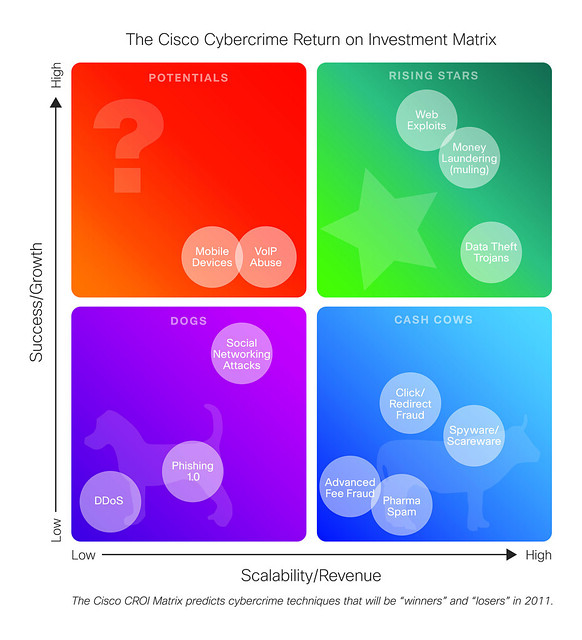
  • Cisco Cybercrime Return on Investment (CROI) Matrix: The Cisco CROI Matrix, which made its debut in the Cisco 2009 Annual Security Report, analyzes types of cybercrime that Cisco's security experts predict profit-oriented scammers will channel their resources toward in 2011. Based on performance in 2010, the matrix predicts that the data-theft Trojans such as Zeus, easy-to-deploy Web exploits, and money mules will continue to rise in prevalence in 2011. The "wait and see" moneymakers include mobile malware, with Zeus already being adapted for the mobile platform in the form of SymbOS/Zitmo.Altr ("Zitmo" stands for "Zeus in the Mobile"). Social networking scams, on the other hand, will not be a significant area for cybercriminals to invest resources in 2011, despite ranking in last year's report in the Potentials category. That does not mean that social networking scams are declining; they are simply a small part of a bigger plan — launching Web exploits like the Zeus Trojan.
www.ePINDebit.com www.e-PINDebit.com www.iPINDebit.com www.PINDebit.mobi
Enhanced by Zemanta

Online Spending hits $58.8 Billion in 2010

Online spending hits 58.8bn in 2010
(from ComputerWeekly on 1-24-2011)
Internet sales hit a record 58.8bn in 2010, an increase of 18% on the previous year - outstripping analysts' forecasts of a 13% growth rate. December also saw record sales growth of 25% compared to the same month in 2009, reaching a total spend 6.8bn, according to the IMRG and Capgemini online shopping index. The results follow warnings from analysts that the snow had an impact on sales for the sector, with delivery problems affecting consumer confidence.... read more»


IMRG Capgemini e-Retail Sales Index: January 2011


Cold snap rounds off an impressive 2010 with a record high
• £6.8 billion spent online during December: equates to a 7% monthly increase and an increase of 25% year-on-year
• £58.8 billion spent online in 2010; 18% increase on previous year
• Clothing and alcohol retailers see strongest growth
• Forecast for 2011: 18% growth and approx £69 billion in total e-retail sales
21st January 2011:  The latest figures from the IMRG Capgemini e-Retail Sales Index reveal that shoppers in the UK spent a total of £6.8 billion online during December, equivalent to £111  per person. Sales were up by 7% on November and by 25% on December 2009, with the Index value reaching a record high.
The results round off what has been an impressive year for online retail. A total of £58.8 billion was spent online in 2010, which resulted in the Index increasing by 18%, far outstripping the original prediction of 13%. For 2011, IMRG and Capgemini have predicted the Index will see a further 18% growth, with total e-retail sales estimated to be worth £69 billion.
The December figures showed that despite the dire predictions during the run up to the festive season, online retailers had a very successful Christmas, resulting in an above average year-on-year growth in nearly all sectors. This impressive growth can be attributed to two major factors, the impending increase in VAT and of course the coldest recorded December in the UK for 100 years .
It seems that as the snow fell, shoppers across the country opted to buy online, instead of battling the elements to the high-street. This trend had a positive impact for all online traders, including those with a multi-channel proposition; House of Fraser reported 120% growth in online sales compared to the same period the year before. Similarly, John Lewis and Marks & Spencer reported exceptionally strong results.
In terms of specific sectors, the harsh conditions had an inevitable impact in sales for clothing, footwear and accessories. As the country looked to wrap itself up in winter coats and chunky scarves, the sector saw a year-on-year increase of 40%: the strongest growth for this sector for 19 months. Clothing retailers also experienced a massive 50% leap in conversion rate, suggesting consumers are not just surfing the net to window shop, but researching the best price and placing an order.

Another noteworthy sector is alcohol, which, in keeping with the festive and party season, saw the largest growth, boasting a massive month-on-month leap of 32%. What’s a little less expected is the year-on-year growth as the sector saw a significant 36% increase from December 2009.
Chris Webster, head of retail consulting and technology at Capgemini says: “Online sales in December have grown again off the back of a very impressive November. This is down to two main reasons. Firstly, the spike in sales can be attributed to the season; not only is it traditionally the strongest month for retail but coupled with the heavy snow fall clearly led to many consumers staying at home to do their Christmas shopping. Secondly, the ongoing trend of consumers putting down the car keys and turning on their computers is only set to continue particularly as consumers use the power of the web to make their money go further as the economy recovery remains fragile.”
James Roper, Chief Executive at IMRG, commented: “December saw an incredible jump in online sales as a result of the weather conditions and it’s reassuring to see that despite the coverage of delivery problems, consumer confidence was not affected. Growing confidence and reliance on e-retail during times of adversity, whether that’s harsh weather conditions or belt-tightening as a result of the economy, has been reflected in the impressive growth throughout 2010.”
% Change Nov 10 – Dec 10
% Change Dec 09 – Dec 10
Beers, Wines and Spirits
32%
36%
Clothing, Footwear and Accessories
8%
40%
 - Accessories
22%
59%
 - Footwear
12%
44%
Electricals
13%
8%
Gifts
20%
22%
Health and Beauty
14%
19%


Industry quotes
Jonathon Brown, head of online selling at John Lewis, said: "We've had an outstanding Christmas and Clearance period in 2010, and there's no doubt johnlewis.com was a vital part of that success. Online sales for the five weeks to 1st January 2011 were 42% up on last year, and it was particularly pleasing to have achieved several trading records. We have also now passed the £500m mark for online sales for the year.
"The hard work our team put in over the year to develop the website really paid off, especially when snow affected trade at many of our branches. The increase in online sales, especially during the adverse weather in early December, demonstrated just how important the website has become to our customers."

Francesca Krajewski, Head of Communications at Naked Wines, comments: “We had a strong festive period at Naked Wines, with sales up 100% on last year -  and over 35,000 cases shipped in the first three weeks of December alone. 99.4% of all orders were delivered when promised, thanks to a sterling job by Parcelforce our carrier.

"Since launch, we’ve seen a 100% growth year-on-year with sales of over £15 million. To make our mark , we knew we had to offer both consumers and producers a game-changing model – and by inviting UK wine drinkers to invest in their wines before they’ve been made, we’ve attracted over 100,000 customers in our first two years of trading. The website, which is hybrid of social network and wine merchant, also offers customers and winemakers a platform to interact and shape the direction of the business - and with a £10 million investment pot to invest in new winemakers, we’re forecasting strong growth and an exciting year ahead.”

Phillip Rinn, Director of Advertising Partnerships for eBay Advertising in the UK and Ireland, comments: “The latest IMRG Capgemini e-Retail Sales Index reflects that Christmas 2010 was a bumper festive period for online retailing in the UK.  That online shopping saw a 25% growth on December of the previous year, highlights the level to which UK consumers migrated to the virtual high street during the poor weather. Indeed, online clothing retailers saw a 40% year-on-year sales increase and perhaps more impressively, a 50% leap in conversion rates, illustrating that the internet is increasingly becoming the place where consumer browse, research and indeed buy items of clothing. As we progress through 2011, brand marketers should be aware of the potential to reap the benefits of advertising on e-commerce sites, which allow them to reach consumers who have high purchase intention at a time when the VAT hike and rising inflation are likely to squeeze consumer spending.” 

Mark Lewis, CEO of Collect+, comments: “The soaring volumes for Collect+ this Christmas reflect the true demand for flexibility and convenience in returns and deliveries. A combination of the snow and changing shopping habits meant that purchases were made later than ever this year, and we were pleased to be able to provide our retail partners with a new and effective way of keeping their delivery promises and maintaining a returns service in the face of bad weather.”
Bruce Fair, Managing Director at Kelkoo, comments: ‘’More than a third of British consumers admitted to buying items early to beat the January VAT increase which will have contributed to last month’s strong sales across the sector. This coupled with a natural peak in sales over the festive season and December’s adverse weather conditions saw online retailers reaping the rewards as more people than ever before bought their goods online. However, the retail industry is moving into a difficult period following the VAT increase - our research predicts that consumers are expected to reduce their annual spending by £324 this year – so online retailers need to ensure they’re offering the most competitive deals in the market to avoid seeing a sharp drop in consumer spending.”

Bjorn Kvarby, European Managing Director, Shopping.com, comments: “Technology, fashion and home improvements were key drivers making 2010 a bumper year for Shopping.com, seeing overall growth in December at an average 24% year-on-year. Despite the recession leading to conservative forecasts for 2010, consumers proved that although they may be watching the pennies, they are becoming cannier that ever, attracted to the money and time savings they find when shopping online.  Innovative product launches like the iPad have re-ignited consumer interest in the latest technology gadgets, with eBooks and Tablet PCs accelerating growth of our computer category at 50% year-on-year. Secondly, fashion leaped forward with average growth of 45% in December, year-on-year. Finally, with the uncertain property market, consumers turned to updating their homes themselves, with building supplies and home furnishing achieving average growth of 43% year-on-year. The momentum behind online shopping means we’re remaining quietly confident for 2011.
Notes to Editors
About IMRG
IMRG (Interactive Media In Retail Group) is the industry body for global e-retail. Formed in 1990, IMRG is setting and maintaining pragmatic and robust e-Retail Standards to enable fast-track industry growth, and facilitates its community of members with practical help, information, tools, guidance and networking. Consumers can be confident when dealing with IMRG Members because all have committed to operate using methods that are Honest, Decent, Legal, Truthful and Fair, and have undertaken to not bring the industry into disrepute. The strength of IMRG is the collective and co-operative power of its members.
About Capgemini
Capgemini, one of the world's foremost providers of consulting, technology and outsourcing services, enables its clients to transform and perform through technologies. Capgemini provides its clients with insights and capabilities that boost their freedom to achieve superior results through a unique way of working, the Collaborative Business ExperienceTM. The Group relies on its global delivery model called Rightshore®, which aims to get the right balance of the best talent from multiple locations, working as one team to create and deliver the optimum solution for clients. Present in more than 30 countries, Capgemini reported 2009 global revenues of EUR 8.4 billion and employs 90,000 people worldwide.


www.ePINDebit.com www.e-PINDebit.com www.iPINDebit.com www.PINDebit.mobi
Enhanced by Zemanta

Saturday, January 22, 2011

Acculynk Brings PIN Debit to Mobile Phones

Eye on Mobile: Acculynk Brings PIN Debit to Mobile Phones
(from Digital Transactions on 1-22-2011)
Atlanta-based Acculynk Inc. said it will introduce in March a mobile version of its service that lets consumer make online payments with PIN-secured debit cards. The new service, initially available for Apple Inc.’s iPhone, will feature a version of the company’s virtual, scrambling PIN pad, which will display on smart phone screens to allow consumers to enter debit card PINs. Availability for phones using Google Inc.’s Android, BlackBerry, and Windows 7 operating systems will follow soon after the introduction.  Ashish Bahl, Acculynk’s chief executive, says the company began work on the mobile version of its PaySecure service in August and soon began talks with unnamed money-transfer networks that expressed an interest in a mobile PIN-debit capability. Bahl says the company has arrangements with several of these companies, though he is not yet ready to announce them. “The reason for doing the money-transfer option first is that it’s such a large and burgeoning market,” he notes.   Retail payments could follow, he says. In particular, the Durbin Amendment, by drastically cutting interchange costs on debit cards, has made the cost of processing small-value transactions more attractive, he says. “Durbin just expands our market dramatically,” he says.  Launched in 2009 as a means by which consumers could pay online merchants with PIN-secured debit cards, the PaySecure service has been adopted by nine electronic funds transfer networks. The company says it has been enabled on more than 1,000 merchant Web sites.... read more»


www.ePINDebit.com www.e-PINDebit.com www.iPINDebit.com www.PINDebit.mobi

How PaySecure Works
When a consumer uses their debit card at a participating merchant, PaySecure’s patented, graphical PIN-pad appears at the checkout for the option of PIN entry if the debit card can be used with a PIN and is in Acculynk’s network of issuers. Consumers enter their PIN using their mouse or hit Cancel on the PIN-pad to process as signature debit – preserving the choice they already get at the retail POS.
PaySecure Benefits
  • For consumers, PaySecure provides greater security for online purchases with a convenient payment method that requires no enrollment, new passwords or redirection from the merchant checkout.
  • For merchants, PaySecure reduces fraud and charge-backs, lowers transaction costs and can be implemented quickly.
  • For issuers, PaySecure is a competitive weapon to non-bank sponsored alternatives that helps keep more business “in bank” while providing attractive margins, incremental volume, lower fraud and brand extension to the merchant checkout.
Acculynk Partnerships
Acculynk partners with merchant acquirers and EFT networks, allowing merchants and issuers to quickly adopt PaySecure.
  • Merchant Acquirers: Acculynk leverages a merchant’s existing acquirer connections to process PaySecure transactions so that there is no change to a merchant’s settlement, reporting or back-end processes. As a result, merchant integration of PaySecure only requires adding code to the checkout, which can be completed in less than two weeks. Acculynk does not charge merchants any fees for PaySecure.
Current acquirers include Elavon and Merchant e-Solutions.
  • EFT Networks: Acculynk partners with EFT networks to process PaySecure transactions. Once an EFT network is connected with Acculynk, the PaySecure service is available to all eligible issuers that utilize that network.
PaySecure is available now to issuers that use ACCEL/ExchangeNYCE andPULSE as their EFT network. Alaska OptionCredit Union 24the Jeanie Network, NetWorksMasterCard and SHAZAM and will be adding PaySecure to their suite of product offerings in 2010 / 2011.
Contact us for additional information.

Friday, January 21, 2011

Barney Frank Wants to Revoke 12-Cent Cap on Debit-Card Fees

Representative Barney Frank, co-architect of t...Image via Wikipedia

Frank Set to Lead New Bipartisan Effort to Change Durbin Swipe Fee Amendment

(from Convenience Store News on 121-2011)
WASHINGTON, D.C. -- U.S. Representative Barney Frank, one of the authors of last year’s financial reform legislation, said he is ready to work with the Republican majority to force changes in a Federal Reserve proposal to cap debit-card swipe fees, reports Bloomberg News. According to the new swipe fee rules included in an amendment to the Dodd-Frank bill, the Fed proposed capping debit interchange fees charged to merchants at a flat 12 cents for each transaction, replacing a graduated fee that came out to about 1 percent of the transaction price. This authority was granted to the Fed by the so-called Durbin amendment, named after Senator Richard Durbin of Illinois. The Fed must finalize its rules on the cap by April 21 and in effect by July 21 to comply with the legislation. Credit-card interchange fees, which average about 2 percent, remain untouched...
read more»


RelatedFrank Says He'll Work to Revoke 12-Cent Cap on Debit-Card Fees 


www.ePINDebit.com www.e-PINDebit.com www.iPINDebit.com www.PINDebit.mobi
Enhanced by Zemanta

epay Partners with Florida’s Turnpike to Add More Than 2,000 New SunPass® Cash-Reloading Locations


LEAWOOD, Kan.--(BUSINESS WIRE)--epay, a division of Euronet Worldwide, Inc. (NASDAQ: EEFT) and a leading prepaid and payments processor in the U.S., along with Florida’s Turnpike Enterprise (FTE), today announced that SunPass customers can now reload their accounts using cash at more than 2,000 epay locations statewide. Customers can also check their SunPass account balance. SunPass is Florida’s electronic prepaid toll program, and is accepted on all toll roads and nearly all bridges in the Sunshine State.
“It is important that we provide as many places as we can for our customers to reload their SunPass accounts, especially as we get close to February, when we will implement all-electronic no cash tolling on the Turnpike Extension in Miami-Dade County.”
“Through our partnership with epay we have nearly tripled the number of SunPass cash replenishment locations from 1,161 to more than 3,100 locations statewide, including more than 450 locations in Miami-Dade,” said FTE Deputy Executive Director Jennifer Olson. “It is important that we provide as many places as we can for our customers to reload their SunPass accounts, especially as we get close to February, when we will implement all-electronic no cash tolling on the Turnpike Extension in Miami-Dade County.”
Reloading an existing SunPass account with epay is easy. Customers just give their SunPass transponder number to the cashier at any participating retailer, along with the amount of money they want to add to the SunPass account plus a $1.50 convenience fee per transaction. Customers then get back a receipt showing the amount added to the SunPass account. Checking SunPass account balances works the same way, except there is no convenience fee.
The new locations offering SunPass cash-reloading services include gas stations, convenience stores, check-cashing stores, wireless dealers, bodegas and more. The locations generally have on their door or window a green and yellow sign with the SunPass logo, clearly advertising to the customer the availability of the service. Customers can go to the SunPass website to find a reload location nearby. It is as simple as entering a ZIP code and choosing a preferred location. Customers can click on a location to view a map and get directions. Many new locations will be added in the near future, for added convenience.
FTE is working with its current vendors, including epay, to provide additional cash-based services to its SunPass customers in the coming months.
“epay is extremely pleased to be partnering with FTE to offer a simple payment method to SunPass cash customers through our innovative technology platform,” said Eric Mettemeyer, Managing Director of epay Americas/APAC. “When customers reload their SunPass account at an epay location, they also have access to other cash-based products, such as prepaid wireless top-ups, bill payments and Internet credits.”
In June 2010, Florida’s Turnpike Enterprise became the first toll agency in the U.S. to provide its customers a program to replenish their transponders with cash at retail locations. FTE is a leader in transportation and continually strives to provide its customers value in the form of safety, service and convenience.
About epay
epay, a Division of Euronet Worldwide, Inc. (NASDAQ: EEFT), is a global processor and distributor of electronic payment solutions – enabling service providers to maximize the sales of their products and services. epay delivers innovative and tailored electronic payment, cash collection solutions including POS systems integration, a full settlement and reporting service and full marketing and distribution service support.
The epay product portfolio includes prepaid mobile top-up, prepaid debit cards, e-wallets, bill payment, gift cards, digital music and other content, money transfer through its sister company RIA, lottery and transport payment solutions including road tolls and public transport.
epay delivers these products through a worldwide network of approximately 266,000 retailer locations and 541,000 points of sale (POS) across a number of markets including Australia, Austria, Brazil, France, Germany, India, Ireland, Italy, New Zealand, Poland, Romania, Spain, Switzerland, UK and the US. Visit www.epayworldwide.com for more information.
About Florida’s Turnpike Enterprise
Florida’s Turnpike Enterprise is part of the Florida Department of Transportation overseeing a 460-mile system of limited-access toll highways: THE FLORIDA’S TURNPIKE, EXTENDING NORTH FROM HOMESTEAD IN MIAMI-DADE COUNTY TO WILDWOOD IN SUMTER COUNTY, THE SEMINOLE EXPRESSWAY AND SOUTHERN CONNECTOR (TOLL 417) IN SEMINOLE, ORANGE AND Osceola COUNTIES, THE BEACHLINE EXPRESSWAY WEST (TOLL 528) IN ORANGE COUNTY, THE POLK PARKWAY (TOLL 570) IN POLK COUNTY, THE VETERANS EXPRESSWAY AND SUNCOAST PARKWAY IN HILLSBOROUGH, PASCO AND HERNANDO COUNTIES (TOLL 589), THE SAWGRASS EXPRESSWAY (TOLL 869) IN BROWARD COUNTY, AND THE Daniel Webster Western Beltway Part C (Toll 429) in Orange County. For information about Florida’s Turnpike, go to www.FloridasTurnpike.com.
About SunPass
SunPass is the Florida Department of Transportation's innovative prepaid toll program. SunPass can be used on Florida's toll roads and most toll bridges. SunPass customers typically pay 25 cents less than cash customers at most toll plazas and exits on Turnpike roads. For information about SunPass®, visit www.SunPass.com.

Contacts

epay
John Livers, 1-913-327-4123
Investor Relations
jlivers@eeft.com
or
Kim Kliethermes, 1-913-327-4247
kkliethermes@epayworldwide.com
Permalink: http://www.businesswire.com/news/home/20110121005912/en/epay-Partners-Florida%E2%80%99s-Turnpike-Add-2000-SunPass%C2%AE
www.ePINDebit.com www.e-PINDebit.com www.iPINDebit.com www.PINDebit.mobi

Disqus for ePayment News