Friday, July 15, 2011

Debit Card Interchange Regulation: Implications for the United States and Beyond


A New Report from Aite Group

The Federal Reserve Has Interpreted The Durbin Amendment, And The U.S. Payments Industry Must Now Scramble To Comply.

Boston, July 11, 2011 – A new report from Aite Group predicts 17 ways in which the Durbin amendment will reshape the U.S. payments industry in coming years. The report provides an overview of the amendment’s rules and an assessment of which market players will lose out and which will win as a result of the new order.

The interchange battle between merchants and issuers is coming to a close now that the Durbin Amendment has been interpreted by the Federal Reserve Bank; the payments industry must scramble to comply. The merchant community has largely prevailed, but not to the extent that it had hoped. While the interchange-rate cap was set at a higher level than was originally anticipated, merchants have become the major force in the routing of debit-based transactions. Large banks, issuers, and networks have been stripped of their ability to set debit card interchange fees as they please. Debit and prepaid card issuers are grieving over significant losses in revenue and the added expense of making it all work.

“As a result of the Durbin Amendment, the payments industry will be forever changed, with some—like three-party payment networks and independent prepaid issuers—faring well, and others—like Visa, MasterCard, and large bank debit and prepaid card issuers—receiving a hard hit,” says Madeline K. Aufseeser, senior analyst with Aite Group and author of this report. “Meanwhile, the consumer stands to become the biggest loser. Banks will likely raise the direct cost of banking to make up for lost revenue, while merchants are unlikely to pass any of their cost savings onto consumers.”

This 13-page Impact Note contains one table. Clients of Aite Group's Retail Banking service can download the report by clicking on the icon to the right. 
Related Aite Group Research:
To purchase this report or
for additional information,
please contact:

Aite Group SalesTel: +1.617.338.6050sales@aitegroup.com

From Mag Stripe to Malware: Card Security Risks in 2011


A New Report from Aite Group

After Years Of Uncertainty, The Payments Industry Is Confident That EMV Will Be Adopted In The United States.

Boston, July 13, 2011 – A new report from Aite Group analyzes top card threats and discusses the prospect of EMV and near-field communication (NFC) making inroads in the U.S. market within the next decade. In April 2011, Aite Group conducted a survey of North and South American card security professionals attending MasterCard’s Americas Global Risk Management Conference, an annual event that helps foster collaboration among industry stakeholders and data security experts, with a focus on minimizing fraud risk and maximizing profitability. Based on this survey, the report offers insight into top fraud prevention mechanisms, respondents’ perceived effectiveness of the Payment Card Industry Data Security Standard (PCI), and the propensity of financial institutions to use fraud prevention capabilities in their marketing messages.
While credit card fraud losses in North America have been flat over the last few years, debit card fraud losses are on the rise, driven in part by the increased debit card volume over the last decade and in part by increasing common point-of-purchase (CPP) events, which result in debit card compromise. Fraudsters are nimble and backed by a highly organized underground economy, and financial institutions must constantly evolve their tactics to keep pace with the wide range of attacks. Though the United States has lagged behind much of the developed world in the deployment of EMV, card executives and risk management professionals are bullish that EMV and NFC will finally make inroads in the United States.

“Card industry executives believe that EMV in the United States is no longer a matter of ‘if,’ but of ‘when,’” says Julie Conroy McNelley, senior analyst with Aite Group and co-author of this report. “The relevance of the magnetic stripe has disappeared. Whether the replacement is EMV, NFC, or a combination of the two, fraud will evolve and the industry will have to remain vigilant.”

Vendors mentioned in this report include 41st Parameter, ActivIdentity, Acxiom, Anakam, Arcot, AurionPro, Authentify, Authentium, BancVue, Comodo, Deepnet Security, Detica, DigiCert, Entrust, Eunexus, FICO, First Data, FIS, Fiserv, Fundtech/S1, Gemalto, Giesecke & Devrient, GlobalSign, GoDaddy, Guardian Analytics, Harland Financial Solutions, Identita, Idology, InfoSys, Intuit, IronKey, Iovation, Jack Henry, Kount, LexisNexis, NagraID, NICE Actimize, Network Solutions, Online Resources, Open Solutions, Oracle, PhoneFactor, Polaris, Prevx, Q2banking, Quova, RSA, SafeNet, SAS, Silver Tail Systems, Strikeforce, SWIFT, Sybase, TeleSign, Temenos, Thales, TransUnion, Threatmetrix, Trusteer, Trustwave, Vasco, VeriSign, Wipro, and Wolters Kluwer.

This 20-page Impact Note contains one table. Clients of Aite Group's Retail Banking service can download the report by clicking on the icon to the right. 
Related Aite Group Research:
To purchase this report or
for additional information,
please contact:
Aite Group SalesTel: +1.617.338.6050sales@aitegroup.com

Union Bank of India Partners with ElectraCard Services to Launch eCommerce Services for its Customers


Pune, India, July 13, 2011 -- ElectraCard Services, a leading provider of software solutions for electronic payment systems, has set up an electronic internet payment gateway with its solution, electraECOMM™ for Union Bank of India, one of the leading public sector banks in India.

ECS’s electraECOMM is a highly secure, online, real time payment processing solution, supporting all major credit and debit cards from global payment processing networks and multiple currencies. It provides transaction acquiring and processing interfaces to Web Merchants, Customers, EFT Switches & Acquirer Networks.

ElectraCard Services will host the payment gateway and merchant management systems for Union Bank of India from its state-of-the-art data centre in Mumbai. Along with electraECOMM, Union Bank of India has also implemented electraSECURE, a solution that will enable safe online transactions.

Shri Lalit Sinha, General Manager, Union Bank of India said, “Our Bank is one of the forerunners amongst the peer banks in the area of technology banking and payment gateway business fits strategically to our overall value proposition to the target customers. We believe the tie up with ElectraCard Services would be beneficial to both the organizations.”

Mr. Ramesh Mengawade, CEO, ElectraCard Services said, “Handling more than 70% of ecommerce transactions in India, electraECOMM is one of our flagship solutions. We are confident that our platform will provide a superlative ecommerce experience to Union Bank of India customers.”

About ElectraCard Services

ElectraCard Services, a subsidiary of Opus Software Solutions, provides business critical applications and third party processing services for credit and payments management industry across the world. ECS is a PCI DSS certified Third Party Processor (TPP) for MasterCard® and VISA® across the issuing and acquiring spectrum of the electronic payments business. MasterCard Worldwide also has a strategic investment of 12.5% in ElectraCard Services.

ElectraCard Services enables financial institutions, retailers, finance companies and corporations to electronically process, in real-time, any type of payment transaction, including credit, debit, pre-paid, and ACH. In addition to typical back office processing, ECS also offers ecommerce gateway and switching solutions. Its solutions support multiple institutions, multiple currencies, and varying processing requirements on a single platform. By providing comprehensive and flexible solutions that can be deployed to a market of one, ElectraCard Services offers unmatched services and solutions.

www.electracard.com .

www.opussoft.com .

Source: Company press release.

India Set for m-Commerce Boom


From Warc  

NEW DELHI: Mobile commerce and banking are set to "take off" in India, the Boston Consulting Group has predicted. The company estimated there are over 500m mobile subscribers in the country, compared with the 240m people holding bank accounts, 20m credit cards, 88,000 bank branches and 70,000 cashpoints.  Nine out of every ten card transactions are currently attributable to ATMs, demonstrating that electronic payments remain in their "infancy", with m-commerce at an even less advanced stage.  

Indeed, half of Indian households, or 110m homes, do not yet have a bank account, but 42% possess at least one mobile handset, and 90% of these devices can handle basic financial transactions.  "The mobile payments and banking opportunity is on its launch pad, ready to take off," BCG said.  "But companies must show that they can develop services that respond to consumers' needs and achieve scale."  
BCG's analysis suggested mobile payment and banking transactions would reach $350bn by 2015, measured against approximately $235bn of credit and debit card purchases at present.


More specifically, it argued India's two main "metamarkets", namely the cities and the countryside, had different requirements.
"Unbanked rural markets have a tremendous need for mobile payment and banking services," BCG said. "Over the next five years, they could begin to rival the urban market in size." "In urban areas, many consumers have bank accounts but still rely on cash for 90% to 95% of small-ticket transactions. Mobile payments would be a tremendous convenience for these consumers."

In valuing the market, BCG stated consumer banking could be worth $150bn by 2015, the largest of five key sectors it identified.   "Banks could profitably serve many of the unbanked households with basic bank accounts and credit and savings products if they adjust their business model," BCG said.
Peer-to-peer remittances are expected to deliver $70bn by 2015, mostly as people in metropolitan hubs transferring funds to their families in rural markets.
Bill payments and point-of-sale purchases are set to hit $40bn by this date, and should see considerable further growth going beyond the forecast period.
"India's retail industry is dominated by mom-and-pop shops," BCG said. "If they trusted the service, store owners could easily and inexpensively accept mobile payments through text messages."  "With every mobile handset potentially acting as a debit card, this is likely to emerge as the second-largest category."

Government payments are anticipated to supply $40bn, coming in at $60bn for business payments, such as transferring salaries to employees or the movement of funds from one firm to another.

From a corporate perspective, BCG reported it costs business representatives equipped with mobile tools between 8¢ and 15¢ to serve a customer, standing in the $1 to $1.50 range for a formal branch.

Moreover, these staff can help promote the uptake of services in rural communities, and assist new customers in utilising the products available.

When consumers are willing to bank directly via a mobile phone, the cost per transaction declines to under 1¢.

While the fees generated may only touch $4.5bn by 2015, lower commissions and costs on airtime purchased using mobile money, reduced churn and more touchpoints through which to engage consumers should all prove beneficial.

"So long as operators recognise that these reasons -rather than fees - will drive the business, they can gain important advantages in customer 'stickiness' and lean operations," BCG said.

Many telcos and financial services providers have already joined forces, such as Bharti Airtel partnering with the State Bank of India.

Vodafone and ICICI Bank have pursued a similar venture, as is also true for Idea Cellular and Axis Bank, while Nokia has teamed up with the Union Bank of India and Obopay to roll out a slate of services. 

Data sourced from Boston Consulting Group; additional content by Warc staff, 15 July 2011 

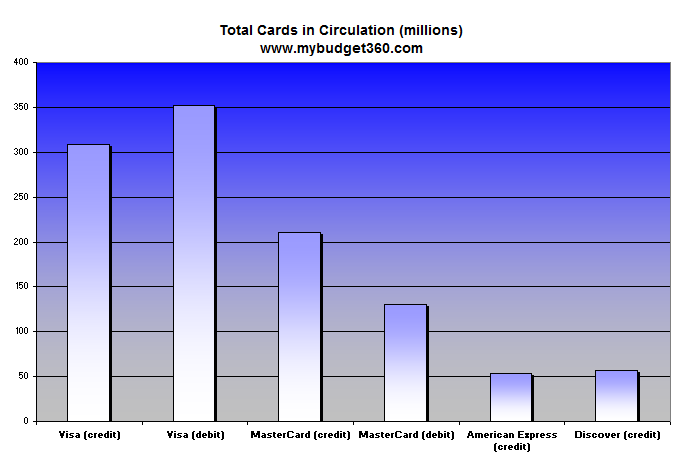
U.S. Hits 1 Billion Bankcard Circulation Plateau - Here's the Breakdown

Through year-end 2010, there were more than a billion credit and debit cards in circulation in the United States.

Here's the breakdown:  

  • American Express credit: 48.9 million
  • MasterCard credit: 171 million
  • Visa credit: 269 million
  • MasterCard debit: 123 million (as of Sept. 30, 2010)
  • Visa debit: 397 million (as of Sept. 30, 2010)
Sources: American Express, Mastercard, Visa

CreditCards.com has this data regarding Total purchases/transactions: 
Total purchases/transactions

Issuer purchase volume
(Through year-end 2010)
  • American Express: $131.1 billion (Source: American Express)
  • Discover cards: $92.5 billion (Source: Discover)
  • MasterCard credit: $479 billion (Source: MasterCard) 
  • MasterCard debit: $333 billion (Source: MasterCard)
  • Visa credit: $809 billion (Source: Visa)
  • Visa debit: $1.05 trillion (Source: Visa)

Issuer transaction volume
(Through year-end 2010)
  • American Express: Doesn't disclose publicly
  • Discover cards: Unavailable
  • MasterCard credit: 5.85 billion (Source: MasterCard) 
  • MasterCard debit: 8.46 billion (Source: MasterCard)
  • Visa credit: 9.4 billion (Source: Visa)
  • Visa debit: 28.6 billion (Source: Visa)


Read more: http://www.creditcards.com/credit-card-news/credit-card-industry-facts-personal-debt-statistics-1276.php#ixzz1S8B6uDCI
Compare credit cards here - CreditCards.com

Thursday, July 14, 2011

First Data Helps Merchants Accept Payments Anywhere their Business Takes Them with VeriFone PAYware Mobile


Solution Turns Smartphones into Affordable and Secure Point-of-Sale Systems
ATLANTA, JULY 14, 2011 – First Data Corporation, a global leader in electronic commerce and payment processing, and VeriFone Systems, Inc. (NYSE: PAY), today announced that First Data will offer its merchant clients VeriFone’s PAYware Mobile solution through its alliance partners.

VeriFone’s PAYware Mobile is a complete payment solution that transforms a smartphone into a secure payment portal; it provides a secure mobile platform to accept electronic payments, along with real-time reporting capabilities that include extensive transaction search. Using VeriFone’s VeriShield Total Protect, PAYware Mobile is tightly integrated with First Data’s security infrastructure to help assure merchants and consumers they are paying over a secure mobile payment channel.
“With mobile devices becoming a main channel for how we transact and interact, we wanted to make it easier for merchants to maximize their mobile phone investment by turning it into a payment system,” said Bruce Dragt, SVP and division manager of Payment Acceptance, First Data. “This is another way merchants, financial institutions and consumers can use mobile devices to conduct commerce with First Data.”
To use PAYWare Mobile, merchants simply slip their smartphone into a special sleeve, so they can then swipe their customer’s card, capture a signature, electronically transmit the payment and email the customer a receipt. PAYware Mobile is ideal for merchants that operate remotely, or on the go, such as home services and in-home sales, events and markets, limo and taxi services, or restaurant delivery.
Sovereign Merchant Services, an alliance between First Data Merchant Services and Sovereign Bank, is one of the alliance partners offering the solution. A financial institution with principal markets in the northeastern United States, Sovereign Bank is a subsidiary of Banco Santander, S.A. “This solution is easy to implement, is compact and portable, and arms our clients with the ability to offer electronic payments to their customers from virtually anywhere without the need to carry additional point-of-sale equipment,” said Eduardo Tobon, Head of Santander's U.S. Cards and Payments Division. “We think PAYware Mobile is a simple and innovative solution that will save our merchants time and money.”
PAYware Mobile honors all forms of credit transactions processed as an online credit purchase and comes equipped with its own stylus for fast and secure signature captures. For more information on PAYware Mobile:www.paywaremobile.com.
About VeriFone Systems, Inc. (www.verifone.com)
VeriFone Systems, Inc. (“VeriFone”) (NYSE: PAY) is the global leader in secure electronic payment solutions. VeriFone provides expertise, solutions and services that add value to the point of sale with merchant-operated, consumer-facing and self-service payment systems for the financial, retail, hospitality, petroleum, government and healthcare vertical markets. VeriFone solutions are designed to meet the needs of merchants, processors and acquirers in developed and emerging economies worldwide.
About First DataAround the world, every second of every day, First Data makes payment transactions secure, fast and easy for merchants, financial institutions and their customers. First Data leverages its vast product portfolio and expertise to drive customer revenue and profitability. Whether the choice of payment is by debit or credit card, gift card, check or mobile phone, online or at the checkout counter, First Data takes every opportunity to go beyond the transaction.
ContactsPete Bartolik
VeriFone
Tel: 508-283-4112
Email: pete_bartolik@verifone.com
Cara Crifasi
First Data
Tel: 303-967-6367
Email: cara.crifasi@firstdata.com

FIS Chosen by Amalgamated Bank of Chicago for Credit Card Processing, Loyalty and Fraud Prevention


JACKSONVILLE, Fla.--(BUSINESS WIRE)--FIS™ (NYSE: FIS), the world’s largest provider of banking and payments technology, today announced that Amalgamated Bank of Chicago has signed a five-year agreement for several FIS card processing and fraud protection solutions. The bank selected FIS’ industry-leading card, merchant and fraud technologies in order to enhance its customer experience as well as its consumer and commercial card processing and fraud prevention capabilities.
“We are pleased that Amalgamated Bank of Chicago has chosen to expand their relationship with FIS and are confident that combining the management of their fraud prevention, loyalty and card processing with one provider will positively impact Amalgamated Bank’s ability to better serve their customers.”
Since 1922, Amalgamated Bank of Chicago has been serving the union laborers and working class members of the Chicago area and nationwide. Amalgamated Bank selected several FIS solutions to aid in the management of their card processing and fraud efforts, including Base2000®, ScoreCard®, FIS card personalization and fulfillment, FIS Secured™, COMPROMISE MANAGER™, Merchant Processing and Fraud Alert Management.
FIS’ credit card processing solutions supports both consumer and commercial accounts, including business, corporate, fleet and purchasing cards. ScoreCard is a card loyalty solution that has proven to increase card acquisition, activation and usage of both credit and debit card programs by members. ScoreCard’s Relationship Rewards improves a financial institution’s customer loyalty and retention. With FIS’ full suite of card and fraud solutions, Amalgamated Bank will enhance its ability to provide personalized card services and bring new financial solutions to market quickly.
FIS Fraud Alert Management is a comprehensive fraud management platform that features the ability to adapt intuitively as new card and merchant data models are added. A unique attribute of the solution is its ability to synthesize credit, debit and prepaid transactions on the same platform, significantly improving accuracy through the monitoring of multiple types of cards. FIS Secured is a fraud protection program that leverages proprietary analytical tools and enhanced data mining to identify emerging fraud patterns and potential points of compromise to stop fraud runs before they occur. With the addition of these solutions, Amalgamated Bank will be able to identify potential fraudulent trends and activity before it occurs while minimizing the overall impact to legitimate cardholder spending.
“FIS’ card and merchant processing, as well as fraud solutions will bring us to a new level of efficiency. The combination of increased system flexibility, robust functionality and improved cardholder experience were all key differentiators for us,” said Jonathan Telzrow, senior vice president, Amalgamated Bank of Chicago.
“FIS has developed a platform at the forefront of credit card processing technology integrated with fraud and loyalty programs that deliver the flexibility and adaptability banks need to remain highly competitive,” said Frank D’Angelo, executive vice president, FIS Payment Solutions Group. “We are pleased that Amalgamated Bank of Chicago has chosen to expand their relationship with FIS and are confident that combining the management of their fraud prevention, loyalty and card processing with one provider will positively impact Amalgamated Bank’s ability to better serve their customers.”
FIS (NYSE: FIS) is the world’s largest global provider dedicated to banking and payments technologies. With a long history deeply rooted in the financial services sector, FIS serves more than 14,000 institutions in over 100 countries. Headquartered in Jacksonville, Fla., FIS employs more than 32,000 people worldwide and holds leadership positions in payment processing and banking solutions, providing software, services and outsourcing of the technology that drives financial institutions. FIS is ranked 426 on the Fortune 500, is a member of Standard & Poor’s 500® Index and consistently holds a leading ranking in the annual FinTech 100 list. For more information about FIS, visit www.fisglobal.com.

Enhanced by Zemanta

Mobile Hacking: How Safe is Your Smartphone (Hint: Phoney Security)


 Mobile Hacking: How Safe Is Your Smartphone? 
 (from Mashable at 14-7-2011) 
 Experts say that its still fairly easy to hack into your phone, but unless youre a celebrity, youre unlikely to be a target. Dont get too comfortable, though. The era of safe mobile computing may be coming to an end as smartphones and other mobile devices become more popular than PCs.... read more»

Mitek Systems Shares Trade on NASDAQ Capital Market Today


Editor's Note:  Congrats to Drew Hyatt
SAN DIEGO, July 14, 2011 /PRNewswire/ -- Mitek Systems, Inc. (NASDAQ: MITK;www.miteksystems.com), today announced that its shares have begun trading on the NASDAQ Capital Market. The company will be traded under the ticker symbol "MITK."  
Mitek is the leader in mobile-imaging applications using smartphone cameras for check deposits, bill payments and ACH enrollments.  The company's patented flagship product, Mobile Deposit®, allows users to deposit checks anytime, anywhere simply by snapping photos of checks with their camera-equipped smartphones and is being deployed by the nation's leading banks. The company's recently launched Mobile Photo Bill Pay™ allows a consumer to pay any bill just as conveniently by photographing it with a smartphone camera.
About Mitek Systems
For more than 20 years, Mitek Systems (NASDAQ: MITK) has provided financial institutions with advanced imaging and analytics software to authenticate and extract data from imaged checks and other financial documents.  Mitek's patented technology has created the Gold Standard for Mobile Check Deposit and is currently used by leading financial organizations in the United States to process more than 10 billion items per year.  
Today, Mitek is applying its patented technology and extensive expertise in image correction, optical character recognition and intelligent data extraction to mobile devices.  Using Mitek Mobile Apps, smartphone users can now deposit checks, pay bills, save receipts and fax documents while on the road or sitting at a desk -- eliminating trips to the bank, Post Office and file cabinet.  Simply take a picture of the document and Mitek does the rest -- correcting image distortion, extracting relevant data, routing images to their desired location, and processing transactions through users' financial institutions.  
For more information about Mitek Systems, contact the company at 858-503-7810 or visit www.miteksystems.com.

Acxiom Study Unveils the Key to Influence $700B Financial Services Market Segment


Personal engagement missing yet necessary to engage consumers most likely to switch
http://www.acxiom.comLITTLE ROCK, Ark.--(BUSINESS WIRE)--In a purchasing environment where consumer loyalty continues to be elusive, how do financial services marketers capture those consumers who may be willing to make a switch in their primary payment method? A new Consumer Dynamics study from Acxiom® Corporation (Nasdaq: ACXM) creates a roadmap for marketers to reach consumers whose payment choices may be affected by complex economic, regulatory and technological factors.
“Cashing in on Changing Payment Preferences: How Cards and Payments Marketers Can Become Top of Wallet with Potential Switchers”
This first-of-its-kind, comprehensive Acxiom study, “Cashing in on Changing Payment Preferences: How Cards and Payments Marketers Can Become Top of Wallet with Potential Switchers,” provides marketers with concrete, actionable recommendations on how to attract and retain customers through personalized marketing, leading to better performance and less wasted effort. Using data and insight into nearly 3,000 consumers’ primary payment choices – credit cards, debit cards, paper checks or cash – the report identifies their willingness to switch payment methods and why; and how demographics, life stage and other personal circumstances affect their decisions.
“The choice of how to pay for a purchase is personal, and is based on a combination of rational and sometimes irrational decision-making. But most financial product marketing fails to connect to individual needs and interests,” said John Albrecht, managing director for Acxiom’s Banking and Payment Services group. “The study’s findings will help these marketers influence target audiences by demonstrating how multidimensional insights across shopping, purchase and attitudinal behaviors, can lead to greater success.”
The survey, combined with Acxiom’s Personicx® demographic analysis, produced a wealth of information about potential payments switchers, including:
  • 25% of respondents, who represent a potential of $700 billion in annual transactions, would consider switching payment method if benefits such as “help control spending” or “ease of record keeping” are highlighted in the messaging
  • The age of your target is important, as most potential switchers are in the 18-44 group
  • Travel purchasers represent one of the biggest opportunities with 26% of switchers whose primary payment method is a debit card saying they use a credit card for travel and 19% use a credit card when making a big-ticket electronics purchase
  • Understanding specific influences, such as rewards or lower fees, allows marketers to create a more relevant and personalized offer tailored to the potential switcher and ideally suited to be made through addressable digital channels
As a marketer, it is crucial to identify and aim for potential switchers at the moments when they might be inclined to use something other than their primary payment method. The study also contains information on what messages have better chances to influence switchers, how personalized marketing can attract and retain customers and what advertising channels are most efficient to reach consumers in various life stages and economic segments.
For a copy of Acxiom’s latest study, please click here or call 1-888-3ACXIOM.
About Acxiom
Acxiom is a recognized leader in marketing services and technology that enable marketers to successfully manage audiences, personalize consumer experiences and create profitable customer relationships. Our superior industry-focused, consultative approach combines consumer data and analytics, databases, data integration and consulting solutions for personalized, multichannel marketing strategies. Acxiom leverages over 40 years of experience in data management to deliver high-performance, highly secure, reliable information management services. Founded in 1969, Acxiom is headquartered in Little Rock, Arkansas, USA, and serves clients around the world from locations in the United States, Europe, Asia-Pacific, the Middle East and South America. For more information about Acxiom, visit Acxiom.com.
Acxiom and Personicx are registered trademarks of Acxiom Corporation.

Zeus Banking Trojan Hits Android Phones


Zeus crimeware creators adapt Zitmo malware, disguised as a banking activation application, to steal financial details from Android users.

10 Massive Security Breaches
(click image for larger view)
Slideshow: 10 Massive Security Breaches
The Trojan spyware application known as Zitmo, which is designed to steal people's financial data, has now been altered to target devices running the Android mobile operating system. "The malware poses as a banking activation application," said Axelle Apvrille, a senior antivirus analyst and researcher for Fortinet, in a blog post. "In the background, it listens to all incoming SMS messages and forwards them to a remote web server." read more

Content Marketing Infographic Shows 2Blog4 Value

2Blog for creates a SEO loaded Blog (microsite) delivering a Fresh Content Marketing Platform.

Infographic: The History of eCommerce


The Six Biggest Websites Compared

Wikipedia, Amazon, Twitter and more...


Dynamics Inc. Reveals Angel Investors


Leading CEOs among notable investors in next-generation payments technology company
PITTSBURGH--(BUSINESS WIRE)--Dynamics Inc., an innovator in next-generation payment cards and systems, today announced a partial list of its angel investors who participated in its Series A and Series B investment rounds. Dynamics launched its award-winning Card 2.0® technology last fall and its products are currently in consumer trials with several top multi-national payment card issuers.
“The caliber of our angel investors is a testament to the strength of the Dynamics opportunity and the informed belief in our ability to execute”
Many of Dynamics’ angel investors are founders and leaders of disruptive and dominant companies relevant to Dynamics’ business. In addition to financial support, Dynamics’ angel investors provide technical, strategic, legal, and business advice. The CEO-heavy investment group represents informed investments in Dynamics by skilled business leaders.
The angel group includes:
Joseph “Rod” Canion – Founder and CEO, Compaq Computer (1982-1991). In addition to holding the record for first-year sales by any company, Compaq was the fastest company in history to reach both the Fortune 500 and $1 billion in revenues.
Michael Holthouse – Michael worked in sales at Apollo Computer before founding Paranet, an information technologies company that Michael sold to Sprint in 1997 for $425MM. Michael is also the founder and Chairman of Prepared 4 Life, a non-profit internationally praised for the blockbuster entrepreneurial educational initiative Lemonade Day.
Jack M. Gill – Founder and Managing Member, Vanguard Ventures. Jack was the lead investor in companies such as Aldus, Digital Microwave, Pyramid Technology, EndoSonics, Mycogen, EndoTherapeutics, Macromedia, Network Appliance, LightSpeed (CISCO), Digital Island, Zip Realty, and Hansen Medical. Jack is also a member of the Harvard Medical School faculty and founder of Autolab, which was acquired by Spectra Physics.
Leo Linbeck III – President & CEO, Aquinas Companies, LLC. Leo grew Aquinas’ annual revenues from $40MM to $500MM. Leo serves as an adjunct professor in the Rice and Stanford MBA programs.
Thomas R. Mullen – President and CEO, Mercy Health Services (MHS), which most recently added a $400MM state of the art hospital building in Baltimore, MD. Under Tom’s leadership, MHS revenues have grown from $180MM to more than $523MM. Tom was recently named to the nation’s list of Top 100 Performance Leaders by Solucient.
Joseph F. Pinkerton – Founder & CEO, Clean Energy Labs. Joe was also the founder, CEO, & Chairman of Active Power (NASDAQ: ACPW), where Joe raised $45MM in venture capital before completing a $140MM IPO. Joe is a recipient of the Ernst & Young Entrepreneur of the Year award for central Texas.
Arthur A. Ciocca – Chairman, The Wine Group, Inc. – the third largest wine company in the United States by sales and volume.
Sean McDonald – President and CEO, Precision Therapeutics Inc. Sean also founded Automated Healthcare, which was sold to the McKesson Corporation in 1996 for $65MM.
Nancy Chang – Founder and CEO, Tanox, which was acquired by Genentech in 2007 for $919MM.
Terry M. Giles – Founder of Landmark Education Enterprises Incorporated, Medical Design Technology, Great Escapes, and Giles & O’Malley.
Kristopher Brown – Partner, Dechert LLP. Kristopher’s practice centers on private equity and venture capital transactions. Kris also advises on corporate and transactional matters for numerous financial and corporate strategic investors, as well as emerging growth companies.
Richard Inz – Assistant General Counsel, Purdue Pharma. Richard was previously a partner at the Fish & Neave Intellectual Property Group of Ropes & Gray LLP.
Alan Gordon – Corporate Counsel, Profectus BioSciences, Inc.
David N. Lambeth – David has been a Professor in the Department of Electrical and Computer Engineering and in the Department of Materials Science and Engineering at Carnegie Mellon University since 1989. David earned his Ph.D. degree in Physics from MIT and worked with Eastman Kodak Laboratories and Control Data Corporation from 1973-1989. David served ten years on the Board of Directors of Intevac.
“I first met Jeff Mullen in 2009 when he was presenting Dynamics to the International Rice Business Plan Competition, which I helped judge,” said Rod Canion, founder of Compaq. “I believed then and there that Dynamics had the potential to revolutionize the payments space. After winning the $100,000 main prize, and personally investing in Dynamics, I have worked closely with Jeff and his team. Over the last two years, I have seen a payments and consumer technology powerhouse begin to mature in Dynamics – equipped with the right team, expertise, experience, leadership, and vision it needs to become an industry leader.”
“The caliber of our angel investors is a testament to the strength of the Dynamics opportunity and the informed belief in our ability to execute,” said Jeff Mullen, CEO of Dynamics. “Dynamics has grown from the mentorship of our angel investors – many of whom are founders and CEOs of successful technology companies. I look forward to continued advice and guidance from our angel group as Dynamics continues to advance the largest and oldest industry in the world – the financial industry.”
About Dynamics Inc.
Dynamics Inc. was founded and seeded in 2007 by Jeff Mullen, its President and CEO. Dynamics produces and manufactures intelligent powered cards such as advanced payment cards. Focused on introducing fast-cycle innovation to top card issuers, the company's first commercial application is the world's first fully card-programmable magnetic stripe for use in next-generation payment cards. The company has won many of the world's most prestigious international business plan competitions, including the Rice Business Plan Competition, Carnegie Mellon McGinnis Venture Competition and the University of San Francisco Business Plan Competition. The company won DEMOgod and the $1M People's Choice Award at DEMO Fall 2010 and Best of Show at FinovateFall 2010. In January, the company won Best in Show at the 2011 International CES for Personal Electronics. Dynamics has closed a $5.7M Series A round led by Adams Capital Management and a $35M Series B round led by Bain Capital Ventures. Dynamics is headquartered in Pittsburgh, Pa. More information on the company, its technology and applications can be found at www.poweredcards.com.

Disqus for ePayment News