MasterCard Inc., the world’s second- largest electronic payments network, will lose more than half of a $59 billion portfolio of U.S. debit-card users after JPMorgan Chase & Co. decided to shift more business to Visa Inc., "two people" familiar with the matter said.
MasterCard held the portfolio since 2005, said "the people", who declined to be identified because the switch hasn’t been officially announced. The customers had checking accounts at Seattle-based Washington Mutual Inc. until JPMorgan bought assets of the failed lender last year, the people said. Bidding for the accounts began in October, "the people" said.
“We recognize that given the highly competitive nature of our industry and the challenging environment facing our financial institution customers today, decisions such as these can occur,” said Joanne Trout, a spokeswoman for Purchase, New York-based MasterCard. The move won’t have a material impact on MasterCard’s revenue, Trout said. (priceless?)
The shift strengthens Visa’s hold on debit cards as consumers use them for a bigger share of their purchases, including staples such as gasoline and food. Visa already controls about two-thirds of the U.S. debit market, according to the Nilson Report, an industry newsletter. Issuers are counting on more debit card use to make up for declining credit-card profit as the 8.9 percent U.S. jobless rate drives up defaults. Continue Reading
Twitter users! Be warned that you could be the target of a latest phishing campaign that tries to persuade all you micro-bloggers into revealing your login details. Security researchers at Sophos warn that messages are being circulated that point Twitter users towards a website called tvviter.com (with two 'v's rather than a 'w'). (I wouldn't recommend you visit) People who make the mistake of clicking on the link will be taken to a bogus (cloned) website which is pretending to be Twitter.
It hopes to fool people into handing over their username and password,” Sophos said on one of its official blogs, which it reckons could lead ultimately to some painful identity fraud, as well as an account being used for the purposes of spam or spreading malware.
Editor's Note: There's those ever present "username and passwords" causing problems again. And yet another cloned website. When Twitter's gets serious about TwitPay I hope these whispers are heard as shouts and they use a secure 2FA (not username and password).
LOS ANGELES - Four San Fernando Valley men are charged in an alleged electronic crime scheme in which more than two dozen victims lost more than $400,000 via phony ATM withdrawals. Oganes Tangabakyan, 31, and Edgar Yerkanyan, 25, both of Sherman Oaks, Aznaour Poghosyan, 26, of Tujunga; and Vahe Hovsepyan, 33, of Reseda, are scheduled to be arraigned May 28 at the downtown Los Angeles courthouse on the 57-count complaint.
The investigators also seized several late-model, high-end automobiles and more than $200,000 in cash -- most of it in $20 bills, officials said.
The District Attorney's Bureau of Investigation began investigating the case last August after being informed by Citibank of possible ATM fraud, according to the District Attorney's Office.
The defendants allegedly gained access to ATM personal identification numbers through skimming devices placed on debit card point of service terminals and ATMs in Southern California and at least one other state.
Bail was set at $1 million each for the four men, who were arrested Tuesday.
In an article written for Australian PC Authority, Daniel Long talks about the recent rash of card skimming incidents over there.
Credit card fraud costs Australia $120m, but there are ways to protect yourself
Card skimming and online fraudsters are costing Australians over $120m a year, but there is hope say experts. We've got some tips on how to navigate your local ATM and what to look out for.
According to a new white paper by information security specialist Steve Darrall of CQR Consulting, Australia is experiencing something of a credit card fraud epidemic.
In recent months, ATM machines have been blown sky high, card skimming machines have grown increasingly more prevalent in our suburbs and credit card fraud, online and offline is at an all-time high.
The white paper claims that card skimming alone now costs Australians more than $49m a year, and that's just in 2008. In all, total credit fraud made up around $120m from two main groups:
- Counterfeit cards and card skimming ($49m) - Card not present fraud (CNP) concerns your mail, telephone, fax and internet transactions. ($71m)
Two banking security initiatives have been offered by CQR as a better way of protecting against credit card frauds and they hope that the wider adoption of these measures can help the banks/card companies better protect consumers:
1. Payment Card Industry Data Security Standard (PCI-DSS): Developed by the major credit card brands, this standard applies to all organizations that store, process or transmit cardholder payment data, regardless of size or transaction numbers.
2. Payment Application Data Security Standard (PA-DSS). This standard applies to software applications designed to store, process or transmit payment card information.
Mr Darrall believes that what's holding back the mass adoption of these standards are costs and mindset of the merchants. Darrall told PC Authority that while the banks are very interested in adopting these standards, merchants have not been so crash hot about the idea. Furthermore, this isn't an area for complacency. Even with the introduction of more advanced chip and PIN cards, "this isn't the magic bullet" we might be hoping for, but a step in the right direction says Mr Darrall.
The card skimming problem
Even with the growth of online fraud and banking phishing schemes, physical card skimming is a growing problem. Physical card skimming uses electronic equipment to steal your PIN at the ATM. And it can be much harder for customers to detect.
ATM skimming is getting so high tech that some gangs are resorting to using Bluetooth and fake keyboards to 'catch' your PIN when you enter it, so holding your hand over the keyboard will make little difference in this case.
But according to Mr Darrall, there are techniques you can use to minimize your risk. (Continue Reading)
The HomeATM Blog has spent considerable time in its efforts to "attempt" to educate readers about payments security (and/or the lack thereof) Here's a quick rant on mobile phone security.
iCan't help but cringe (the first time iLaughed) every time I see that iPhone commercial, you know the one that shows somebody entering their credit card iNformation iNto an iPhone. Are they freaking iNuts? iDon'tGetiT.
Here's why: When you do that you are entering your valuable credit card iNformation iNto a "BROWSER." Any guesses as to why they call iT a browser? iF anyone said: "Because hackers can browse for iNformation on iT" congrats! So here's my beef: "Where's the Security?
iUnderstand the hoopla and the fact that there iS a rush to market for applications that enable mobile phones as payment devices, but we (hopefully) already have learned that web browsers ARE NOT SAFE. Question: What does a mobile phone use? Yup. So what iS the only logical conclusion you can come to? Yup.
Have we learned NOTHING from the errors of our ways? You don't type your PAN (Primary Account Number) iNto a web browser or iT can be seen by anyone who wants to see iT. Case in Point: Arecent study by an American security company found that 93 per cent ofmobile devices in the US lack data loss protection and other systems toprevent a data leak. - Source Credant Technologies 11/18/08
So why on earth have we "graduated" (we shoulda been held back) to typing our number iNto a phone. The security on a phone iS certainly less formidable than Web security. Slow down people...Haste makes Waste. Do iT Right.
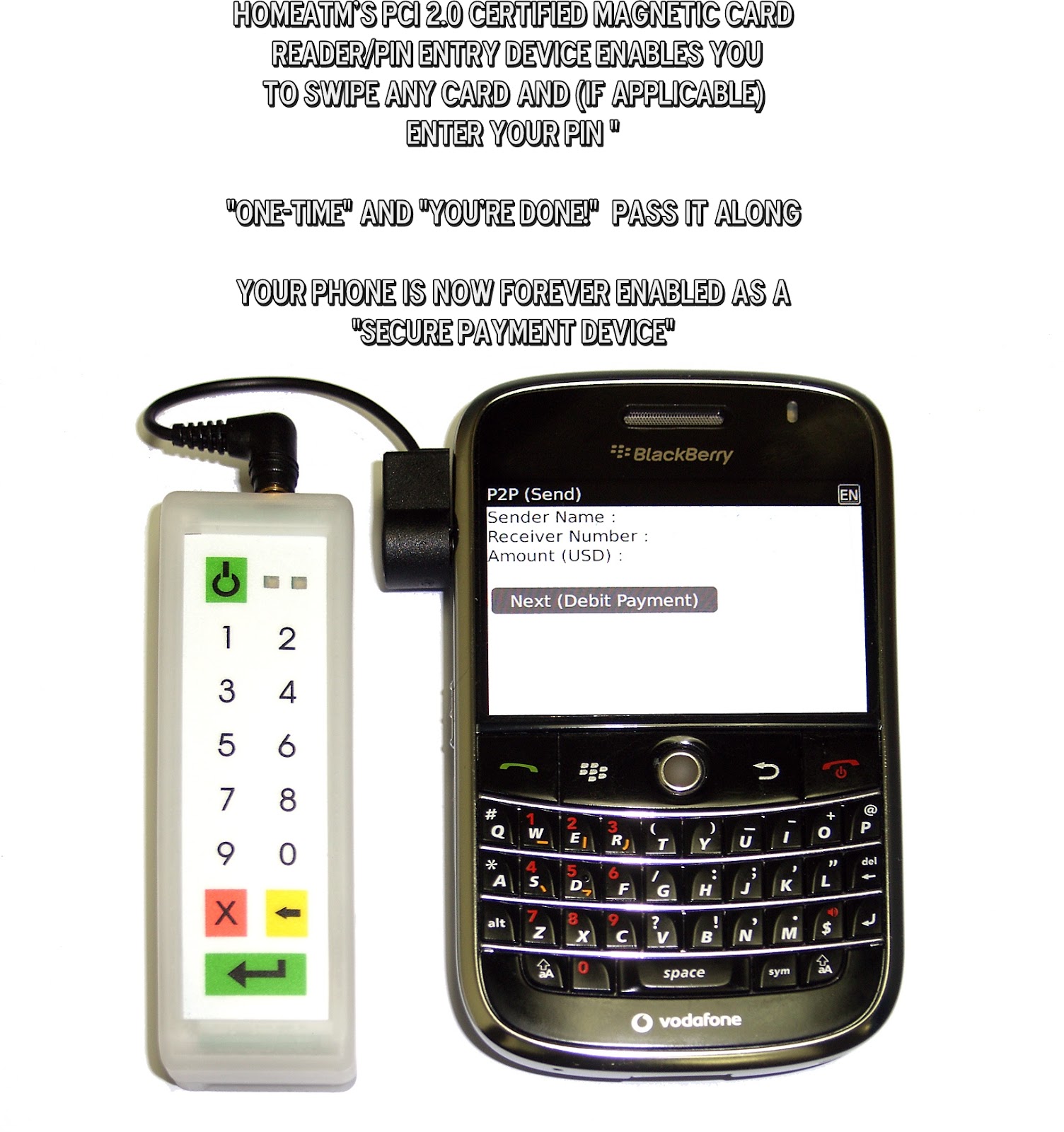
As iN the case of the web, payments need to be done "outside the browser" and they need to be done securely. That said, here iS an example of a "secure" mobile payments application...
1. Plug in the world's first and only PCI 2.0 Certified 3DES, Protected by DUKPT end to end encrypted PIN Entry Device 2. Swipe your credit or debit card (and thus your PAN & Track 2 data on the magstripe) ONE-TIME! 3. Enter your PIN (if applicable) ONE-TIME! (Repeat with any credit/debit card you'd like to enable in your iWallet)
The result? Your sensitive PAN and PIN (and your Track 2 data) is "instantaneously" encrypted "outside the browser space" and henceforth protected by the aforementioned "military grade" encryption. The cardholder data is NOT unencrypted until it arrives safely into a secure HSM (hardware security module) at our processing NOC (Network Operations Center).
Your phone is now "safely and securely" forever enabled as a payments device and your PAN, your Track 2 data and your PIN is NEVER in the clear...so you are. Simply pass along the HomeATM PCI 2.0 Certified PED to a friend or family member and they can also "securely enable" their phone as a payments device.
But NEVER type your PAN into a browser unless you want to "share the wealth." We say it is imminently more intelligent to "share the HomeATM PIN Entry Device" in order to enable friends and family to safely transact on their mobile phone.
Oh...BTW...in a related (rush to market) story, Intuit, the maker of QuickBooks software for small businesses, is announcing a new service called Intuit GoPayment, (where does it Go?) that will put credit-card processing technology into most cell phones, paving the way for electricians, tow-truck drivers or any other mobile workers who normally depend on sending a bill, collecting a check or sticking to a cash-only model to collect immediate payment. (Yeah, electricians, tow-truck drivers, pizza delivery drivers, etc. could also be enabled with our "Don't Go/Stay Secure Payment" application as well.)
But the system does more than just allow mobile workers to collect payment. It also allows users to tap back into their Quickbooks accounts to input different types of information, such as invoicing or estimate information and synchronize it with the Quickbooks data back at the home office. Yeah, that sounds safe too!
This is BIG news folks. Game Changing. Only the tip of the Iceberg though. We can't be using web browsers for financial transactions (internet or mobile) because it too dang hackable. As the article states, money transfer, unsafe, One-Time-Passwords (OTP's) unsafe, Internet Transactions, unsafe, Mobile Phones, unsafe, browsers, unsafe. As I said, this is BIG news and it all bodes well for HomeATM's theory that financial transactions need to be encrypted outside the browser space...and the only way to do that is with a hardware device. Period. It doesn't hurt that HomeATM owns the patent and the worlds ONLY PCI 2.0 Certified PED designed for eCommerce! Anyway...here's some background...
I was working on a post I think I'll call "Comparing Apples to "Let's Just Say" The Real Deal" and I saw this (as I said) "GAME CHANGING" news come across the wires. Since it related directly to the post I was writing, I thought I'd take a time out and post this one first in order to create a perfect segway. Think there is such a thing as a secure transaction done "over" the internet? Think mobile phones are secure for financial transactions? Think again. Think Different!
Financial Transactions must be done (and ENCRYPTED) "outside the browser space!" PERIOD. Here's an excerpt from an article released less than 30 minutes ago by PC World:
A Nokia 1100 mobile phone has been used to break into someone's online bank account, affirming why criminals are willing to paying thousands of euros for the device. See my post: I'll Give You $10k for Your Nokia 1100
Using special software written by hackers, certain models of the 1100 can be reprogrammed to use someone else's phone number and receive their SMS (Short Message Service) messages, said Max Becker, CTO of Ultrascan Knowledge Process Outsourcing, a subsidiary of fraud investigation firm Ultrascan.
The Nokia 1100 hack is powerful since it undermines a key technology relied on by banks to secure transactions done over the Internet.
Banks in countries such as Germany and Holland send a one-time password called an mTAN (mobile Transaction Authentication Number) to a person's phone in order to allow, for example, the transfer of money to another account.
Since the Nokia 1100 can be reprogrammed to respond to someone else's number, it means cybercriminals can also obtain the mTAN by SMS. (Editor's Note: OTP's are overrated!)
Cybercriminals must already have a person's login and password for a banking site, "but that's easy" since millions of computers worldwide contain malicious software that can record keystrokes.
Editor's Note: Well a publication besides the PIN Payments News Blog that states getting a person's login and password for a banking site is easy. It took a while...now that it's done, I say: "That Was Easy! Need I say more about why HomeATM engineered the worlds first and only PCI 2.0 certified PED designed to conduct financial transactions "outside the browser space" (for any web enabled device...including mobile phones) I think I do. You watch...at the end of the day when the smoke clears, you'll see it how we see it.
Description: A federal judicial panel will hear arguments next week on whether to consolidate the class action lawsuits brought against Heartland Payment Systems (HPY) by financial institutions. The Judicial Panel on Multidistrict Litigation in Louisville, KY will hear the arguments next Wednesday, according to Benjamin Johns, one of the lawyers representing the class action suit from the law firm of Chimicles Tikellis, Haverford, PA.
"These cases tend to be long and drawn out - there have been multiple class action suits filed in New Jersey and in Texas," says Johns. Two class action suits have been filed by Chimicles Tikellis, (New Jersey Filing PDF) (First Bankers Trust PDF), and a third class action suit was also filed in Texas against Heartland by Lone Star National Bank, Pharr, TX. (Lone Star Filing PDF)
As first reported on Jan. 20, Heartland, the sixth-largest payments processor in the U.S., revealed that its processing systems were breached in 2008, exposing an undetermined number of consumers to potential fraud.
Since then, a growing number of banking institutions have stepped forward to announce that their customers were among those affected by the breach.
About the Lawsuits
Johns says that generally multiple class action suits are consolidated and heard in one court. "Nothing of substance has happened before this," he says. "The court, once it hears the argument, will take anywhere from a month or two to release its ruling on where the suit will be heard."
Motions have been made to hear the case in Florida, Texas and New Jersey US district courts, says Johns.
There are three types of class action suits being brought against Heartland: the financial institutions' class action suits; consumer cases; and also some securities fraud class action suits have been filed by Heartland's investors. Johns says there are a total of 30 suits filed against Heartland in various federal courts.
There are five banks and credit unions named as plaintiffs in the New Jersey filing: Amalgamated Bank, New York, NY; Matadors Community Credit Union, Chatsworth, CA; GECU, El Paso, TX; MidFlorida Federal Credit Union, Lakeland, FL; and Farmers State Bank, Marcus, IA. All the institutions say they have had to re-issue "substantial" numbers of credit and debit cards because of the Heartland breach. Johns says thus far no other financial institutions have been named to the suit, but that doesn't mean others won't be joining.
"We've talked to a lot of banks and credit unions and gathering their information," Johns says. "Once the cases are consolidated we'll be making a determination of who will be added to consolidated complaint."
Cloud Security Alert By Tim Greene , Network World
Cloud security is enough of a potential problem that it’s being investigated by the group that sets standards for protecting credit card data.
The Payment Card Industry (PCI) Council has set up a task force to examine cloud computing services to figure out what unique exposure credit card data faces if stores, restaurants, hotels and the like relegate their card information to a provider.
The council, which has issued data security standards that businesses that process credit card transactions must follow in order to be PCI compliant, is looking more closely at cloud computing because its members are using the technology more.
“As a result, the Council is evaluating various options to address more formally, with our participating organizations, how cloud computing applies to the current requirements of the PCI Data Security Standard and where we take the DSS in the future,” the council says in an e-mail reply to questions about its plans.
The PCI council has ongoing revision cycles of its standard in order to keep personally identifiable data as private as possible and minimize the number of data breaches. The council is also taking a closer look at virtualization as a possible threat vector that should be separately addressed by the standard, although the council says the current standard might cover it.
Source: Finextra: Barclays worker jailed for stealing £455,000 from Lloyds chairman
I guess that's smarter than stealing from the chairman of your organization? According to Finextra, a Barclays worker has been sentenced to three years in prison for helping to steal £455,000 from the account of Victor Blank, chairman of rival bank Lloyds.
According to press reports, Anthony Webster, 23, worked as a client executive at Barclays Premier Bank in Moorgate, London in 2007 when Blank's account was raided.
Southwark Crown Court was told that he acted as the inside man for an organised crime gang, which stole the money from Blank's savings account through bogus transfer requests, with forged signatures, sent by fax. The money has not been recovered, with some of it sent overseas. Continue Reading at Finextra
Description: Houston-based personal financial management start-up Rudder has inadvertently exposed the private account details of hundreds of individuals to other users of the site.
Daily account updates sent to two percent of Rudder's active users also provided a direct link through to the accounts of hundreds of other subscribers, where visitors could view balance updates and transaction information relating to personal bank accounts, credit cards and bill payments.
Rudder says that in total 732 accounts were compromised, but that no bank user names, passwords, addresses or other personal identity-based information were exposed.
In a statement posted on its site, Rudder says: "This issue was not the result of a data breach, but due to a software issue in our program that generates emails. It is important to know that Rudder has "read only" access to your account balances and transactions and we do not store account credentials like user names, passwords, or your personal information like name, address or social security number."
As a precautionary measure, the company says it will be offering a free identity-theft service to all compromised Rudder members.
Finextra verdict Competitors such as Mint and Wesabe might be rubbing their hands with glee at the prospect of picking off defecting Rudder subscribers, but this security lapse reflects badly on the entire sector. Mint for one has recently been talking about charging commercial third parties for access to aggregated anonymous consumer spending data. Like Rudder, Mint doesn't store names or account numbers - and there's no danger of individual account compromise - but subscribers might revolt at the idea that details of their personal spending habits are being sold on to the private sector.
The National Archives is privy to a wide range of sensitive information. It is the nation’s official record keeper. Now the National Archives has had a security breach that has far reaching, national implications:
“The National Archives lost a computer hard drive containing massive amounts of sensitive data from the Clinton administration, including Social Security numbers, addresses, and Secret Service and White House operating procedures, congressional officials said Tuesday.”
This security breach goes beyond the possibility of identity theft. Among the data could be sensitive data that foreign nations would covet. One wonders whether security procedures included data encryption so that the hard drive data had additional security.
The amount and nature of the data remains undetermined to a point. There is a question as to whether this hard drive was “accidentally” misplaced. Surely the security protocols and procedures at the National Archives are stringent enough that hard drives just don’t become lost in the system somewhere.
Obama ready to sign credit card bill: White House | Reuters
WASHINGTON (Reuters) - President Barack Obama looks forward to quickly signing a credit card reform bill passed on Wednesday by Congress, the White House said.
"Obviously this has been something the president has championed," White House spokesman Robert Gibbs said, adding the bill contains "important" protections for consumers.
Credit card holders 'should be wary of "SMiShing" threat'
Smishing, where fraudsters use text messages to target victims rather than the internet, is on the rise, according to one group.
Credit card holders are being warned by the fraud prevention squad Cifas to watch out for the fraud method. The smishing trend comes as banks and other financial services providers increasingly contact customers by text message.
HM Revenue and Customs (HMRC) has also warned that fraudulent text messages have been sent to victims asking for financial information. Similarly this was because HMRC has been using text messages to contact people, a fact which fraudsters have exploited.
According to UK payments industry association Apacs, fraud where the card is not present amounted to £328.4 million in 2008. This is an increase of 13% since the previous year.
Richard Hurley, Cifas communications manager, said: "While the rest of us are reining in our behaviour as a result of the recession, the increase in facility takeover and online frauds demonstrates clearly that fraudsters are simply redirecting their efforts."
More on SMiShing (from Wikipedia) Similar to phishing, smishing uses cell phone text messages to deliver the "bait" to get you to divulge your personal information. The "hook" (the method used to actually "capture" your information) in the text message may be a web site URL, however it has become more common to see a phone number that connects to automated voice response system.
The smishing message usually contains something that wants your "immediate attention", some examples include "We’re confirming you've signed up for our dating service. You will be charged $2/day unless you cancel your order on this URL: www.?????.com."; "(Name of popular online bank) is confirming that you have purchase a $1500 computer from (name of popular computer company). Visit www.?????.com if you did not make this online purchase"; and "(Name of a financial institution): Your account has been suspended. Call ###.###.#### immediately to reactivate". The "hook" will be a legitimate looking web site that asks you to "confirm" (enter) your personal financial information, such as your credit/debit card number, CVV code (on the back of your credit card), your ATM card PIN, SSN, email address, and other personal information. If the "hook" is a phone number, it normally directs to a legitimate sounding automated voice response system, similar to the voice response systems used by many financial institutions, which will ask for the same personal information.
This is an example of a (complete) smishing message in current circulation: "Notice - this is an automated message from (a local credit union), your ATM card has been suspended. To reactivate call urgent at 866-###-####."
In many cases, the smishing message will show that it came from "5000" instead of displaying an actual phone number. This usually indicates the the SMS message was sent via email to the cell phone, and not sent from another cell phone.
This information is then used to credit duplicate credit/debit/ATM cards. There are documented cases where information entered on a fraudulent web site (used in a phishing, smishing, or vishing attack) was used to create a credit or debit card that was used halfway around the world, within 30 minutes.
A bank in New Zealand mistakenly deposited NZ$10m (£3.85m) – 1,000 times the requested amount – into a NZ couples business bank account.
The temptation to not be honest apparently was too much. After withdrawing NZ$6m the couple disappeared from a service station they ran inRotorua, about 150 miles south of Auckland. According to Media in the country suggested they may have fled to Korea or China, and police have asked Interpol for help.
Thebank, Westpac, which has reportedly recovered NZ$4m, said it was"pursuing vigorous criminal and civil action to recover the sum ofmoney stolen". TheNew Zealand Herald reported a bank spokesman as saying human error wasresponsible for the mistake and that the bank was reviewing itsprocedures. The paper named the couple as Leo Gao and his girlfriendCara Young.
Description: It's a huge scam that's so sneaky you may not even know you've been hit till it's too late. Victims across the country are complaining they've been left holding the bag for iTunes charges they never made. They blame cyber-scammers who use financial information and iTunes as a weapon to drain their accounts. It's a widespread scam that's unfolding across the country but it's still unclear how it's being pulled off.
But ultimately scammers use iTunes to funnel cash from a victim's bank account, PayPal or credit card.
"I panicked, I was absolutely freaking out!" says Kimberly Pullis, from Naples, Maine, who discovered mysterious charges popping up in her iTunes account that she says she didn't make.
Daniel Buergo of Long Beach, Calif., says he spotted mysterious charges too that immediately posted to his bank account, "It makes me feel pretty down and out, upset, disgusted, of course you don't feel safe."
The high-tech scam has claimed victims from New York to California. At the heart of it all is Apple's wildly popular iTunes. Victims say it starts with an unexpected e-mail for purchases they never made. That's how Rachel Katz from Manhattan found out, "I got two emails thanking me for my purchase."
But by the time victims get the e-mail receipt it's usually too late. The receipts appear to be legitimate, and come from Apple, generated by the user's iTunes account. The receipts show purchases for iTunes electronic gift certificates and charges that hit checking accounts, credit cards or PayPal depending on what the user has linked to his or her iTunes account.
Many alleged victims say they've been nailed with $100 worth of charges, usually in the form of two electronic iTunes gift certificates valued at $50 each. But on blogs and complaint boards, some victims say they've been hit for much more. In some postings, victims claim fraudulent charges in the hundreds and even thousands of dollars.
"In this economy a hundred dollars to some people is a huge amount of money," says Kimberly Pullis, who says she had a hundred bucks sucked right out of the PayPal account she has registered with iTunes.
But Rachel Katz's case in New York City seems to be the most unusual; she says the gift certificates charged to her iTunes account were billed to a total stranger's PayPal account. She only found out about it after the fact when what appears to be a legitimate iTunes receipt popped up in her inbox. She makes an interesting analogy about the alleged fraud: "They just had a party in my house, they paid the bill for their own liquor, and I only know it happened because I got an invitation to the party after it was over."
When Kimberly Pullis searched for other victims she found tons of people with new postings generated almost daily.
"I have read online Web site after Web site, blog after blog, where it has happened to thousands of people, out thousands of dollars," she says. If the postings popping up online are legitimate victims, then the scammers are making out like cyber bandits, racking up quite a bill on the backs of innocent victims.
Victims tell Fox 5 News that they either find it impossible or have a whole lot of trouble getting the charges removed. Kimberly Pullis says she tried fighting the charges with Apple, but customer service told her to deal with PayPal. She says PayPal tells her the charges appear to be valid, deal with Apple.
In Daniel Buergo's case, he disputed the charges with his bank, but he says his bank is pointing at Apple and in the middle of it all, Daniel is getting no where. He says what he learned from his bank is making it difficult to fight the mysterious charges.
"I found out that having my banking or credit card information in iTunes actually gives them authorization for future purchases," he says.
As of today, Daniel says his bank has offered to temporarily remove the charges while it investigates, but warns they may be put back if the fraud cannot be proven. The problem is Daniel is not sure how to prove the fraud, and he says Apple isn't helping.
Victims say they are stuck between endless finger pointing: Apple customer service reps blame the financial institution and identity theft, and the financial institution customer service rep blames Apple. When Kimberly Pullis finally gave up on the customer service reps at Apple and PayPal, she says she decided she might as well just use the gift codes that she supposedly bought. But when she tried to redeem them she was in for another shocker.
Napster, which helped start the digital music revolution (and helped end the music industry) by enabling consumers to share tunes online, has unveiled its first new subscription offer since being acquired late last year by Best Buy Co. Inc.
For $5 a month, subscribers can download five songs each month and stream all the music they want to their PCs. Songs that are downloaded are free of restrictions, and can be played on all portable music players, including Apple’s iPods and its iPhone mobile phone, Napster says. The streamed music can only play on PCs. Subscribers can buy additional downloads for between 69 cents and $1.29.
“A decade ago, Napster revolutionized the way people discovered and enjoyed music,” says Julie Owen, senior vice president of entertainment for Best Buy. “The brand that started it all is shaking things up again with this new service that provides music lovers continued access to the entertainment experience they’ve come to expect of Napster and Best Buy.”
Here's the Press Release:
Napster Unveils Latest Digital Music Service Napster Offers MP3s With its Popular On-Demand Streaming Service for One Low Monthly Price
LOS ANGELES – MAY 19, 2009 – Napster, the pioneer of digital music, today unveiled its latest music offering combining the freedom of MP3s with the discovery benefits of a high-quality streaming music service – all for one low price. For as little as $5 per month, Napster users get five unrestricted MP3 downloads, and unlimited access to Napster’s award-winning on demand music streaming service.
Music fans now have the best of both worlds: MP3s to keep forever, play, transfer and burn as much as they like, as well as unlimited music listening from Napster’s catalog of more than seven million tracks. “There’s no need to settle for 30-second clips to decide if you want to buy a song,” said Chris Gorog, CEO of Napster. “For five bucks now you can have access to our entire music catalog and get five MP3s to add to your permanent collection.”
Napster users can now: • Get five MP3s each month to download, with their choice of songs from the Napster MP3 library that covers all types of music from all the major labels and includes the largest catalog of independent artists available. • Listen to any track, as often as they like, in CD quality from Napster’s catalog of more than seven million songs. • Choose from more than 60 commercial-free radio stations and more than 1,400 expertly programmed playlists. • Discover new music and artists through personalized recommendation tools. • Enjoy the top hits from more than 50 years of Billboard charts. Want to know what was popular when you graduated high school? Now you can. • Play MP3s on any MP3 player, including iPod®, iPhone® and music enabled MP3 mobile phones.
“A decade ago, Napster revolutionized the way people discovered and enjoyed music,” said Julie Owen, senior vice president of entertainment for Best Buy. “The brand that started it all is shaking things up again with this new service that provides music lovers continued access to the entertainment experience they’ve come to expect of Napster and Best Buy.”
The new Napster offering is now available for U.S. residents at www.napster.com. About Napster Napster (www.napster.com), the pioneer of digital music, offers the ultimate in interactive music experiences, creating better ways to discover, share, acquire and enjoy music – anytime, anywhere. The company’s flagship service, Napster, is the ultimate digital music package, offering unlimited ondemand music streaming as well as downloadable MP3s for one’s permanent collection playable on any MP3 compatible device, including iPod®, iPhone® and all MP3 music-enabled mobile phones. The company’s online service is available in the U.S., Canada, the U.K., Germany and Japan. Napster Mobile, one of the industry’s fastest growing mobile music platforms, provides the premier mobile music experience for customers in select markets around the world. A wholly owned subsidiary of Best Buy, Inc. (NYSE: BBY), Napster’s headquarters are in Los Angeles.
A warning from computer security specialists (issued on May 9, 2009) asks the general public to be on guard against 'Brett Favre,' a new computer virus that has reportedly infected a massive number of PCs, counting to some millions, as reported by bleacherreport on May 9, 2009.
The virus sends e-mail spam to the end-user. The messages depict misguided and inflated content on retired football star Brett Favre who used to play for the National Football League.
It is understood that while the worm wildly propagates on both PC and Mac operating systems, it installs itself on the target computer's hard-drive as its user accesses the websites of Foxsports, ESPN, Yahoo Sports and Access Vikings.
Moreover, the virus downloads itself whenever the computer user views a S.A. Smith, Siefert, or Florio article.
In addition, the worm is the first malware that disseminates its payload through Twitter. Consequently, Twitter users worldwide are complaining of inundating with 'Brett Favre' tweets. Some of the users say that they are from Brett Favre himself.
The security specialists state that to exploit a user's computer, the virus implants itself into each process running on the CPU. It also uses P2P file sharing to spread all over the Web. Further, according to the specialists, as the virus renews its diction and form, it makes detection more difficult by antivirus software.
Ronald Wolf, Security Expert, Computer Emergency Response Team (CERT), says that the virus has amassed a large number of compromised, zombie PCs all of which produce content on Brett Favre at a frightening rate. According to him, the virus has created a perilous situation, inflicting chaos on computer networks and web servers all over, as reported by bleacherreport on May 9, 2009.
Meanwhile, reputed sources say that security researchers working at well-known antivirus firms are spending most of their time and efforts to find a means to destabilize the 'Brett Favre' virus. A major problem that the researchers have discovered is that any time a computer user believes that the virus is dormant or has gone away, it just reappears.
Security experts at the top anti-virus companies are working aroundthe clock looking for a way to stop this virus. One of the problems,they say, is that even when you think it's gone away and seems to bedormant ("retired", in computer-speak), it just comes right back.
For now, there is no known way to stop it, but they say the bestapproach is probably to just ignore it and it will retire itself. Disclaimer: There is no guarantee that the article you are reading right now is real. Yes folks, Brett Favre has gone viral. What a joke.
Janco in Park City and the IT Productivity Center have just released their March 2009 Browser and Operating System Market Share White Paper.
Janco reports Microsoft’s IE browser market share has stabilized at 72.23 percent versus 69.72 percent in March 2008 and 78.69 percent in March 2007;
Firefox maintains its number two browser position and is used by almost 17.18 percent of all users;
Google, with its Desktop and Chrome offerings, has just under percent of the market; and acceptance of Vista continues to be below Microsoft's expectation.
Victor Janulaitis, the CEO of Janco, said, “The major browser findings of the study are: Microsoft's Internet Explorer’s market share has stabilized, Firefox a strong number 2, and Google’s Chrome is a non-event.” The White Paper has a detailed historical analysis of browser market share since 1997. The findings are supported by data that is provided both graphically and in spreadsheet format.
On the Operating System front, Microsoft's Vista is installed on just under 1 in 5 desktops (19.53 percent) after 27 months since Vista's first release (RC1).
Janulaitis added, "Vista proves that large companies like Microsoft can and do make huge blunders in technology. Microsoft can no longer count on moving users to new products like Vista as quickly as they want."
gomez Reports that Google outage caused slowdown in online retail sites
A networking glitch that Google says caused a traffic jam in its Internet servers led to a drop in performance at many retail web sites, with some transaction speeds four times slower than usual, site performance measuring firm Gomez Inc. reports.
The May 14 outage occurred for about an hour starting at 7:48 a.m. Pacific time, Urs Hoelzle, Google’s senior vice president of operations, said in a Google blog posting last week. “An error in one of our systems caused us to direct some of our web traffic through Asia, which created a traffic jam,” he says. “As a result, about 14% of our users experienced slow services or even interruptions. “
Analyst Blog: Credit Card Reform Passes Senate By: Eric Rothmann May 20, 2009 | Zacks.com
On Tuesday May 19, 2009, the Senate overwhelmingly voted to curtail credit card rate increases and excessive fees, in an attempt to give consumers (i.e. voting constituents) some latitude amid the current recession. It appears all that is needed is to have the executive branch sign off on it.
If enacted into law, the players in the credit card industry -- such as, but not limited to, Visa (V), MasterCard (MA), American Express (AXP) and Capital One (COF) -- would have less than a year to make changes. These changes would include card lenders having to post their credit card agreements on the Internet, and permit all customers the ability pay their bills online or by phone without an added fee, rationalize over-the-limit fees and provide 45 days notice and an explanation before interest rates are increased. Continue Reading at Zacks.com (Chicago)
Online research can lead to quick buying decisions, study says
Among shoppers who buy something online or offline after conducting online research, 49% buy within three days, JupiterResearch says in a new report.
The study, “Behavioral Targeting: Pushing Relevance to Maximize Advertising Spending,” also notes that 65% of online shoppers pay more attention to behaviorally targeted ads, which are based on a consumer’s tracked shopping behavior, than to contextual ads, which appear on web pages showing content related to the ads.
JupiterResearch, a unit of Forrester Research Inc., conducted the study of 2,151 U.S. online consumers for AudienceScience, an online marketing services company that delivers behaviorally targeted ads for advertisers. Continue Reading at Internet Retailer
Wells Fargo Mobilesm Banking Makes It Quick and Simple to Stay in Touch with Your Money Anywhere, Anytime WF.com Now Available Free* in Apple® App Store; Broader Distribution of Service Reflects Rise of Mobile Banking Adoption
San Francisco — May 20, 2009
As Americans increasingly rely on mobile devices for communications andfinancial management, Wells Fargo & Company (NYSE:WFC) todayannounced it has expanded availability of Wells Fargo Mobilesm Banking service for iPhone™ and iPod® touch users by making it accessible from Apple’s App Store online.
Wells Fargo’s secure and innovative mobile banking provides customers with mobile account access that is fully iPhone and iPod touch-optimized. This ensures that key banking tasks such as checking account balances, moving money between Wells Fargo accounts and paying bills can be done quickly. In addition, Wells Fargo Mobile Banking is integrated with the iPhone and iPod touch built-in maps feature so customers can search for the nearest ATM or Wells Fargo banking store with the touch-of-a-button.
According to Aite Group, a leading independent research and advisory firm, the mobile banking market is expected to more than double in 2009 to 21.1 million users in the United States. That’s expected to increase to 35 million users by 2011. Aite Group attributes that growth to consumers’ desire to access financial services remotely, increased mobile device penetration, more sophisticated devices, faster networks and increasing familiarity with data applications.
“We’re committed to providing products and services that meet our customers’ evolving banking needs,” said Secil Watson, senior vice president, Wells Fargo Internet Services Group. “We’ve been providing the mobile banking service for nearly two years, and we know that customers want and demand convenient banking solutions that help them manage finances while on-the-go. We help them view accounts and take care of tasks anytime, anywhere -- whether it’s a customer in a taxi or a customer who realizes at the last minute that the utility bill needs to be paid before leaving for vacation.”
The free* service allows users to connect to their Wells Fargo accounts in two easy ways:
Customers who browse the web on their mobile phone can go to Wells Fargo’s mobile website at WF.com and sign on to their bank accounts to:
Check account balances
Check account activity
Transfer funds between accounts
Pay a bill
Find the nearest ATM or store location
Customers who send text messages on their phone can send a text message to the short code “93557” (for “WELLS”) to automatically receive their balance within moments - without having to log in.
Type – “bal” to check primary account balance
Type – “bal all” to check all account balances
Type – “act” to check recent account activity
“Mobile phones are becoming an integral part of our customers’ lifestyles,” said Arah Erickson, head of Wells Fargo’s Retail Mobile Banking. “People are expecting to do so much more on their phones: check e-mail, get directions at a maps site or find a restaurant. That’s why we’re seeing ever increasing adoption of mobile banking. We have seen growth beyond our expectations.” Wells Fargo customers use the mobile website service an average of six times per month and text banking customers send a balance request an average of 19 times a month. The Wells Fargo Mobile service has a number of practical uses:
Consumers can review their account balances while standing in the store checkout aisle. This option can help ease anxiety about making a large or special purchase.
Travelers can search for the nearest ATM location “on the spot.” This helps save time for travelers who want to find an ATM quickly or are in a hurry.
Working parents can pay a bill while attending their sons’ or daughters’ soccer practice. This allows parents to address their “to do” lists in real-time.
College students, who have grown up relying on their mobile phones, can check account balances while walking to the campus bookstore. To ensure there is enough money
The free* Wells Fargo Mobile Banking app is available from Apple’s App Store on iPhone and iPod touch or at www.itunes.com/appstore/. For those customers who use a BlackBerry® smartphone, a WF.com icon can be placed on the home screen for “one-click” access to Wells Fargo anytime. Just go to WF.com from the BlackBerry® browser and follow the simple steps to download the icon.
Mobile Banking is covered by the Wells Fargo Online Security Guarantee. Mobile banking sessions have the same layered security approach and technology as all sessions on wellsfargo.com. In text banking sessions, there’s never more information in a text message than would be found on an ATM receipt.

 Source: Bloomberg


 4 Charged in San Fernando Valley "Skim" Scam after milking $400k from a Citibank ATM
 In an article written for Australian PC Authority, Daniel Long talks about the recent rash of card skimming incidents over there.


 This is BIG news folks. Game Changing. Only the tip of the Iceberg though. We can't be using web browsers for financial transactions (internet or mobile) because it too dang hackable. As the article states, money transfer, unsafe, One-Time-Passwords (


 Credit card council looks into cloud security


 Data Breach with National Implications ~ DogReader


 Credit card holders 'should be wary of "
 The smishing message usually contains something that wants your


 Best Buy's Napster introduces a new music offer


 gomez Reports that Google outage caused slowdown in online retail sites

 Is Interchange Next?

 Online research can lead to quick buying decisions, study says
 Wells Fargo Mobilesm Banking Makes It Quick and Simple
