Thursday, November 6, 2008

It's Global Warfare Against Visa/MasterCard

Visa and MasterCard recently paid $6.8 Billion collectively (pun intended) to Amex and Visa to settle their anti-trust lawsuits and  a couple of days ago I reported that the Department of Justice informed Visa and MasterCard they're under investigation again.

At last count, Visa and MasterCard has got Canada (Stop Sticking it To Us) the U.S (see previous post) and now even Europe (Stop Unfair Credit Card Fees) all battling Interchange Fees. (Australia won a couple years ago).   Looks like the whole world hates and is up against them...I'd be willing to bet that Visa and MasterCard are starting to know how George Bush feels...

European Interchange Fee battle escalates
MasterCard Europe recently introduced a new interchange fee structure for MasterCard credit and Maestro Intra European Economic Area debit cards to merchant acquirers.

But EuroCommerce, the governing body representing the retail, wholesale and international trade sectors in Europe, said MasterCard raised its interchange fees as much as 160 percent, which, according to EC, violates a December 2007 agreement to eliminate interchange at the POS. The European Commission and the EC are trying to determine if implementation of this new and reportedly unexpected fee structure is a violation of antitrust law.

Additionally, EC said merchants and consumers realized no savings during the fallback (period of no interchange for POS purchases) because banks refused to renegotiate acquiring contracts with merchants to reflect savings from lack of interchange.

Down Under dilemma

"Our merchants complained about the variety of excuses banks gave for not passing on the savings to them," said Xavier Durieu, Secretary General of the EC. "MasterCard said that the zero rate was only provisional and under appeal, so banks subsequently refused to pass fee reductions onto merchants and, ultimately, the consumer."

MasterCard cited Australia's decision in 2003 to eliminate interchange as a justification for its rate increases in Europe. The card network said eliminating inter-change Down Under was a boon to merchants, but consumers have paid almost $1 billion more since then as a result of increased annual fees and reductions of rewards programs.

Broken promises


The EC disputes MasterCard's position.

"We see such fee increases as a clear attempt by MasterCard to circumvent the Commission's decision against their cross-border interchange fees," Durieu said. "[MasterCard] is trying to recoup lost revenue by increasing fees without justification.

"And with the arrival of SEPA [Single Euro Payments Area - the consolidation of European payments into one platform], we need full transparency on all card fees; MasterCard's fee increases contradict European financial institutions' promises that SEPA would prevent price increases for cardholders."

MasterCard applied to the European Court of First Instance in March 2008 to annul the Commission's suggested interchange rates and said it reserves the right to change its rates at any time.

MasterCard's concerns with the Commission's decision focused on:

  • The Commission's failure to recognize that four-party payment systems (issuer, acquirer, cardholder and merchant) cannot operate without settlement terms between the issuing and acquiring banks, which require interchange fees.
  • The Commission's refusal to recognize the efficiencies of four-party systems and the fairness of MasterCard's interchange rates.
  • The Commission's inaccurate conclusion that MasterCard's interchange fees restrict competition under the EC treaty rules.
Javier Perez, President, MasterCard Europe, said "MasterCard firmly believes that market forces, not regulation, should drive interchange rates, as well as give retailers' choice over which payment forms to accept."


Reblog this post [with Zemanta]

Fighting Visa and MasterCard

In the ongoing quest to lower Interchange Fees, some small US biz owners have banded together to lobby for lower card fees.  Here's a story from today's NY Times regarding the fight:

Small-Business Owners Lobby to Cut Credit Card Fees - NYTimes.com
Small-Business Owners Lobby to Cut Credit Card Fees
By JANE BIRNBAUM


Small merchants have long chafed at the fees they must pay banks every time a customer swipes a debit or credit card. But now, with business slowing and every dollar important to their bottom line, some merchants are pushing for changes.

The merchants are lobbying for legislation that would compel banks to negotiate fees with them and are supporting a second measure that one of its sponsors calls a “credit card bill of rights for merchants.” At the same time, some merchants are seeking class-action status for litigation claiming antitrust violations by banks and the MasterCard and Visa card networks.

Alan L. Carsrud, professor of management and entrepreneurship at Florida International University in Miami, said small-store owners have little choice but to accept the cards. “If a mom-and-pop merchant doesn’t like paying them, it can’t just stop taking cards — it would bleed customers because Americans have been socialized to use plastic,” he said.

“Although all merchants are facing real problems about profitability,” he added, “this may be a life-and-death matter for the small ones.”

A typical merchant card payment has two parts: an “interchange fee,” which includes an average 1.7 percent of the sale price and a flat per-transaction fee, and a separate fee that goes to the merchant’s bank. Take, for example, a driver who pays for a $1,000 car repair with a credit card. The bank that issued the consumer’s card receives an interchange fee of $17.10 (including a 10-cent flat fee), while the repair shop’s bank gets $4, or four-tenths of 1 percent of the total sale. The repair shop pockets $978.90. 

Editor's Note: It's more complicated than that.  For example, there's not a "standard fee." ..the repair shop might have a rate of 2.25% and .15 cents or 2.00 and .25 cents... it usually depends on volume, average ticket and their knowledge of Interchange at the time they signed the contract.. 


In 2007, merchants paid $61.56 billion in electronic payment fees, up from $48.58 billion in 2005, according to the Nilson Report, a payment systems industry newsletter. The report estimated that lenders took in 82.5 percent of those dollars.


“What merchants are getting for their money is convenience, risk management and guaranteed payment,” said Denise Dunckel, a spokeswoman for Visa Inc.

Various factors make every interchange fee unique. If the magnetic strip on the consumer’s card does not work and a cashier has to enter its number manually, for example, a higher charge results. If the card “rewards” the consumer with cash back or airline miles, that, too, has a higher charge.

Beyond setting fee schedules, card agreements also reach into merchants’ daily operations. Merchants who take cards are supposed to accept them for purchases of any size. But to protect profits from customers who use plastic for everything — a recent Visa television advertisement campaign humorously suggested that only social malcontents pay with cash — some small merchants break the rule and set minimum amounts for card purchases.

Click Here to Continue Reading the Full Article at the New York Times


Reblog this post [with Zemanta]

Guilty Please...Citibank Scam

Guilty pleas in $2 million Citibank ATM scam
By Jacqui Cheng | Published: November 06, 2008 - 11:46AM CT
Three people who were accused of helping to steal $2 million from Citibank customers using stolen debit card numbers and PINs have pleaded guilty to access device fraud and federal conspiracy charges. The trio—Ivan Biltse, Angelina Kitaeva, and Yuriy Rakushchynets—used stolen card numbers to withdraw cash from ATMs across New York and sent the proceeds to Russia.

The story goes back to 2007, when a hacker from Russia apparently cracked Citibank's ATM server and was able to steal account and PIN numbers when people withdrew money from various cash machines. That hacker then had Rakushchynets, Biltse, and Kitaeva—along with up to seven others located in the US—burn those card numbers to the mag-stripes of fake debit cards, which were then used to withdraw cash from those accounts.

As recounted by Wired, in one way or another, many of the mules in the US managed to get caught in the months after Citibank finally reported the breach to the FBI. Rakushchynets was tied to the scheme after he was seen on ATM surveillance photos, while others were caught with blank cards and a mag-stripe writer in their car when they were pulled over for a traffic stop. Another participant was caught withdrawing money from an ATM where $180,000 had already been stolen in recent days.

In the end, Kitaeva, Biltse, Rakushchynets, and Rakushchynets' wife were charged with access device fraud, conspiracy, bank fraud, money laundering, and obstruction of justice. Olena Rakushchynets allegedly tried to destroy the contents of a safe deposit box "with the intent to impair the object's integrity and availability for use in one or more official proceedings," according to court documents. Biltse was also charged with passport fraud and illegally becoming a US resident through a fake marriage.

The team eventually pleaded guilty to various charges during the months of September and October this year, with Rakushchynets pleading guilty to the most charges (access device fraud, conspiracy, bank fraud, and money laundering). According to court documents, the parties involved will be in plea negotiations until tomorrow (November 7, 2008), at which time the updated status of the case will be determined.

Further reading:

* If you have PACER access, search for case number 1:08-cr-00384-BMC-3


Reblog this post [with Zemanta]

Canada's EMV Transition Numbers


Last week I posted about the decision (after a long pilot) to rollout Chip and PIN (EMV) cards and terminals across Canada. The goal is to combat fraud and the production of counterfeit cards, Interac said.

People will notice a change in the way they make a payment.  When making a purchase consumers will no longer swipe their card through a debit reader. Instead, they'll insert  the card into the terminal and leave it there during the transaction.

It will read the information on a computer chip embedded into the card. (smart card) For additional(dual authentication) security, consumers will then be required to enter their PIN.

Magnetic stripe transactions will be accepted at automatic banking machines until 2012 and at store terminals until 2015, according to Interac. Chipped cards will still have a magnetic stripe, so, if you travel to a country that doesn’t have debit chip technology, you can still use your card, Interac said.

Chip technology is based on a global standard known as EMV. EMV is named after its founders Eurocard, MasterCard and Visa.  The ongoing opinion is that US won't switch to EMV because of the costs involved, speaking of which, here's some numbers I pulled off the web painting a picture of what's involved for Canada to make the EMV switch:

Canadian debit system by the numbers:

  • 35 million: The number of debit cards that must be upgraded;
  • 603,248: The number of terminals that must be upgraded;
  • 55,562: The number of automatic banking machines that must be upgraded;
  • 1,631: Automatic banking machines per one million people in Canada;
  • 48: Percentage of Canadians who choose Interac direct payment;
  • 2012: The year after which magnetic stripe transactions will no longer be accepted at automatic banking machines and;
  • 2015: The year after which magnetic stripe transactions will no longer be accepted at store terminals. 
  •  
     
Reblog this post [with Zemanta]

Wednesday, November 5, 2008

HomeATM 's "P2P/Me2Me" Money Transfers

HomeATM Introduces Innovative "Real Time Peer 2 Peer Money Exchange Platform

HomeATM ePayment Solutions has introduced the world's simplest and most convenient real time "Person to Person" or "Me2Me" Money  Transfer Platform.

The new program is the most secure way to send money to anyone...anywhere...from the privacy, convenience and security of your own home.

Here's How Easy it is:
1.  Choose send money
2.  Enter email and Amount
3. Swipe Your Credit or Debit Card and Enter Your PIN

Your Done!  It's that easy!  And it's in "real time!"

Here's a more detailed overview including graphics: (which you may click to enlarge)

1. Choose "Send Money"
2. Enter Recipients e-mail Address


Input your (as sender) email address and then input the recipient's email address. As you can see from the example illustrated on the left, you can do a "Me 2 Me" transaction by inputting your email address as both the "sender" and the "recipient."  Of course you can just as easily send money to a friend, family member, business, etc by entering their email address as the recipient.

3. Enter the Amount you'd like to send.
4. Send Instantly or Schedule a Payment 

You may choose whether you want the money transfer to occur in "Real Time" (Transfer Now) or whether you'd like to transfer the money on a specific date of your liking.  If you'd like to choose a "Transfer Date" simply click on the calendar located on the right and select the date you'd like the transfer to take place.  As you can see from the graphic on the left, I chose October 28th, 2008 as my transfer date.

5. Enter Personalized Message

You may then enter your memo.  "Happy Birthday", "Here's the Money I.O.U" or "Others" which will prompt you to type in your personalized message.After you complete typing in your personalized message to the recipient, you will be given the choice of whether to accept responsibility for the transfer fee yourself, or charge the recipient for the amount of the transaction fee.

6.  Swipe Your Card and Enter Your PIN


To complete the transaction, you then simply Swipe Your Card" through your Wedgie. (HomeATM's Personal Swiping Device) Your personal swiping device will read the information off your magnetic stripe so you will not have to manually enter your Personal Account Number or expiration date. 

Not only does that make it more convenient for you but it makes it safer, because you are not "keystroking" your PAN.  The card data is instantaneously encrypted thus providing the user with the most secure transaction available on the web today. 

But we make it even safer.  After swiping your card, you will then be prompted to enter your PIN.  This provides the users with a dually-authenticated transaction.  After entering your PIN the transaction processes automatically.  You've just completed the world's easiest money transfer!

The email recipient gets an email with a "remittance" ID number and a password.  They copy and paste both the remittance ID and the password at HomeATM's site and are then prompted to "swipe" their card and "enter" their PIN and the transaction is completed in real-time.

To see a flash demo of this innovative new platfrom from HomeATM,
please click below:

Visit http://www.HomeRemittance.com for more details
.

We also have a Facebook Application at:
 
http://apps.facebook.com/HomeATMPtoP/


TrialPay Teams with Atimi

Full-service software development company Atimi announced today that it has partnered with TrialPay, a revolutionary e-commerce payment system, to help its clients increase their online sales. Atimi, one of the world's largest developers of Apple software, pre-qualifies complementary services for their clients' software and will now offer alternative online payment options through TrialPay.

Atimi is like a general contractor for software, addressing all aspects of development for our clients from project planning and engineering to financing and monetization Software companies are generally limited to standard payment options or ad-supported versions to monetize their products online. But our partnership with TrialPay gives our clients a new way to make profits on the Web.

Atimi offers the most comprehensive software development to some of the highest-quality companies in the world, and now TrialPay can help ensure that their clients follow best practices in e-commerce.

We are thrilled that such a renowned developer recognizes and endorses TrialPay as a successful way for software companies to monetize online sales.

Atimi clients can now implement TrialPay's innovative ad-supported payment platform directly into their products, which creates new revenue from online traffic by ensuring that every customer can find an offer that compels him to make a purchase. Companies from around the world turn to Atimi, an expert in Apple technology, to port their software between Macintosh, Linux and Widows platforms or to produce their software ideas from start to finish.

"Atimi is like a general contractor for software, addressing all aspects of development for our clients from project planning and engineering to financing and monetization," says Romel Alibudbud, Vice President of Sales and Alliances of Atimi. "Software companies are generally limited to standard payment options or ad-supported versions to monetize their products online. But our partnership with TrialPay gives our clients a new way to make profits on the Web."

By adding TrialPay to their list of industry recommendations, Atimi ensures their clients remain at the forefront of e-commerce technology. TrialPay is a revolutionary online payment platform that lets customers pay for products by interacting with one of 2,000 blue-chip advertisers (e.g. sending flowers from FTD, signing up for Blockbuster or buying clothes from Gap). TrialPay boosts online sales, increases trial upgrades and improves e-mail campaign performance by providing thousands of ways to pay. More than 6,000 premier merchants use the TrialPay platform, including a number of software industry leaders.

"Atimi offers the most comprehensive software development to some of the highest-quality companies in the world, and now TrialPay can help ensure that their clients follow best practices in e-commerce," says Alex Rampell, co-founder and CEO of TrialPay. "We are thrilled that such a renowned developer recognizes and endorses TrialPay as a successful way for software companies to monetize online sales."

About Atimi Software Inc.

Atimi Software Inc. is a cross-platform development company that specializes in Macintosh applications, porting applications from Windows to the Macintosh, and mobile application development for the new generation of smartphones. As a pure services company, Atimi handles high-value intellectual property for some of the largest technology companies in the world. Atimi's processes ensure their clients reach their projected targets reliably and efficiently, allowing them to focus on building strong, lasting relationships with their own customers. Atimi is a privately owned Canadian corporation with offices in Vancouver, Nevada, and Bangalore. For more information, visit http://www.atimi.com .

About TrialPay, Inc.

TrialPay is the only payment method that increases a customer's willingness to pay. Visa, MasterCard, PayPal and other standard payment options process transactions but they do nothing to boost sales. TrialPay entices shoppers to complete their purchase by giving a 2-for-1 with every transaction. Shoppers get their original product for free by completing one offer from blue-chip advertisers. With TrialPay, everyone wins: merchants make more sales from their current traffic, advertisers acquire new customers on a pay-for-performance basis and shoppers get a free product with every purchase.

TrialPay works with more than 6,000 premium merchants, including McAfee, The Wall Street Journal, Skype, Match.com and other industry leaders in software, games, publishing, online services and retail. TrialPay currently has more than 12 million registered users and offers 2,000 ways to pay by transacting with name-brand advertisers. For more information, visit http://www.trialpay.com.

Source: Company press release.

Reblog this post [with Zemanta]

Another TJ Max Data Breach Indictment?

http://www.networkworld.com/news/2008/110408-ny-man-indicted-for-role.html

N.Y. man indicted for role in data breaches

By Jaikumar Vijayan , Computerworld , 11/04/2008

Sniffer Program Captures Card Payment Data
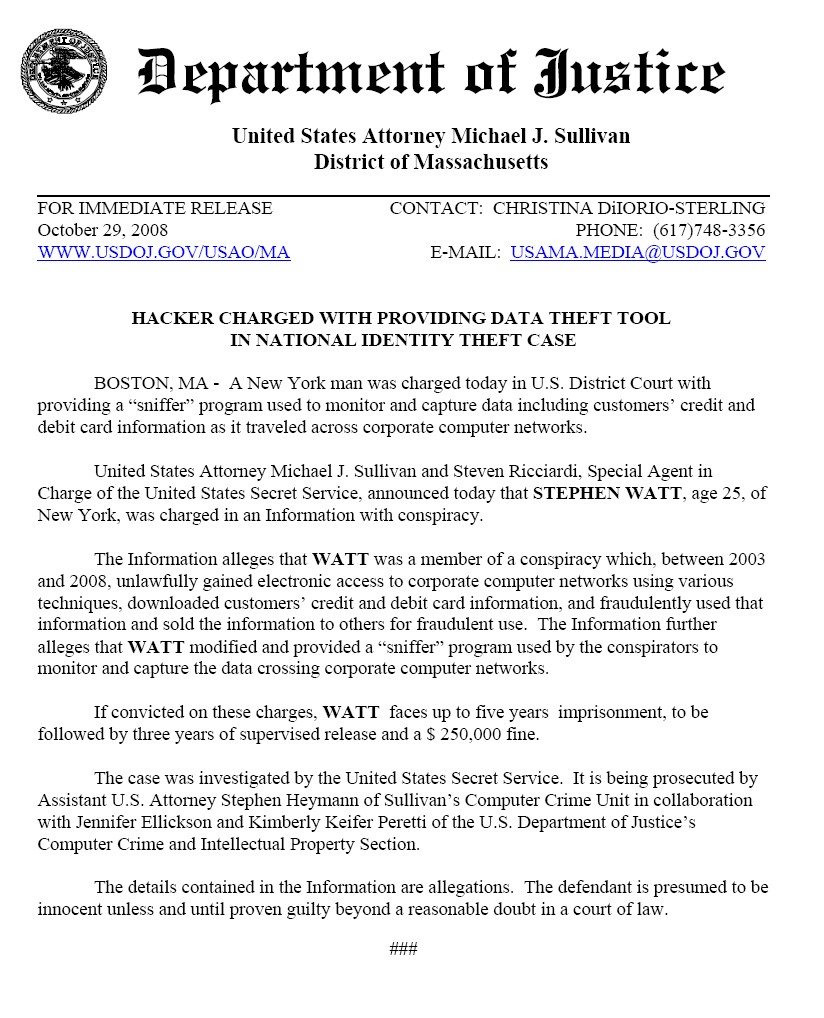
A New York man has been charged with providing co-conspirators with a 'sniffer' program for capturing payment card data as it traveled across corporate networks, apparently the latest person to be indicted in connection with data breaches at TJX Companies Inc and other major retailers.

Stephen Watt, 25, of New York, was charged in U.S. District Court in Boston on Oct. 29 with unlawful access to computers, wire fraud, aggravated identity theft and money laundering.

The indictment makes no direct mention of Watt's role in a series of breaches at major retailers such as TJX, BJ's Wholesale Club, DSW Inc., OfficeMax Inc., Boston market, Barnes and Noble Inc., Sports Authority and Forever 21.

But it names Albert Gonzalez as one of the individuals Watt supplied the sniffer programs to; Gonzalez has been indicted for his role as the alleged ring leader of the gang responsible for the retail break-ins. He has pleaded innocent to the charges.  A spokeswoman for the U.S. Attorney's office in Massachusetts Tuesday declined to comment on whether Watt's indictment is related to the retail breaches since it is not mentioned in the indictment.

Gonzalez was one of 11 people indicted in August in a massive identity theft and computer fraud scheme involving some of the largest data breaches in recent U.S. history. Gonzalez and his gang are accused of breaking into numerous retail networks and stealing payment card data -- including data on nearly 44 million cards from TJX alone -- over a five-year period starting from 2003.

The thefts relied on vulnerabilities in the wireless networks used at retail store locations: Gonzalez and others would go "war-driving" in commercial areas of Miami looking for vulnerable retail networks. Once they broke into a network, they would locate and steal "Track 2" data from the magnetic stripe on the back of payment cards, as well as PIN-block data associated with debit cards. The gang is alleged to have maintained servers in the U.S., Latvia and Ukraine that were used to store tens of millions of stolen credit and debit card numbers.


So far, two of the indicted individuals have pleaded guilty to charges in the case. In September, Damon Patrick Toey pleaded guilty to four felony counts, including wire and credit card fraud and aggravated identity theft. He is scheduled to be sentenced on Dec. 10 in U.S. District Court in Boston, and faces a maximum prison term of five years and a fine of US$250,000 on each of the counts.


That same month, Christopher Scott, 25, of Miami become the second man to plead in the case. He faces a maximum of 22 years in prison and a $1 million fine. Scott also will forfeit the $400,000 or so that he made in profits from the payment card thefts.


Court documents filed in connection with Watt's indictment, meanwhile, said he was part of a criminal gang that between 2003 and 2008 broke into several corporate networks to steal payment card information and use or sell that information to others. The stolen funds were funneled through Internet currency exchanges and bank accounts in Latvia to conceal the source, ownership and control of the money.


Watt allegedly provided a sniffer program that allowed Gonzalez and other gang members to identify and capture credit and debit card data traveling over the networks they had broken into. In January, he edited and modified a sniffer program dubbed 'blabla" that was used by the gang and stored in a server with a Latvian IP address, according to the indictment.  (see graphic below)


If convicted, Watt faces up to five years in prison, a fine of $250,000 and three years of supervised released, according to a statement released by the U.S. Attorney's office in Massachusetts


Enhanced by Zemanta

Visa and MasterCard under DOJ Investigation


Interesting week in the Payments Biz.  American Express disclosed it's under DOJ investigation (DOJ "Steering Investigation Towards American Express), and MasterCard released it's 3rd quarter results. (MasterCard Shares Soar on 3Q Results) while disclosing,  that it too, had received a request for information in October from the Department of Justice regarding rules related to merchant acceptance. 


Now it comes to my attention that Visa and the DOJ are dancing as well. 
MasterCard included in its Securities and Exchange Commission filing that it, along with Visa, has been under investigation by the Department of Justice regarding the allegations of antitrust activity.  MasterCard added that it is cooperating with the Justice Department in the investigation. 


The Justice Department is seeking information that focuses on reasons merchants scale back their acceptance of certain cards, information on penetration rates by merchant category, cobranded cards and transactions in various countries, MasterCard said.


The credit card companies have not admitted fault and never will... despite the hefty settlements they have now agreed to pay to Discover and American Express. 


The disclosure of the Justice Department inquiry comes a day after MasterCard said it lost $193.6 million, or $1.49 per share, during the third quarter as it took a $515.5 million charge related to a settlement agreement with Discover Financial Services.


MasterCard and rival Visa Inc. agreed last week to pay Discover up to $2.75 billion to settle an antitrust suit filed by Discover in 2004. The lawsuit claimed MasterCard and Visa had harmed Discover's business by preventing their member banks from issuing credit cards for Discover's network.


Visa said earlier in the week that credit card transactions growth slowed in September and "halted" in the first few weeks of October as the full weight of the economic crisis hit.  But the credit card processor said that "debit use continued to grow at strong rates".


Reblog this post [with Zemanta]

MasterCard to Promote Online Debit Card Usage

Maestro logoImage via Wikipedia
Source: MasterCard

MasterCard to promote online debit card usage with streamlined authentication

MasterCard has announced a new program that will improve the speed and convenience of using Maestro debit cards online and rapidly increase the number of locations where Maestro debit cards will be accepted.

The new program, Maestro Advance Registration Program, maintains the security of using Maestro cards while allowing e-commerce merchants to reach a largely untapped audience by accelerating and streamlining online payments.

To date, all e-commerce purchases on Maestro cards leverage MasterCard SecureCode authentication to ensure the highest security for payment card transactions. The Maestro Advance Registration Program enables select online merchants to accept Maestro cards for e-commerce transactions by using SecureCode to enroll the customer during the first transaction. Subsequent purchases the same customer makes at the merchant web site using the same Maestro account can now be processed without MasterCard SecureCode authentication, making repeat buying both convenient and fast.

"With a growing number of worldwide virtual shoppers buying items 24/7 we need to provide payment systems that are quick, safe and familiar to customers. The Maestro Advance Registration Program enables Maestro cardholders to shop online using a secure platform while maintaining the merchants' highly effective and convenient checkout experience," said Yves Lalieu, Business Leader at MasterCard Europe.

In countries where cardholders have the choice to use debit cards for their online shopping, a significant percentage have done so.  In many countries, there is limited or no access to online purchases using debit cards.

"With the new Maestro Advance Registration program, the whole e-commerce payments landscape will change, facilitating consumer access to online purchases using debit cards. Issuers are looking differently at e-commerce and are ready to activate Maestro cards in new environments to innovate, differentiate and create new value for their customers. And retailers are confident in accepting online payments from customers around the world using Maestro-branded debit cards, one of the most secure global payment card solutions available today," commented Luke Olbrich, Vice President, MasterCard Europe Debit.

Reblog this post [with Zemanta]

Tuesday, November 4, 2008

HomeATM and Universal Air Travel Plan

UATP Offers Payment Option Challenging the High Cost of Other Credit Card Options - MarketWatch

UATP Offers Payment Option Challenging the High Cost of Other Credit Card Options

UATP Offers Airlines/Corporations Option to SAVE!
Last update: 1:14 p.m. EST Nov. 4, 2008


Universal Air Travel Plan, Inc., (UATP), offers a travel payment option that helps to mitigate the high cost corporate credit cards in the market today, while offering revenue streams for Issuers and a low merchant service fee to all Merchants.

Responding to the recent American Express announcement (30 October 2008) of moving forward with "pricing initiatives designed to generate significant additional revenue next year," on some business cards, UATP President and CEO, Ralph Kaiser commented, "The airline industry is already facing a challenging market and, with the global economic forecast, now is not the time to be raising prices and generating revenue at customer expense."

Kaiser added, "While we hope that the airlines and corporations won't be negatively affected by American Express' pricing initiatives, UATP offers a viable option."  UATP's core product is a low cost corporate charge card that airlines Issue globally to corporate account holders. The key benefits of UATP cards include:

For Merchants
  •   Low Merchant Service Fees
  •   New Revenue Streams via Additional Flown Revenue
For Corporations

  •   Centralized Billing for Improved Cost Control
  •   Level III Data
  •   No International or Currency Conversion Fees
  •   No Membership or Annual Dues
"UATP continues its vision of offering the best payment option at the lowest possible cost," Kaiser continued. "We are on track to generate more than (US$) 12 billion dollars in charge volume this year and expect further growth in 2009."

In addition to its core corporate travel product, UATP has expanded its offering by utilizing the UATP Network to facilitate alternative forms of payment for current partners  HomeATM, PayPal,  BillMeLater, gift card partner Stored Value Systems and others.

During 2009, UATP expects to continue growing its partnership base and adding new Merchants and Issuers to the UATP Network.

Contact:
UATP Corporate Communications
Wendy Ward, wward@uatp.com
+1 202 626 4077

SOURCE Universal Air Travel Plan, Inc.
http://www.uatp.com


Copyright (C) 2008 PR Newswire. All rights reserved


Reblog this post [with Zemanta]

Transit Visa Needed To Get Around L.A.

Visa Inc.Image via Wikipedia
Visa to Improve Payment Experience for Commuters in Los Angeles and Paris; Working with Transit Operators to Enable Visa Payment at the Fare Gate - MarketWatch

PARIS & SAN FRANCISCO, Nov 04, 2008 (BUSINESS WIRE) -- Visa Inc.


Visa today announced it is working with the Los Angeles transit authority to allow train, subway and bus riders to speed through turnstiles and past fare boxes with a simple wave of their Visa payWave-enabled contactless card.

Los Angeles pilot

In Los Angeles, Visa is working with the LA Metro system to offer special Visa payWave cards that also incorporate the transit system's "TAP" fare application. These dual-use, prepaid Visa cards will let riders pay their fares and purchase fare products using their Visa account, while also allowing cardholders to make purchases anywhere Visa debit is accepted.

Two types of cards will be available through the pilot:

  • Ride, pay and reload cards -- sold through automated ReadySTATION kiosks within the LA Metro system, these cards will be active and ready to use immediately for both transit fares and Visa purchases everywhere Visa debit is accepted. Riders will be able to add up to $500 in value at the kiosks.

  • Ride, pay, reload and ATM cash access cards -- these are personalized cards with a maximum value limit of $10,000 which are ordered online or over the phone. Beyond a larger value limit the personalized cards have the added feature of a Personal Identification Number (PIN) for obtaining cash at ATMs. It will also function as a standard Visa prepaid card for purchases outside the transit system. In addition, cardholders will be eligible for free direct deposit of their paychecks directly to the Visa prepaid card account, providing added convenience and security over payment alternatives like checks and cash, for those riders without traditional banking relationships.
"Combining TAP and Visa payWave on a single contactless card is a great idea and delivers convenience and speed at bus fare boxes and rail station validators for LA transit riders," said Roger Snoble, Chief Executive Officer, at the Los Angeles County Metropolitan Transportation Authority. "It also provides commuters with an easy way to reload and manage their LA transit accounts, while providing them with a Visa prepaid card that is accepted at any Visa debit acceptance location or ATM."


Reblog this post [with Zemanta]

Chasing Alternative Payments

Chase Eyes Alternative Payments

Digital Transaction News writes that "the bank-owned Chase Paymentech will focus on alternative payments and geographic expansion with its 51% share of the former joint venture’s assets, but it’s unclear what First Data will do with its 49% share.  According to the article, Chase will take a closer look at the "Alternative Payments" space."

"
Bank card processing will remain the core service, but alternative payments, both online and physical, will get a lot of development attention, according to Chase. “That’s what the customer wants,” noting that in some European and Asian countries, online alternatives rival traditional card payments in volume."

Click Here to Read the Article in Full

Reblog this post [with Zemanta]

Debit Talks and Credit Walks

The US braces for next crisis: Credit cards


Editor's Note:  Many posts over the last few months have been dedicated to the idea that debit card usage will continue to grow leaps and bounds while credit card usage will stagnate.  Here's an article further supporting that belief...

Reports indicate that a substantial portion of of the 158 million US card holders using 1.5 billion cards have started defaulting and banks had to write of approx $21 billion in bad credit loans in the first six months of this year and expect a further loss of $55 billion in the next 12 months.

For years, consumers in the US have become ever more dependent on credit cards with American Express, the largest credit card issuer in the US coined the famous by line ''Never leave home without it.'' Now an average American does not leave home without at least 10 credit cards and a whole host of other supermarket credit cards in his wallet.  Five big financial companies, Discover Financial Services, Bank of America, Citigroup, JPMorgan Chase and Capital One Financial issue around 80 per cent of all US credit cards.


How deep is the problem?

According to Federal Reserve figures, in the US alone more than $850 billion in unpaid credit card balances is at stake and fast approaching $1 trillion, roughly the same amount as in the subprime market.  CNN reported that worldwide, consumers have racked up more than $2.2 trillion in purchases and cash advances on major credit cards in the last year.
  • The unpaid debt portion of this with US consumers is $68 billion, thus increasing credit card debt by 7.8 per cent, the largest increase in seven years.

  • Even as they spent, consumers had been going into default at a stunning rate with delinquent credit card accounts this year hitting a six-year high of 4.9 per cent and the charge-offs -when banks give up on collecting debt, have reached a all time high of 5.5 per cent in the second quarter, as per the latest data available with the US Federal Reserve.

  • Since last year, major banks were setting aside billions as reserves for credit card loan loss and anticipating an increase of 20 per cent in non payments over the next two to four quarters.

  • Capital One, one of the biggest credit card banks, was forced to write off $1.9 billion in bad debt in the last quarter of 2007 and serious delinquencies among some of the biggest lenders rose by 50 per cent or more in the value of accounts that were at least 90 days delinquent.

  • Just like the mortgage debt which created a financial havoc worldwide, credit card debt is pooled and then resold to investment houses, other banks and institutional investors.

  • US credit card debt grew by 435 per cent from 2002 to year-end 2007, from $211 billion to approx $915 billion.

  • About 45 per cent of this $915 billion in credit card debt has been packaged into these pools, which not only creates a risk to a few banks but many other institutions as well who will be forced out of business due to credit card debt write offs.

  • The national savings rate was 10 to 11 per cent in the l980s and since 2005, Americans have saved less than 1 per cent of their disposable incomes with a negative saving rate as of March this year, making an average America broke, and credit cards played a major role in getting them there.

  • Currently, the losses on credit card debt which stands at 5.5 per cent could rise to 7.9 per cent and the industry will stand to lose $55 billion this year, as the financial crisis has seen companies laying off thousand of workers all over the US. People will add up to the credit card debt as the unemployment rate has increased by about 2 million people in the last 12 months.
The US Department of Labour reported that the US shed 1,59,000 jobs in September and the list of companies which have announced a cut in jobs read like a Who's Who of corporate America: Merck, Yahoo, General Electric, Xerox, Pratt & Whitney, Goldman Sachs, Whirlpool, Bank of America, Pepsi, Hewlett Packard, Alcoa, Coca-Cola, the three big Detroit auto manufacturers, leading newspapers, banks and financial institutions and nearly all the airlines.

To solve the ever increasing credit card defaults, banks and consumer groups are lobbying US regulators to forgive 40 per cent of the debt of most financially stressed consumers who are close to bankruptcy and they could pay off their remaining card debt, interest free in five years.Banks could begin with this test scheme on 50,000 consumers, in hopes of expanding it to tens of thousands of others.

Editor's Note:  Looks like Debit Talks and Credit Walks and Debit Transactions will continue with it's exorbitant growth while credit transactions will stagnate.


Reblog this post [with Zemanta]

Cybercriminals...Crisis? What Crisis?

Economic Crisis May Be Boon For Cybercriminals, Experts Say
How the global financial crisis is affecting organized cybercrime

By Kelly Jackson Higgins, DarkReading

URL: http://www.informationweek.com/story/showArticle.jhtml?articleID=211601123

One industry sector is actually happy about the current state of the global economy: cybercriminals.

"One thing we've seen is financially based cybercrime is recession-proof," says Darren Mott, supervisory special agent for the FBI's Cyber Division. "With [this] changing economy, the only thing that changes is the way they go about obtaining their information."

Organized cybercrime has already begun capitalizing on the global financial crisis, cybercrime experts say, with targeted phishing attacks on customers whose banks have folded, and attacks that scam consumers who may be shopping less online, but are now spending more time at home. With fewer business and consumer targets available, the bad guys are redirecting their efforts to adapt to the market. For example, credit cards are out; debit cards are in.

"The crisis is good for cybercrime because people become more desperate for 'good deals.' It is bad for cybercrime in that they will continue operations much like they do now, but have to move around more often," says security expert Gadi Evron.

And they are already on the move: A wave of targeted phishing attacks on doomed banks and brokerages has been spotted by The Shadowserver Foundation during the past few weeks. "They were crafted a little better, mentioning the affected banks," as well as some that posed as the Better Business Bureau, says Andre' DiMino, co-founder and director of Shadowserver. "They are almost preying on how people are trying to be more savvy in what they buy and what they are doing as they are more careful in where they spend."

One attack used Citigroup's attempted takeover of Wachovia as a premise for stealing Wachovia customers' credentials. (Wells Fargo eventually outbid Citigroup for Wachovia). "There's been a surge in phishing, telling customers that due to the new takeover, they need new credentials," says Ori Eisen, founder and chief innovation officer for 41st Parameter. If the victim hands over his old credentials to "set" his new ones, it's game over for his bank account information.

Socially engineered attacks are typically a lucrative ploy by seasoned attackers. The FBI is seeing more spear phishing aimed at businesses that were hit hard by the economic downturn. "There has been an increase in attacks on specific individuals, such as CEOs and CFOs, because a lot of businesses are going under...that gives them more directed targets," the FBI's Mott says. The attackers lure them with promises of financial assistance, for instance, and some even pretend to be subpoenas from the Justice Department. One attack via e-mail urged bidders who had lost out on a government contract to resubmit their bids and, thus, spill sensitive contact and other information.

Bad guys continue to go after "hot items," such as online banking credentials and online shopping accounts, security experts say. "People are tending to be more focused on their finances and the economic situation than they are in securing their networks" and systems, Shadowserver's DiMino says. "They are logging into their banking and brokerage accounts more frequently, and malware [planted on their systems] will wake up when" they visit these sites, he says.

In the past two months, researchers at Finjan have found three times the number of servers with stolen data. "Before that, we'd see five or six servers in a single month, or one every week or so. Now we're seeing four or five servers a week," says Yuval Ben-Itzhak, CTO of Finjan. "Increased phishing attacks might be the reason, and a combination of both corporate and consumer [victims]."

Other researchers have cited a direct correlation between the stock market's nosedive and an increase in cybercrime activity.  Ryan Sherstobitoff, chief corporate evangelist for PandaLabs says he and his team first noticed a jump in overall malware on Sept. 16 when stocks started to dip significantly. Panda discovered a 5 to 30 percent increase in malware that day related to the recent wave of rogue antivirus adware attacks. "If the stock market is crashing, there's not a lot of confidence," Sherstobitoff says. And phony antivirus popups warning that your system-may-be-infected-so-you'd-better-run-this-scan preyed on fears, he says.

Meanwhile, law enforcement and cybercrime experts say more malicious Web sites posing as economic or financial advisory services will start to emerge in this jittery financial climate. "'Have you been victimized by your bank's closing? Check us out,'" is the type of lure the bad guys may use with these sites, DiMino says.

That means a reverse in the trend from the past few months of cybercriminals' silently infecting legitimate sites. "Expect to see malicious sites crop up that are geared to information-stealing, malware-dropping, pharming, and phishing rather than compromising legitimate site," he says.

And just as street crime increases in times of financial stress, more novice attackers and script kiddies are likely to perform an online version of shoplifting and bank robbery. "You're going to see more quick-hit script kiddies, like street crime," DiMino says.

It's simple enough for these amateur hackers to get into the business -- there's plenty of off-the-shelf software that automates phishing. All it takes is a Web server. "We know [when] it's an amateur because they are leaving their servers completely open and unprotected," Yuval Ben-Itzhak says.

The insider threat, too, will likely also intensify as layoffs spread in the corporate world. "You're going to see insider attacks and less direct hacks," Shadowserver's DiMino says. "There will be more of an attempt to infiltrate from inside, with botnets and SQL injection."

With potentially fewer overall enterprise targets, cybercrime organizations could end up fighting over turf. "In general, cybercrime is nothing more than a new form of organized crime," the FBI's Mott says. "You may see more online cybercrime 'violence.' DDoS attacks may go up."

Still, the bottom line is that the crisis hasn't hurt the cybercriminal's bottom line. Nor has it slowed any activity in the bustling online black market, at least thus far. "Right now, there's no observable effect. We still see the same trading activity on IRC channels," says Guillaume Lovet, senior manager for Fortinet's Threat Response Team.

Copyright © 2007 CMP Media LLC

Cloud Computing Zombies for $299 Month...


Editor's Note:  File this under "A Perfect Storm is Brewing and HomeATM is Perfectly Placed"


Cloud-computing zombies for $299 per month | Tech News on ZDNet


Cloud-computing crimeware means networks of zombie machines can be hired to steal online-banking details for as little as $299 per month.

'Fraud as a service' is opening up computer crime to people with no technical expertise, warned Uri Rivner, head of new technology at security company RSA.

Speaking at the RSA Conference Europe 2008 in London, Rivner laid the pricing bare, revealing how fraudsters offer botnet networks as a subscription service, with patching and upgrades thrown in.

These networks could be tailored to infect other users' computers with malware, or to launch massive distributed denial-of-service attacks designed to take down computer systems.

Rivner said: "This is the danger with making this technology open to the mass market.   Anybody can become a high-end online fraudster."

Malware is also being sold for both the high-end and budget markets, from the $1,000 Zeus Trojan, a sophisticated Trojan that harvests data and entrenches itself in the system, down to $350 for the Limbo Trojan. 

Rivner said the fraudsters usually split their roles between the "harvester", the hacker who writes and deploys the malware to steal the details, and a "cash-out" criminal who will handle the money.

Cash-out fraudsters use "money mules", who are often unwittingly recruited as "finance officers" working from home, to have the dirty money laundered through their account.


Reblog this post [with Zemanta]

Monday, November 3, 2008

DOJ "Steering" Investigation at American Express

Justice Department investigating American Express
NEW YORK – American Express has received a request from the U.S. Department of Justice for information regarding the credit card company's policies related to merchant surcharging, according to a regulatory filing Friday.

The company said it received a Civil Investigative Demand on Oct. 14 from the Justice Department's antitrust division. The department can issue CIDs to anyone it believes may have information related to an investigation, the filing said. Receipt of such a request does not mean that a formal complaint will be filed.

American Express said it intends to cooperate with the department's request for documents and other information regarding the company's policies related to merchant surcharging and its “anti-steering” policies that prohibit merchants from discriminating against the American Express card in favor of other forms of payment.
Reblog this post [with Zemanta]

25 E-Commerce Tech Terms You Should Know

E-commerce tech terms you should know
By Dale Buss - Forbes
Transacting business seamlessly over the internet means having a decent grasp of how things work, and more importantly, why they don't. That's why, with help form the smart folks at technology publisher O'Reilly Media, we've assembled a glossary of e-commerce-related tech terms that every entrepreneur should know.
Some of that gobbledygook is the province of tech jocks. However, if entrepreneurs want to achieve operational excellence while keeping technology investment in check, they have to be able to at least speak the language. And you don't have to know how to get down and dirty with computer code to understand the implications these issues have on strategy and budgeting.

Online retailers, for example, are trying to move beyond what has become the conventional, rather static consumer experience. One solution: real-time, individualized pricing. A new system, developed by uBee, allows merchants to "sense" what items a shopper is looking for on their websites, and spits out a custom price based on inventory levels and other particulars.

"That," says uBee CEO Bill Carpenter, "can give you personalization between buyer and seller."

The e-commerce platform that UBee plans to launch next month will rely on SOAP, for Simple Object Access Protocol, a technology standard based on using "envelopes" that retailers and uBee use to exchange information quickly enough to make these real-time offers. The "documents" in these envelopes invariably are written in XML, the most common software language in e-commerce, including variants such as XML-RPC and XML Business Reporting Language. (The acronyms are dizzying at first, but you get used to them.)

For all the billions of dollars being spent and collected online, the code at the core of e-commerce remains highly fragmented — and that creates communication breakdowns within the overall system.

"The Internet is still the wild, wild west," said Clint Page, chief executive of Dotster, a Vancouver, Wash.-based provider of Internet-business services. "It's not like more-developed parts of business and commerce where you get standardized platforms."

Take setting up a merchant account with a bank so that you can accept and process online payments. While bricks-and-mortar retailers only have to decide whether to accept checks and major credit cards, e-commerce is open to all sorts of other payment possibilities and transactions in currencies other than the dollar, such as HomeATM's PIN Debit/Credit Platform.

You'll also want to know a thing or two about affiliate programs. Under these advertising arrangements, companies collect cash for driving traffic to your site, and visa versa.

With Google now as much a verb as a company name, search engine optimization (or SEO) — the process of increasing a site's odds of ranking high in the search stacks — is a key consideration for any e-commerce player.

Says Dotster's page: "There is ferocious competition to be on the first two or three pages of each search." Editor's Note:  Do a Google Search on PIN Debit. 


Then there's the problem of security. While millions of consumers have grown comfortable with entering credit-card information into a Web site, reports of massive identity theft continue to crimp online sales. Editor's Note:  Consumers should NOT be comfortable entering their credit/debit card information into a Website. 

The lines of defense begin with authentication programs that determine whether someone signing on under a specific name is actually authorized to use the site via that specific account. Editor's Note: Dually Authenticated HomeATM PIN based transactions allow consumers to swipe their card (eliminating the risk and conveniently saving them from typing their card numbers onto a website). Entering the PIN (non-keystroke) makes for a  highly (dual) secured transaction.   Force users to jump through too many hoops, though, and you risk driving them away. Hence the single sign-on approach, in which either the user's computer or the website "remembers" passwords. Access control beefs up the barricades by granting entry only to specific site functions, such as adding an item to a shopping cart.

Want to make it clear that your site is indeed secure? Use software that adds a padlock icon in the user's browser window. Editor's Note:  Or use HomeATM's globally patented PIN based checkout system!

"Ensuring that your checkout process and, more important, the credit card form are well-secured will guarantee your customers feel safe when transmitting their information," says Pat Kaeowichien, director of information technology for Magnetic, a Tampa-based Web-development firm.

Credit card firms have taken critical steps to fend off identify thieves, too. In 2006 a consortium including Visa, MasterCard, American Express and Discover helped devise the PCI/DDS standard for providing secure communication for transactions over the Internet. 

"This standard is now in place for all merchants globally who accept credit cards — no exceptions," says Bill Bradley, senior industry marketing manager for Akamai Technologies in Cambridge, Mass. "Non-compliance can mean fines and, for that retailer, a loss of public trust. And that's the main reason people don't buy online in the first place."  Editor's Note:  Ironically, PCI DSS was initially designed for bricks and mortar retail locations, there is no specific WPCI (Web Payments Card Industry) standard...

Keeping them buying: That's what understanding e-commerce — and the technology that drives it — is all about.  Editor's Note:  Keep them buying securely, that's what HomeATM's technology is all about!
Reblog this post [with Zemanta]

Disqus for ePayment News